
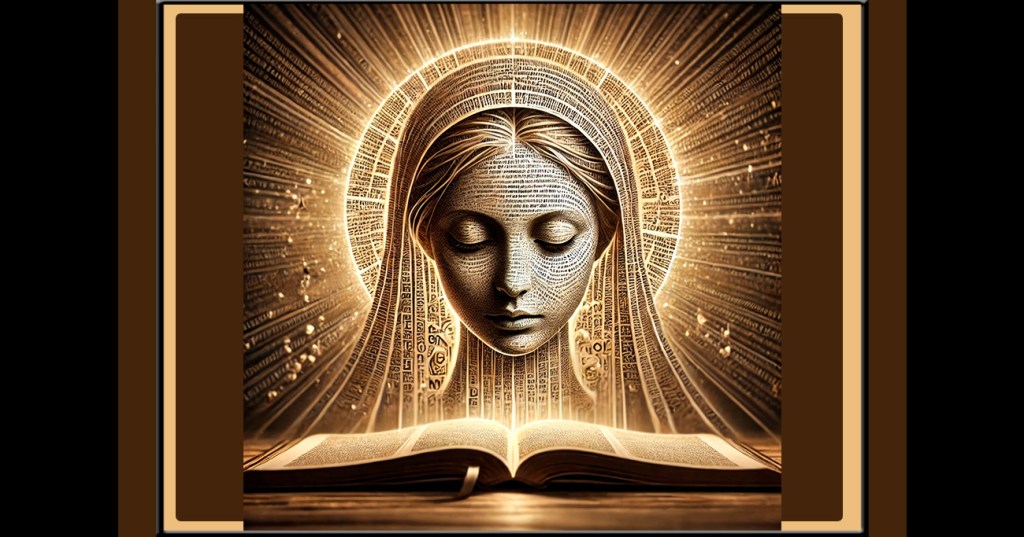

What the Scriptures and the Church Say
Marian doctrines are not medieval innovations but truths contained in Sacred Scripture, often in a veiled or seminal form. To understand these teachings, it is essential to grasp the concept of typology, a biblical interpretative principle that reveals how events, people, or elements of the Old Testament prefigure fuller and superior realities in the New Testament. Although some may think typology is exclusively a Catholic method, it is also recognized by other Christian traditions, as it is extensively employed in the Bible itself, in the Early Church, and throughout Tradition.
In light of this principle, we can better understand what Scripture tells us about Mary, and it is far more than what is apparent at first glance.
This article serves as an introduction to the series on Marian doctrines. At the end, you will find links to the articles in this series, which explain each of these doctrines and show where they appear in the Bible and Tradition.
What Is Typology?
The Greek word typos is translated as “figure” or “sign,” and the study of these typos in the exegesis (biblical interpretation) is called typology. This concept connects the Old and New Testaments, showing how certain characters or events (typos) in the former find their full and superior fulfillment (antitypos) in the latter. The typos anticipates and prepares the way for the antitypos, helping us to contextualize and better understand its fullness.
This principle is not a later invention; it is already present in the Early Church and, even more so, in Scripture itself. The Bible interprets itself using typological methods, demonstrating the continuity of the divine plan and the intrinsic unity of the entire Word of God. In fact, this tool was likely the most used during the initial phase of Christian preaching to the Jews, as it showed them how their own Scriptures (the Old Testament) continually prefigured Jesus.

Biblical Examples of Typology
- Adam and Christ: Saint Paul calls Adam “a figure (typos) of the one to come” (Romans 5:14), presenting Christ as “the new Adam” or “the last Adam” (1 Corinthians 15:45). In Romans 5:12-21, he extensively develops typology as a tool to understand the New Testament.
- The Passover Lamb: John presents Jesus as “the Lamb of God” (John 1:29), the fulfillment of the Passover lamb from Exodus. His audience fully understood the significance of the Passover lamb: a sacrifice to God symbolizing divine deliverance from slavery (in Egypt) and then eaten in family unity. Christ, as the antitypos, surpasses the typos: God Himself becomes the sacrificial victim who frees us from the slavery of sin and offers Himself as nourishment in Holy Communion, within the family of the Church. Hence, He is called “the Lamb of God who takes away the sin of the world.”
- Jonah and the Resurrection: Jesus Himself establishes a typological parallel between Jonah’s three days in the belly of the fish and His three days in the tomb (Matthew 12:39-40).
- The Bronze Serpent: “Just as Moses lifted up the serpent in the desert, so must the Son of Man be lifted up” (John 3:14-15). The serpent was lifted on a pole to save those bitten by snakes; Jesus was lifted on the Cross to save humanity.
- Circumcision and Baptism: Saint Paul sees in the circumcision of the Old Testament a figure of baptism in the New Testament (Colossians 2:11-12).
- The Virgin Shall Conceive (Isaiah 7:14): The prophet Isaiah addresses King Ahaz with this prophecy to show that God is with Judah, but Matthew sees its fuller meaning in the birth of Jesus (Matthew 1:22-23).
- The Road to Emmaus (Luke 24:27): Jesus teaches the disciples how the Scriptures of the Old Testament speak of Him, both in their prophecies and their typos.
Jesus is called the Son of David because the messianic prophecies announced that the Messiah would be a descendant of David (cf. 2 Samuel 7:12-16; Isaiah 11:1). However, the Kingdom of David can be understood as a prefiguration (typos) of the Kingdom of Heaven, since while the former was political and limited in time, the latter, established by Christ, is spiritual and eternal. Within this typological interpretation, the steward of the keys or prime minister in the Davidic monarchy prefigures Peter as the vicar of the King, while Mary appears as the antitypos of the Queen Mother, a central figure in the Davidic dynasty.
Similarly, the Church can be seen as the new Israel, fulfilling and surpassing the mission of ancient Israel as the chosen people (1 Peter 2:9-10; cf. Exodus 19:5-6). We also find other typological figures, such as John the Baptist, whom Jesus identifies as the new Elijah (Matthew 11:11-14 and Matthew 17:10-13), demonstrating how Old Testament typos find their fullness in the New Testament. This, by the way, dismantles any erroneous interpretation suggesting that these passages teach reincarnation.
In conclusion, unraveling all biblical typology took Jesus several hours, covering the entire Road to Emmaus (Luke 24:27), and that was only regarding what pertained to Himself. Thus, let these examples suffice for the reader as a representative sample.
The coherence of typology reveals how the New Testament is prefigured in the Old and how the Old finds its fullness of meaning in Christ. As Saint Augustine said: “The New Testament lies hidden in the Old, and the Old is unveiled in the New.” Saint Augustine, for instance, interpreted the three angels at Mamre (Genesis 18:1-15) as a typos of the Trinity, the Ark of Noah as a typos of the Church, and so forth. In this way, as Jesus did with the bronze serpent, the typos of the Old Testament helped to better understand the antitypos of the New Testament, providing a broader context and showing how the new revelation harmoniously connects with the old, without division.
This is why Jesus said He had not come to abolish the Law but to fulfill it fully (Matthew 5:17), to bring it to completion. The events and figures of the Old Testament, guided by divine Providence, pointed toward the future, and in Christ, they reach their fulfillment. The typos of the Old Testament can be understood as divine seeds that anticipate and prepare the way for the more perfect antitypos found in the New Testament. These are not merely literary symbols but realities that, under God’s direction, prefigure and announce the ultimate fulfillment of His promises in Christ. As Saint Paul explains: “These things happened to them as an example, and they were written down as a warning for us” (1 Corinthians 10:11). Thus, typology is not a manipulation of the texts but the method ordained by God to show us, through Christ, the fullness of His plan of salvation.
Mary in the Bible: The Mystery Unveiled
Having seen the importance of typology, we can now apply it to the figure of Mary to uncover her foundations in Scripture. Just as this principle illuminates the plan of salvation in Christ, it also allows us to clarify Mary’s unique role in that plan. When the Church proclaims her as the “New Eve,” the “Ark of the New Covenant,” or the “Queen of Heaven,” these are not merely late inventions but realities rooted in Sacred Scripture and the living Tradition.

Let us consider two examples briefly:
The Ark of the New Covenant: The Ark of the Old Testament contained the Law, the manna, and the rod of the High Priest Aaron. –> Mary carried within her womb Christ, the living Word, the Bread of Life, and the eternal Priest. In other words, Mary is the full realization (antitypos) of what the Ark prefigured. This is succinctly expressed by saying, “The Ark is the typos of Mary” or “Mary is the new Ark of the Covenant.”
Mary as the New Eve: Just as Eve, while still a virgin, cooperated with Adam in bringing sin and death into the world, Mary, also a virgin, cooperated with God so that Christ (the New Adam) could bring life to the world.
This use of typology is found in the Church Fathers, as seen in Saint Justin Martyr (born in the year 100):
[
[He said] that the Son of God became man through the Virgin, so that the disobedience caused by the serpent might be undone by the same path through which it originated. For Eve, being a virgin, conceived the word of the serpent and gave birth to disobedience and death. But the Virgin Mary, full of faith and joy, upon hearing the good news from the angel, replied: “Let it be done to me according to your word.” Thus, she brought into the world the one who said: “I came from God and the Father into this world.” (Adapted from *Dialogue with Trypho*, Chapter 100).
This early testimony reveals how the Early Church saw in Eve and Mary not only two significant women in the history of salvation but also a typos and its antitypos, in clear harmony with Saint Paul’s teaching on the first and last Adam.

Why Marian Doctrines Become Evident Only Through Typological Analysis
God willed that the figure of Mary, no matter how singular and exalted she may be, would not overshadow the centrality of Christ in the plan of salvation. Thus, in His divine pedagogy, He revealed these truths progressively, adapting to humanity’s capacity to understand them and ensuring that the truths about Mary were always seen in relation to her Son and not as having independent value.
The Church teaches (cf. CCC 66) that public Revelation closed with the death of the last apostle. There are no new revelations, only a deepening of understanding guided by the Holy Spirit. For example, when the Council of Ephesus (431) declared Mary as Theotokos (Mother of God), it did not introduce a novelty but defended the truth that Jesus is one divine Person: His humanity and divinity are not separate, and therefore Mary could not be the mother of just a part of Jesus but of His whole being (both man and God, understood as God the Son, not the entire Trinity).
Jesus Himself spoke of this gradual understanding: “I have much more to tell you, but you cannot understand it now.” This does not mean, “Since you cannot understand it, you will never know,” for in that case, the word “now” would be unnecessary. It means that while you cannot understand it now, in the future, you will be able to.
[
I have much more to tell you, but you cannot understand it now. When the Spirit of truth comes, He will guide you to understand the whole truth. He will not speak on His own, but He will speak only what He hears and will announce to you what is to come. He will glorify Me, because everything He makes known to you, He will receive from Me. Everything the Father has is also Mine; that is why I have told you that everything the Spirit makes known to you, He will receive from Me. (John 16:12-15)
Consequently, the Marian dogmas are not later inventions but deepened understandings of the biblical “seeds” about Mary. These, in the light of faith in Christ’s divinity and humanity, and guided by the Holy Spirit, were gradually understood more fully by the Church, just as Jesus promised.
As the Christological heresies were resolved (Arianism, Nestorianism, etc.), the role and dignity of Mary became clearer: her perpetual virginity, her Immaculate Conception, her Assumption, and other aspects that the Church articulated more precisely. We could say this occurred as a “side effect”: if Jesus is X, then Mary must necessarily be Y. Pure logic. For example, if we identify a fruit as a lemon, we can deduce with certainty that the tree it comes from is a lemon tree. If someone later wanted to deny that the tree is a lemon tree, they would inevitably also deny that the fruit is a lemon. In the same way, by better understanding the nature of Jesus, we can deduce certain essential aspects of Mary’s nature. Thus, Tradition does not add “new truths” about Mary but rather understands and articulates them more clearly up to the fifth century; afterward, it focuses on clarifying and defending them.

This is not all. As we have seen, biblical typology is another essential path to understanding Mary, interpreting figures and elements from the Old and New Testaments. This method is not opposed to logical deduction; rather, they reinforce each other: typology provides confirmation and theological richness that complements and deepens what we logically deduce from her relationship with Jesus, while logical deduction ensures that typological interpretations are not arbitrary. For example, by deducing that Jesus is the New Adam, we understand that Mary is the New Eve; but it is typology that shows us, through Scripture, that this connection is not merely a logical possibility but a reality designed by God in His divine plan. Thus, both methods work together to provide solidity and fullness to our understanding of Mary and the essential role she occupies in the mystery of salvation.
Conclusion
The Bible, through its figures and signs, leads us to the central mystery of Christ and, with Him, sheds light on Mary’s unique role in the plan of salvation. Biblical typology and logical deduction are complementary tools that, together, help us understand how Marian doctrines not only harmonize with Scripture but also flow from it and reach their full development in Tradition.
From the earliest centuries, Christians recognized Mary as the New Eve, the Ark of the New Covenant, and the Mother of God—realities confirmed by typology and reinforced by logic, which reveals the inseparable connection between Christ and His Mother. Thus, what initially seemed hidden in Scripture was progressively understood by the Church with greater clarity, guided by the Holy Spirit.
This series will explore how Old Testament typology, which culminates in Christ, secondarily sheds light on Mary’s mission. Although many reformers, such as Luther and Calvin, initially accepted several Marian doctrines, these were later rejected by some Protestant communities. However, from the earliest centuries, Christians have recognized Mary’s greatness in the plan of salvation, fulfilling her own prophecy: “From now on all generations will call me blessed” (Luke 1:48).


APPENDIX
What the Catechism of the Catholic Church Says
The Unity of the Old and New Testaments
128 The Church, as early as apostolic times (cf. 1 Cor 10:6,11; Heb 10:1; 1 Pet 3:21), and then constantly in her Tradition, has illuminated the unity of the divine plan in the two Testaments through typology, which discerns in God’s works of the Old Covenant prefigurations of what he accomplished in the fullness of time in the person of his incarnate Son.
129 Christians therefore read the Old Testament in the light of Christ crucified and risen. Such typological reading discloses the inexhaustible content of the Old Testament; but it must not make us forget that the Old Testament retains its own intrinsic value as Revelation reaffirmed by our Lord himself (cf. Mk 12:29-31). Besides, the New Testament has to be read in the light of the Old. Early Christian catechesis made constant use of the Old Testament (cf. 1 Cor 5:6-8; 10:1-11). As an old saying put it, the New Testament lies hidden in the Old and the Old Testament is unveiled in the New (Saint Augustine, Quaestiones in Heptateuchum 2,73; cf. DV 16).
130 Typology indicates the dynamic movement toward the fulfilment of the divine plan when “God will be everything to everyone” (1 Cor 15:28). Nor do the calling of the patriarchs and the exodus from Egypt, for example, lose their own value in God’s plan, from the mere fact that they were intermediate stages.
INDEX OF THE SERIES: Mary in the Bible and in the Church
- New Eve and Immaculate Conception – Explanation of how Mary is prefigured in Eve as the new mother of all the living.
- The Ark of the New Covenant, the Assumption, and Other Dogmas – Analysis of Mary as the Ark that contains the fullness of the Covenant and the foundation for her Assumption.
- Queen of Heaven – Exploration of Mary’s role as Queen, prefigured in the Old Testament and recognized in Revelation.
- Mother of God – Biblical and theological basis for the title Theotokos given to Mary at the Council of Ephesus.
- Mother of the Church and Our Mother – Reflection on Mary as the spiritual Mother of all believers.
- Ever Virgin – Defense of the doctrine of Mary’s Perpetual Virginity in light of Scripture and Tradition.
- Mary in the Early Church – What the Early Church believed about Mary in the first centuries.




 Apologia 2.1 in English
Leave your comment (it will be published after review)