

The majority of beliefs held by Catholics and Protestants are common; indeed, we are all Christians. Yet, at the same time, what makes us so different?
It is said that what differentiates Catholic Christianity from Protestant branches are the doctrines of the so-called “solas” formulated by Luther, and this is true. However, if we delve even deeper, we find that at the base of everything lies the doctrine of the Incarnation. Curiously, both understand the Incarnation in the same way, so it is not the doctrine itself that has originated the differences, but the fact that for Protestants, the Incarnation is just that, a doctrine, while for Catholics, it is also the foundation of the entire way of understanding our faith. If we manage to understand this well, we will be able to understand each other much better and at the same time avoid Byzantine discussions doomed to failure.
INDEX
- What is Human Nature
- What is the Incarnation
- Humanity regains its dignity
- The Five Solas: The Foundation of All Protestantism
- Protestantism and the Incarnation
- Catholicism and the Incarnation
- The Church in Protestantism
- The Church in Catholic Christianity
- The Church: The Incarnation of Christ on Earth
- Disjunctive or copulative
- Conclusion
- Appendix A
- Appendix B
Note: Contemporary Protestantism is highly diverse, divided into numerous denominations that differ in many ways. The references to Protestantism in this article are necessarily general. I am aware that within Protestant communities—Lutherans, Reformed/Calvinists, Anglicans, Pentecostals, etc.—there are significant nuances, and not all adhere to the "solas" in the same way. However, when presenting the Catholic perspective and contrasting it with the general Reformed tradition, some degree of simplification is inevitable to avoid making this article excessively long. Those seeking a more detailed analysis of each Protestant branch will find significant internal differences, though all stem, to a greater or lesser extent, from Luther and Calvin’s views on faith, grace, and Scripture, which we discuss here.
What is Human Nature
To understand how God became man, we must first understand what man is.
Pagan Duality
The common belief prior to Christianity was that the true being was the soul, which is spirit or a kind of emanation of the body. The body acted somewhat like a garment or shell that allows us to interact with the physical world. Upon death, the body decays until it disappears, and the soul dies or migrates to the Hereafter. Even Judaism at the time of Jesus wavered between the materialistic view that the soul died along with the body (Sadducees) and those who believed in the immortal soul and even the resurrection of the body (Pharisees).
Christian Unity
In contrast to this dual notion of the person, in Jesus’ preaching we find a conception of man where the duality of body and soul is like two sides of the same coin. Therefore, Christianity believes in the resurrection of the glorified flesh because the soul, without the body, is only half a man, just as space is composed of height+length+width but is at the same time a single and indivisible phenomenon. A true man is, therefore, body+soul.

The resurrection, also called “the resurrection of the flesh,” consists in the fact that part of the person, their physical body, truly dies but is then resurrected (in a glorified state), and the person thus becomes complete again. That is why Jesus told us that even in hell, it is the complete human being, body+soul, who suffers destruction (though not annihilation):
[
And fear not them which kill the body, but are not able to kill the soul: but rather fear him which is able to destroy both soul and body in hell. (Matthew 10:28, KJV)
Note that Jesus does not say “who can destroy the body (here) and (who can destroy) the soul in hell,” but “the soul and the body” in hell. Impossible to interpret it otherwise. If the Resurrection were simply that the soul survives and goes to the Hereafter, then such a doctrine would not be novel to the pagans, for that is what most of them believed, and it would not be a “re-surrection” (rising again), but simply immortality of the soul, which survives physical death.
REMEMBER: A true man is a unity of body and soul. It is in this dual-faceted human nature that God became incarnate through Mary.
What is the Incarnation
“And, behold, thou shalt conceive in thy womb, and bring forth a son, and shalt call his name JESUS.” (Luke 1:31, KJV)
“In the beginning was the Word, and the Word was with God, and the Word was God… And the Word was made flesh, and dwelt among us.” (John 1:1,14, KJV)

Even today, many Christians, without giving it much thought, hold the idea that “God became man” means something like the Spirit of God entering into a human body. Without realizing it, they are falling into the ancient heresy of Apollinarianism, which arose in the late fourth century as a reaction to the Arian heresy of the early part of that same century—a heresy that denied the full divinity of Jesus.
Apollinarianism taught that the Word had been incarnated in a human body without a soul. However, this would mean that His human nature was not truly man, but rather a kind of flesh-and-blood puppet controlled by God. In fact, such a concept would be closer to saying that God became an animal, for a human body without a soul is even less than that.
Many Christian doctrines lost their meaning under this view, which is why it was condemned at the First Council of Constantinople in 381. Finally, the Council of Chalcedon (451) definitively clarified the nature of Jesus in the following manner:
[
We confess one and the same Son, our Lord Jesus Christ, the same perfect in divinity and the same perfect in humanity, truly God and truly man, with a rational soul and a body; consubstantial with the Father according to His divinity, and the same consubstantial with us according to His humanity, like us in all things except sin; (…) We must acknowledge one and the same Christ, Son, Lord, and Only Begotten, in two natures, without confusion, without change, without division, without separation; the distinction of natures being in no way abolished by their union, but rather the property of each nature being preserved and concurring together in one person and one hypostasis; not as if He were divided or separated into two persons, but one and the same Only Begotten Son, God the Word, the Lord Jesus Christ.

Note: Brief Clarification on the Theological Terms "Nature" and "Person"
In Catholic Christology, person (from the Greek hypostasis) refers to a "who"—a unique and conscious subject—whereas nature refers to "what" that subject is in essence. The Council of Chalcedon establishes that in Jesus, there is one single Person (God the Son) and two natures (divine and human), united without mixture or confusion. Thus, we do not speak of "two distinct persons" nor of a "third being" resulting from a fusion, but rather of the same Son of God who truly becomes man without ceasing to be God. This distinction helps us understand why all the acts and experiences of Jesus—whether divine or human—belong to the same subject. For instance, Christ suffers in His humanity without ceasing to be God, and at the same time, He is truly man and capable of redeeming precisely because His person is divine.
This formulation of Chalcedon is what we Catholics (both Roman and Eastern Orthodox) and Protestants alike accept today. Jesus is God, and without ceasing to be truly God, He became truly man (Philippians 2:6-11)—an incomprehensible mystery, yet one that lies at the root of all Christian beliefs.
As a mystery, it is impossible to explain it with complete precision, but we can at least clarify what it is not. Jesus is not partly God and partly man, nor is He a mixture of both, nor two distinct beings coexisting in the same body. He is not a God who merely enters an empty body, nor a God who shares space with a separate man. He is one single being with two natures, and His human nature means that, in addition to being God the Son, He also possesses a human body and soul that belong to Him in the same way that my soul and my body belong to me—without being something distinct from my very self.
Continuing with the same analogy—imperfect but sufficiently accurate—we can say that if I dance, my whole being dances, both body and soul, and if I rejoice, my whole being rejoices, even though dancing is a physical activity and joy is a spiritual state.
In the same way, when Jesus acts, whether He manifests divine qualities (flowing from His divine nature) or human qualities (flowing from His human nature), it is Christ in His entirety who acts, not just one of His two natures independently. This is why Chalcedon affirms that, although Jesus has two natures, He is indivisible. For this reason, in none of Christ’s actions can we separate the divine from the human, as if they acted independently. Everything Christ did—and continues to do—is the action of the God-Man.
If I have an idea, I am the one who has it, but its origin lies in my soul. If I feel pain, I am the one who feels it, but its origin is in my body. In the same way, since Christ is one single being, we observe in Him phenomena that originate either from His divine nature or from His human nature. Yet, in both cases, it is Christ Himself who experiences them or brings them about. Two natures, two wills, but one and the same being. This is what allows Jesus, being God, to feel hunger or fatigue, and also to say things like the following:
[
I have not come to do my own will, but the will of Him who sent me. (John 6:38)
[
Father, if it is possible, take this cup away from me, but not my will, but yours be done. (Luke 22:42)
[
As for the day and the hour, no one knows anything, neither the angels in heaven nor the Son; only the Father knows. (Matthew 24:36)

This also explains why Jesus wept at Lazarus’ tomb, even though He Himself raised him shortly afterward. It also clarifies how God could truly be tempted in the desert. On the other hand, His miracles, His prophecies, and His holiness stem from His divine nature. Time and again, we see how Jesus’ divine nature makes use of His human nature to perform healings. He frequently heals by touching (Matthew 8:3) or even by using physical instruments (John 9:6-7), although, of course, He is also capable of healing without touching or using anything (Matthew 8:5-13).
Whenever circumstances allow, Jesus prefers human, physical contact because He knows that this reaches us more effectively—not just a part of our being (the soul) but our entire being (body + soul). That is why He became flesh and dwelt among us. For a purely spiritual relationship, no Incarnation would have been necessary.
But let us not forget that Christianity goes even further: God not only became man and entered this physical realm to save us; through His Incarnation, the divine Son also became man forever. This means that from that moment on, humanity itself was incorporated into divinity. Can you realize the meaning of this? One of the three Persons of the Trinity—the one true God—is not only divine but also human, even at this very moment. Like us, He now possesses a human nature (a human soul and body) forever, in addition to His divine spirit. God did not merely save mankind; He also dignified it to such an extent that He incorporated it into His very being. In a certain sense, we can say that human nature was exalted and divinized by the act of the Incarnation. As Martin Luther himself rightly said: “My own flesh and blood is seated at the right hand of God and rules over all. No other creature, not even any angel, has such an honor.”
REMEMBER: Jesus has both a divine nature and a human nature. Each nature possesses its own will without one nullifying the other, yet both operate in perfect harmony and with a single purpose, forming one indivisible being—God made true man.
Humanity regains its dignity
The Incarnation compels us to have a positive view of both humanity and the body. Would Jesus have become man—and even more, would He still be man—if humanity were something unworthy and contemptible, incapable of being perfected?
We were created in the image and likeness of God, and although we fell, we have been redeemed by Jesus Christ. That is why the Gospel is truly “the Good News,” and that is why the apostles constantly encourage us to rejoice.
Through the Incarnation, all of us are called to holiness (Matthew 5:48) and to be elevated to participation in the divine nature through grace. Only with this understanding does Jesus’ statement—quoting Psalm 82:6—cease to seem blasphemous:
[
Is it not written in your Law that God said: You are gods? (John 10:34)
Which is the same thing that Peter told us in 2 Peter 1:3-4.
[
…in this way, you may become partakers of the divine nature, having escaped the corruption that is in the world through lust.

From His conception in Mary to His death on the cross, Jesus shared in our limitations. He was truly God, yet with the limitations of the human body, as a true man. When Jesus rises from the dead, He is glorified by the Father, and His human nature no longer limits but instead fully reflects His divine nature.
The Good News proclaimed by the Christian Gospel included the idea that Jesus had redeemed mankind and that man could become like Jesus—he could aspire to holiness, to perfection, and even to perform miracles. All of this is not through the power of human nature itself, but through divine grace, which now acts upon us in a manner similar to how the divine nature operated in Jesus, sanctifying Him. If man could not aspire to be like Jesus, then it would make no sense to say that Jesus was truly man. Likewise, when our resurrection comes, we too will be glorified by the Father, and our human nature will reach its fullness and perfection, just as it now exists in Christ.
The difference between Jesus and us is that grace was—and is—an intrinsic part of His being, whereas in us (who possess only human nature), grace comes from God and not from our own nature. That is why Jesus could perform miracles by His own power (Mark 1:21-28), whereas when a human being performs miracles, it is the power of God acting through him (Acts 3:1-10). However, it is Jesus Himself who repeatedly tells us that we can perform the same wonders as He did, provided we have sufficient faith—that is, that we remain open to God’s power so that He may work through us:
[
If you have faith as a mustard seed, you will say to this mountain, "Move from here to there," and it will move; and nothing will be impossible for you. (Matthew 17:20)
REMEMBER: The Incarnation divinizes human nature and restores its dignity before God. In this way, Jesus, true man, is also a true model for humanity, and it becomes possible for us to aspire to be like Him.
The Five Solas: The Foundation of All Protestantism
Although the so-called Reformation movement of the 16th century gave rise to various Christian currents that have divided and evolved in different ways, the majority still share the three solas originally defined by Luther, which have since been expanded into five for greater clarity. These five doctrines are:
1- Sola Scriptura ⇒ Truth is found only in the Bible, which is self-interpreting.
// Complete rejection of Apostolic Tradition.
2- Sola Fide ⇒ God saves us only through faith.
// Rejection of the salvific value of good works.
3- Sola Gratia ⇒ We are saved only by God’s grace.
// Rejection of the idea that man can contribute to his salvation or make himself worthy before God.
— To these three original principles, two more were implicitly added:
4- Solo Christo ⇒ Christ is the only mediator between God and man.
// Rejection of the intercession of the saints and the salvific role of the sacraments and the Church.
5- Soli Deo Gloria ⇒ All glory belongs to God alone.
// Rejection of any form of veneration of saints, including Mary, or religious images, as these are interpreted as acts of worship.
REMEMBER: For Protestants, in the relationship between man and God, no human or physical element plays a role—only the spiritual is considered truly religious, while the body is deemed irrelevant. In practice, this implies a dualistic concept of human nature and overlooks the significance of the Incarnation.
Protestantism and the Incarnation

Luther defended the same understanding of Jesus’ nature as we do, as defined by the Council of Chalcedon, as we can see in his own words:
For we Christians must attribute to the person of Christ the idiomata [predicates] of both natures equally. That is, Christ is God and man in one person. Therefore, what is said of Him as man must also be affirmed of Him as God. Namely, Christ died, and Christ is God; therefore, God died—not God apart from humanity, but God united with humanity. (Luther, ML 7, Ed. Aurora, Buenos Aires, 1982, p. 212)
But when Luther formulated the doctrines of the solas, the Incarnation does not seem to play any role in them. In other words, according to these doctrines of salvation, the Incarnation would simply not be necessary. God chose this way to save us just as He could have chosen any other—for example, manifesting Himself in human appearance without truly being human (as the Gnostics claimed)—and the result for Protestantism would have been the same. All its doctrines would remain just as valid.
Catholic theology affirms that human nature has received a new fullness through the Incarnation. We are made in the image of God, and whoever strives and succeeds in being in Christ—accepting and imitating Him—becomes a new man:
[
Whoever lives in Christ is a new creation; the old has passed away, and a new reality has come. (2 Corinthians 5:17)
For Luther and Calvin, human nature is corrupt and cannot be purified. It is also incapable of performing truly good works, as these would only be driven by selfish and self-interested motives (the doctrine of total depravity). As Luther himself said:
"Man always sins, even when he tries to do good. Man is so corrupted that not even God can rescue him from his depravity: the only thing God can do is not take his sins into account, not impute them to him legally." (L. F. Mateo Seco, Martín Lutero: sobre la libertad esclava, Madrid 1978, p. 18)

This is why, in his formulation of the solas, Luther held two key ideas with absolute certainty:
- Human nature is fundamentally unworthy.
- It is impossible for man—either individually or within a community—to contribute in any way to his own salvation.
From this, the Protestant idea follows that man can only be saved by passively accepting God’s grace. Good works have no influence whatsoever on salvation; at most, they are seen as a consequence of it. Luther even warns of the danger of good works, particularly if they lead a person to believe that they are gaining any merit before God—thus, in his view, undermining the value of divine grace.
If we add to this the fact that Luther and Calvin denied free will in matters of salvation—meaning that it is God who decides who will receive the grace of salvation and who will not—we find that a deeper exploration of the solas reveals a profound sense of pessimism and even despair. This was already explained in greater detail in our article The Pessimism of Luther (see automatic translation).
Many modern movements that have emerged from Protestantism no longer share this denial of free will, but that denial was crucial in the development of the solas, which they still uphold.
REMEMBER: The Church teaches that sin *wounds* man but does not *corrupt* him; it distances him from God's plan, but divine grace is stronger than sin, enabling and obligating man to aspire to holiness. Luther, on the other hand, believed that original sin left man *corrupted* and therefore incapable of actively participating in salvation. He can only *passively* accept God's saving grace and cannot *cooperate* with it. This idea remains widely accepted among Protestant traditions today.
Catholicism and the Incarnation
We have seen that the foundation of Protestantism—the solas—emerged independently of the Incarnation. They do not deny it, but they ignore it. However, if we were to remove the Incarnation, all of Catcholic Christianity would collapse like a house of cards. The Incarnation is the foundation of all our beliefs and explains the essential differences between Catholicism and Protestantism.

Christian doctrine teaches that, since Jesus was both truly God and truly man, forming one single being, Christ saved us as both God and man at the same time. All His human acts are salvific: His Incarnation, His preaching, His miracles, His works, His death on the Cross, His Resurrection, and so on.
As Luther himself boldly affirms, Jesus is indivisible, and therefore, “God died, not God apart from humanity, but God united with humanity.” On the Cross, both natures of Jesus acted together—God saved us through both the human and divine nature of Jesus, working in perfect cooperation, since in Him they form one and the same being.
The conclusion that we Catholics draw from this is that, just as man can be holy because Jesus was holy, we can also cooperate in salvation because Jesus (as both God and man) did so—without in any way denying that salvation is entirely a work of divine grace.
For us, denying human cooperation in salvation would imply affirming that Jesus was not truly man but, at least in some moments, merely a puppet controlled by God. This is precisely what Paul tells us and what the Council of Chalcedon reaffirms when it declares that Jesus is “like us in all things, except for sin.”
Jesus was pure by His very essence, whereas we can attain purity only through God’s grace. But in all other aspects, Jesus was like us, and we are like Him. As we explained in the section on the Incarnation, salvation comes from Jesus’ divine nature, but it is Jesus—both God and man—who saves us. Likewise, our salvation comes from God, but our human nature, like that of Jesus, can receive it and participate in it. For Catholics, man can—and indeed must—cooperate with God in salvation.
Note: The Grace That Makes Cooperation Possible
When the Church speaks of “cooperating” with grace, it does not mean that man equals God's action. In fact, every good work begins because God takes the initiative (prevenient grace) and then assists our free will (cooperative grace). Thus, even the ability to respond to God is itself a gift from Him. However, man is not left passive; he is invited to respond freely and, in that sense, to collaborate in his own salvation. For this reason, although the glory of salvation belongs solely to God, by His mysterious will, our decisions and efforts can also participate in the work of redemption—in imitation of Christ, who, as true man, actively cooperated in our salvation.
REMEMBER: Jesus, in addition to being God, was like us in all things. Therefore, if He could attain holiness and perfection, we too can: "You must be perfect, as your heavenly Father is perfect" (Matthew 5:48). And if He could participate in salvation, we too can.
That is the great difference in how we understand salvation, from which all other differences arise. By becoming incarnate, God exalted and redeemed human nature and everything it entails—its being, its actions, and even its instruments can take on a sacred character when placed at the service of God. Neither Catholic doctrine, nor liturgy, nor the way we worship would have full meaning unless we trace them directly back to the Incarnation.
Considering the immense wonder that the infinite God became finite flesh, that the Creator also became a creature, could we even conceive of the idea that such a marvel is irrelevant to the entire process of salvation?
God did not need to become incarnate to save us—He could have done so without a body, simply by willing it. But if He chose the difficult path, the inconceivable path—the one that led Him to experience all human limitations and sufferings, including torture and death on the Cross—it was precisely because only in this way could He not only save us but also dignify us, give us a true model to imitate, and express the immeasurable depth of His love. This is why all of Catholicism revolves around three inseparable pillars: the Incarnation, the Cross, and the Resurrection.
REMEMBER: For Catholics, the relationship between man and God involves both body and soul; physical and spiritual elements both play a role. Human nature, both as individuals and as the Church, is an active and cooperative participant in the process of salvation.
The Church in Protestantism
For Protestants, there is a “Church” (with a capital C) and multiple “churches” (with a lowercase c).
The invisible Church is understood as the assembly of true believers—those who are saved—the Mystical Body of Christ that Paul speaks of. This mystical Church has no functions or authority since it is something purely spiritual; in practice, it is merely a symbol or concept.

Note: Some denominations, such as certain Anglicans or historical Lutheran groups, recognize some form of succession or visible structure with religious significance. However, in most of Protestantism, the visible Church is understood as a purely human institution that does not formally participate in the mediation of salvation.
The visible churches are composed of all those who profess to be Christians, including their ministers or pastors, their organizational structures, their buildings, and ultimately, all the human aspects of religious life. This concept applies both to a local community (the equivalent of a parish or diocese) and to a denomination (such as the Lutheran, Methodist, or Evangelical churches).
Just as there can be true or false believers within these churches, the churches themselves can be considered true or false depending on their faithfulness to true doctrine. However, what constitutes true doctrine varies among Protestants—some base it on the Nicene Creed, others add the five solas, while others include even more doctrinal criteria.
These visible churches never play a role in salvation; at most, they are merely the space in which salvation takes place. This is why Protestants can found new churches at any time—since, in the end, being purely human institutions, creating new churches is, in that sense, comparable to establishing new NGOs.
This concept of Church or churches goes hand in hand with the Protestant understanding of salvation and, ultimately, the Incarnation. Salvation comes by grace alone because what we do or do not do with our bodies is considered irrelevant.
However, this perspective diminishes the significance of Jesus’ death on the Cross—the salvation He achieved by dying with His body on the Cross—and therefore, it also undermines the very meaning of Jesus being true man: the Incarnation.
Even though many Protestants today acknowledge that in Jesus’ death on the Cross both of His natures cooperated in salvation, this idea has not led them to modify their understanding of Sola Gratia. They continue to believe that man can only be a passive recipient of salvation—able to open himself to divine grace but unable to cooperate with it.
That same idea permeates their concept of the Church, whether visible or invisible. This is why, for them, churches—including the Catholic Church—can play no role in cooperating with salvation.
REMEMBER: Just as man is passive in salvation and cannot cooperate in any way, for Protestants, the Church or churches are also passive and cannot cooperate in any way. Just as man's relationship with God can only take place on a spiritual level, likewise, the true Church is understood as a purely spiritual community. The Incarnation neither adds to nor changes this belief.
The Church in Catholic Christianity

The Church is the community of believers in Jesus Christ. It is the extension of His body throughout history. We are members of the Body of Christ, where He is our head (1 Corinthians 12:27).
For Catholics, the invisible Church (the Church Triumphant, i.e. Christians in heaven + the Holy Spirit) and the visible Church (the Church Militant or Pilgrim, i.e. Christians on earth) are one and the same. Just as in Jesus His human nature cannot be separated from His divine nature, in the Church that He founded, the spiritual and the physical aspects cannot be separated either.
Just as the faithful relate to God with their whole being—both body and soul—the Church is also a community with both a body and a soul, at once physical and spiritual, yet forming a single and indivisible entity. Because it is the Mystical Body of Christ, the Church is both human and divine at the same time. Everything we have said about Jesus in this regard can also be said about His Church, for the Church is, on the one hand, the Mystical Body of Christ and, on the other, the continuation of His Incarnation on earth. Therefore, like the Incarnate God, the Church is visible, was founded by Jesus, and has been transmitted through apostolic succession.
The distinction that many make today between “the Church” as the hierarchy (or “the priests”) and the faithful is merely a functional distinction that has nothing to do with its true nature and only leads to confusion. The Church consists of all Christians who profess the true faith—whether saints or sinners, clergy or laity.
This notion of the Church as a visible community is the one we find from the very beginnings of Christianity. All the Church Fathers of the early centuries refer to the Church as a visible community that preserves Apostolic Tradition and bases its authority on Apostolic Succession.
This Church is the one that, by the end of the first century, would begin to be called the “Catholic Church” (meaning universal), in contrast to local communities or “churches” with a lowercase c (such as the church of Ephesus, Rome, Mérida, or Antioch).
By the second century, the term “Catholic” began to be used to distinguish the true Church of Jesus from heretical sects. It is in this sense that the Nicene Creed (A.D. 325) professes: “I believe in the Church, which is one, holy, Catholic, and apostolic.”
- One because there is only one true Church.
- Holy because, although made up of men, it is indwelt by the Holy Spirit.
- Catholic because it preserves the true doctrine.
- Apostolic because it maintains an unbroken line of Apostolic Succession.

[
Wherever the Bishop is, there the Church must be, just as wherever Jesus Christ is, there is the Catholic Church. Without the Bishop’s permission, it is not lawful for you to celebrate the Eucharist. (Saint Ignatius of Antioch, Letter to the Church of Smyrna, A.D. 107)
[
The Church is Catholic because it is spread throughout the whole world; it fully teaches all the doctrine that men must know; it brings all men to religious obedience; it is the universal remedy for sin and possesses all virtues. (Saint Cyril, Catechesis 18:23, 4th century, time of the Council of Nicaea).
[
—What is your name?
Pionius answered: Christian.
Polemón: Of which Church?
Pionius: Of the Catholic Church.
(Acts of the Martyrdom of Saint Pionius, A.D. 250)
[
If any heresy claims to have its origins in apostolic times—so that it may appear to be a doctrine handed down by the apostles themselves because it is, as they say, from that time—let them show us the origins of their churches. Let them show us the succession of their bishops from the very beginning, so that their first bishop may have as his author and predecessor one of the apostles or one of the apostolic men who worked side by side with the apostles.

For this is how the apostolic churches hand down their lists: like the Church of Smyrna, which knows that Polycarp was appointed there by John; or the Church of Rome, where Clement was ordained by Peter. In this way, all the other churches can show who they have had as offshoots of the apostolic roots, having received the episcopal office from the apostles' hands.

Perhaps the heretics may wish to fabricate fictitious lists—after all, if they have dared to blaspheme, what sin would seem grave to them anymore? … Therefore, let them undergo this test, even those churches of later origin—new churches arise every day—that do not have an apostle or an apostolic man as their immediate founder. For those who hold the same doctrine as the apostolic churches are also to be considered apostolic, by the close kinship of their teachings.

(Tertullian, The Prescription Against Heretics 32,1, c. A.D. 200)

[
The Church is one, and just as it is one, one cannot be both inside and outside the Church at the same time. For if the Church is with the doctrine of the (heretic) Novatian, then it is against (Pope) Cornelius. But if the Church is with Cornelius, who succeeded Bishop Fabian in his office through a legitimate ordination, and to whom the Lord granted not only the honor of the priesthood but also the honor of martyrdom, then Novatian is outside the Church. He cannot even be considered a bishop, since he succeeded no one and, disregarding the evangelical and apostolic Tradition, arose on his own accord. For we already know that whoever has not been ordained within the Church does not belong to it in any way.

(Saint Cyprian of Carthage, Letter 69, A.D. 253)

[
There are many other things that make it entirely proper for me to remain within her (the Church)... And the succession of priests, from the very seat of Peter—to whom the Lord, after His resurrection, entrusted the task of feeding His sheep (John 21:15-17)—down to the present episcopal order, this also keeps me within her. Finally, the very name "Catholic," which is applied uniquely and exclusively to this Church—not without reason—since there are so many heretics... (Saint Augustine of Hippo, Against the Letter of Mani, A.D. 397)
We see that the Catholic Church’s understanding of itself can be traced documentarily back to just a few years after the death of the Apostle John. Therefore, it makes no sense to assume that this understanding contradicts the vision that the apostles themselves had of the Church.
Thus, the writings of the post-apostolic Church (2nd century) confirm that the Christian community understood itself as a visible body that, while being indwelt by the Holy Spirit, also maintained succession in teaching and authority after the apostles.
With this continuity, the Catholic Church is the legitimate heir of that primitive visible structure:
- Bishops as the successors of the apostles,
- Doctrinal unity safeguarded by both Tradition and Scripture,
- The awareness of being “one Body” with Christ as its Head.
This is the same Church that developed and defined itself through ecumenical councils and has preserved the same essence and apostolic succession to this very day.
But the main difference between the Catholic and Protestant conceptions of the Church lies in the fact that Protestants attribute saving power only and exclusively to CHRIST as a timeless and incorporeal being—almost as if He had never become incarnate or as if He were no longer incarnate even now.
Catholics, on the other hand, understand that in His saving work, God acts through the incarnate and corporeal Jesus Christ, in whom His body plays a fundamental role. And from this same reality, God also works through the created universe, exercising His saving power within the physical realm through other people and things—that is, through the CHURCH.
Catholics, like Protestants, believe that salvation comes only from God. However, we also believe that, just as the incarnate Jesus Christ was the instrument of Redemption, human beings are called to cooperate with Him in it. Just as Yahweh took His people out of Egypt by His own power, but with the cooperation of Moses.
By His own will—not by necessity—God has involved humanity in the process of salvation from the very moment He chose to accomplish Redemption through the Incarnation. Just as the incarnate Jesus was an active agent in Redemption, human beings are not merely passive recipients of salvation.
We can and must contribute to our salvation by cooperating with God’s saving action. This mission consists of receiving the grace that saves us, continuing the work of salvation achieved by Jesus Christ, and doing all of this within the community He founded for that very purpose: the Church, which is made up of people, ceremonies, and things—all those elements that Protestants reject as part of religion.
REMEMBER: For Catholics, the Church is a visible organism, founded by Jesus Himself. It is the guardian of His true doctrine, and its authenticity is based on the fidelity of its transmitters through apostolic succession. This vision aligns with that of the early Christians. The Church is both a spiritual and physical community.
The Church: The Incarnation of Christ on Earth
According to Catholic doctrine on the Church, the Incarnation of Christ continues in the community of His followers (the Church). Just as the Son took on a human body and became incarnate, so too the Church, composed of human beings, is part of the Mystical Body of Christ (1 Corinthians 12:12-30). Jesus became incarnate as a man—the Son of God became man—and through the Church, He allows man to become spiritualized in Him, to become a child of God (a process that is both inverse and complementary to the Incarnation). In this way, just as Jesus is both God and man, so too His Church is both human and divine at the same time. Just as we can no longer separate Christ’s two natures, neither can we separate the two aspects of the Church. The Catholic Church is a human institution, yet at the same time and inseparably, a divine organism that leads us to God. This is why it can act with the authority granted to it by Christ Himself.
[
Whoever listens to you listens to me; and whoever rejects you rejects me; and whoever rejects me rejects the one who sent me. (Luke 10:16)
[
And if he refuses to listen even to the Church, treat him as you would a pagan or a tax collector. Truly I tell you, whatever you bind on earth will be bound in heaven, and whatever you loose on earth will be loosed in heaven. (Matthew 18:17-18)
For Catholics, there is only one Church, and it is through her that we receive the benefit of God’s saving action. Only Jesus could found the Church—no man could ever do so. For us, the Church of Jesus is not merely a human organization nor simply a social environment; it is also the divine organism that God uses to save us. It is the permanent Incarnation of Christ’s Body, acting in and through her.
The Church is the Bride of Christ (Revelation 21), and thus, in a certain way, the two have become one flesh, one being (Matthew 19:5). Just as Christ was the sacrament (sign) that made the Father visible at a particular moment in history, so too the Church is the sacrament that makes Christ visible from the moment He is no longer physically present in history.
Note: What is a sacrament?
In Catholic terminology, a sacrament is a visible sign, instituted by Christ, that objectively transmits divine grace. It is the continuation of the Incarnation in the tangible world: just as Jesus used material elements (water, mud, physical touch) to perform miracles, the Church, as the continuation of His presence, uses visible gestures and substances (water for Baptism, bread and wine for the Eucharist, etc.) which, by divine institution, communicate invisible grace. In this way, the dignity of the body is reaffirmed, and Christian life is incarnated in physical reality.
The legitimate concern of ensuring that Christ alone is recognized as the sole Savior leads Protestants to overlook Christ’s will to continue carrying out salvation through the Church. Since they see the Church as a purely human institution, considering it a cooperator in salvation would seem to imply that not only Christ saves, but that the Church itself is also a savior.
However, for us, the Church does not cooperate in salvation because it is human, but because it is the body of Christ, because it is also divine. And there can be no greater praise than the one Saint Paul himself dedicates to the Church in this very sense:
[
God has put everything under Christ’s dominion, making Him the supreme head of the Church, which is the body of Christ, and as such, is the fullness of Him who fills the entire universe. (Ephesians 1:22-23)
Paul states that the Church is the fullness of God because it is the body of Christ, meaning that it is Christ Himself who acts through it. Therefore, we acknowledge just as Protestants do that only God saves. However, at the same time, we recognize that God also uses the Church to bring us salvation (human cooperation), just as when Christ saved us on the Cross, He did so with the cooperation of His human nature.
For Catholics, the Church is both a spiritual and a visible institution. By extending the salvation of Jesus Christ throughout history, it is vested with the power of Christ. Today, Catholic Christians see this clearly in passages such as these:
- All authority in heaven and on earth has been given to me. (Matthew 28:18)
- Calling his twelve disciples, he gave them authority. (Matthew 10:1)
- I am going to send upon you what my Father has promised… stay in the city until you are clothed with authority from on high. (Luke 24:49)
- As the Father has sent me, so I send you. (John 20:21)
- Having said this, he breathed on them and said: Receive the Holy Spirit. If you forgive anyone’s sins, they are forgiven; if you retain them, they are retained. (John 20:22-23)
- I am the vine, you are the branches. Whoever remains in me, and I in him, will bear much fruit, for apart from me you can do nothing. (John 15:5)
- Whoever listens to you listens to me; whoever rejects you rejects me; and whoever rejects me rejects the one who sent me. (Luke 10:16)
For Protestants, some of these things are attributed only to the apostles, while others are given to each individual Christian, but not to the Church as an institution. This is why apostolic succession holds no significance for them.
For us, and for the early Church, as we have already seen, it is primarily apostolic succession that guarantees fidelity to Jesus Christ and ensures that the power given to the apostles continues to operate within His Church.
In the same way, the early Church shared our same vision that the Church is a visible institution that safeguards the true faith not only through the Scriptures but also through Apostolic Tradition. Thus, in the year 189, Saint Irenaeus tells us in his book Against Heresies (Book III, Chapter 1.4):
[
Since there are so many testimonies, it is no longer necessary to seek the truth elsewhere, as it is so easy to receive it from the Church, since the Apostles deposited in her, as in a rich treasury, everything concerning the truth… Therefore, it is necessary to avoid them [the heretics] and instead to love with all affection whatever belongs to the Church and to uphold the Tradition of the truth.
Likewise, there are many passages where we see Jesus applying to His disciples (His Church) the same affirmations that He applies to Himself, emphasizing the unity between them:
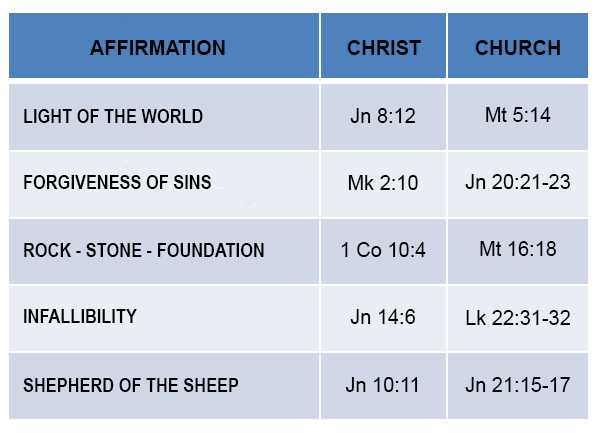
That humanity, both as individuals and as the Church, cooperates in salvation is clearly seen in biblical passages like these, where we are told that man can also do things that, in principle, belong to Christ:
[
Paul: Now I rejoice in my sufferings for you, and in my flesh, completing what is lacking in Christ’s afflictions, I do my part for His body, which is the Church. (Colossians 1:24)
[
Jesus: Truly, I tell you, whoever believes in me will also do the works that I do, and even greater things than these. (John 14:12)
[
Paul: Offer yourselves as a living sacrifice, holy and pleasing to God. This is your true and proper worship. (Romans 12:1)
[
The apostles at the Council: The Holy Spirit and we have decided… (Acts 15:28)
Christ holds the keys to the Kingdom… and He gives them to Peter. Christ is the cornerstone… and He tells Simon that he is the rock. (Matthew 16:18-19)
[
Jesus to the apostles: If you forgive anyone’s sins, they are forgiven; if you do not forgive them, they are not forgiven. (John 20:23)
For there is one God, and one mediator between God and men, the man Christ Jesus. (1 Timothy 2:5)
BUT ALSO
And do all this praying and pleading at all times in the Spirit; give up even sleep if necessary, and pray persistently for all the believers. (Ephesians 6:18)
For no one can lay any foundation other than the one already laid, which is Jesus Christ. (1 Corinthians 3:11)
BUT ALSO: Consequently, you are no longer strangers and foreigners, but fellow citizens with the saints and members of the household of God, built on the foundation of the apostles and prophets, with Christ Jesus Himself as the cornerstone. (Ephesians 2:20)
AND ALSO the Church of the living God, the pillar and foundation of the truth. (1 Timothy 3:15)
Even when its human part falls into sin and corruption:
Go again and love a woman who is loved by another and is an adulteress, just as the Lord loves the Israelites, though they turn to other gods and delight in raisin cakes. (Hosea 3:1)
For us, the Incarnation and the Church are two sides of the same coin. Without the Incarnation, our concept of the Church would have to be the same as that of the Protestants.
REMEMBER: For Catholics, salvation comes from God alone, but man can and must cooperate with it, since through the Incarnation and His death on the Cross, God also used human nature alongside divine nature to save us.

In the same way, the Church also has a dual nature, both human and divine. And just as with Jesus, its divine part (the Holy Spirit) ensures that the entire Church—both the living Christians and the saints in heaven—can cooperate in transmitting salvation.

The Church is the instrument through which God's saving grace reaches us.

Disjunctive or copulative
Protestants establish an opposition between the divine and the human in the work of salvation:
Faith or works
Bible or Tradition
Grace or nature
In one word: CHRIST OR THE CHURCH
But the Incarnation shows us that there is no opposition, but rather collaboration. When Jesus Christ assumes human nature without ceasing to be God, His humanity cooperates in Redemption, demonstrating that there is no need to choose between the human and the divine. This is why, in contrast to the Protestants’ disjunctions, Catholics resolve these apparent contradictions with a “and”:
Faith and works
Bible and Tradition
Grace and nature
In one word: CHRIST AND THE CHURCH
Conclusion
Why did God choose to incarnate and become man to save us? Why does He consider it so important to respect our free will?
Not out of necessity, but out of love.
We say that God’s saving grace reaches us through the Church, but does God need the Church to save us? No. Would God have needed His Son to incarnate and die on the cross to save us? No. Even more, does God need to save us? No.
All of this is not out of necessity but because God wills it, and the reason He wills it is because He loves us. Out of love, not out of necessity, God chose to become incarnate, and out of love, not out of necessity, He wills that men, both individually and as the Church, cooperate in His work of salvation.
INCARNATION: With Jesus, human nature was not only reconciled but also intimately united with divinity; Jesus Christ is the total and indissoluble union between God and man, between the lover and the beloved. God loves us so much that He chose to become one of us, to suffer as we do, and even to endure torture and death as any of us would. Only in this way can we truly feel loved and understood in our tribulations, and only in this way can His life serve as a model for us to imitate.
COOPERATION: On the other hand, without free will, our love for God would not be truly free. Whoever loves desires above all that the beloved responds out of their own will, not by force—otherwise, that love would be merely an illusion, empty of meaning. God loves us and desires that we authentically respond to Him; that is why He does not impose His love but offers it, and at the same time, He desires that we freely offer Him ours. After all, salvation aims to bring us to live with Him eternally. It is love that Love seeks, and love is only true love when it is freely given and actively participated in.

Appendix A
Summary of How the Protestant “Solas” Ignore the Incarnation

Sola scriptura
If the Church is merely a reflection of the Son, but not of the Incarnate Word, it can only be spiritual and invisible. Therefore, the Catholic Church, which is visible, would be nothing more than a mere association of men. By denying that the Church has anything divine, the apostolic Tradition she has received is not trustworthy, for any purely human transmission tends to be corrupted, diluted, and to mix truth with error. For the same reason, the Church’s Magisterium would have no value, as it would consist only of human decisions and would therefore be fallible. This leads to the conclusion that only the Scriptures, being divinely inspired and therefore infallible, can securely contain the Truth, while everything else would be of interest merely as historical testimony, but not as a source of doctrine. This creates two major problems.
A- If we deny Tradition and the Magisterium, even Sola Scriptura itself is left without foundation. A large portion of the New Testament was quickly accepted by consensus among all the churches, but a significant part lacked such consensus. It was the Church—relying on Tradition but also exercising her Magisterium—who infallibly declared, under the inspiration of the Holy Spirit, which books were the Word of God and which were not. If the Church were merely human, then the determination of what is and is not Scripture would largely be a human opinion, and therefore, the Scriptures themselves would not be trustworthy.
B- Without Tradition and the Magisterium, we also find that the interpretations of Scripture can be multiple, and no one can assert with certainty that their interpretation is the correct one. In practice, Truth becomes nothing more than a mere opinion. This unforeseen consequence already led Luther to lament in the following way:
This one does not want to hear about baptism, that one denies the sacrament, another places the world between this moment and the Last Day; some teach that Christ is not God, others say this, and yet others say that. There are as many sects and creeds as there are heads. No peasant is so brazen as when he dreams and imagines that he has been inspired by the Holy Spirit and must be a prophet.

(De Wette III, cited in "The Facts About Luther" by O’Hare, p. 208)
Noblemen, citizens, peasants—people of all classes understand the Gospel better than I or even Saint Paul; now they are wise and think themselves more learned than all the ministers.

(De Wette III, cited in "The Facts About Luther" by O’Hare, p. 209.)
Sola fide
If human nature cannot cooperate in salvation (as it did in the Incarnation), then striving for holiness becomes useless, since good works serve no purpose. For the same reason, praying for others—whether living or dead—would also be meaningless, as it would have no influence on their salvation, either directly or indirectly (for example, it would be futile to pray for someone to receive faith or to convert). In such a case, the only thing that could help us attain salvation would be to have faith in God and accept Jesus as our Savior.
For Protestant branches that adhere to the doctrines of total depravity and irresistible grace, as taught by Calvin and also by Luther (though in a more nuanced way), faith itself is a grace that God bestows only upon those He chooses. This means that each person’s final destiny is entirely sealed—whatever you do is useless; if God has chosen you, you will inevitably be saved, and if He has not, you will be incapable of having faith and will inevitably be damned. The only thing that saves you is having faith, but even that does not depend on you.
Sola gratia
This is closely related to what was said about Sola Fide. Salvation comes purely by divine grace, not through anything that we, either individually (as men) or collectively (as the Church), can do. Man can do nothing for his salvation, nor can he even aspire to make himself worthy before God, for he will always remain, in essence, a sinner (a denial of holiness).
Solo Christo
This is a consequence of the previous three solas. Christ is the sole mediator between God and men. Since human cooperation is ruled out, there is no reason to speak of the intercession of the saints, the salvific contribution of the sacraments, or the role of the Church in salvation.
Soli Deo gloria
Only God is to be worshiped. This is the only sola that Catholics also affirm. The problem arises because Protestants, in rejecting the role of saints and any person, act, or object in salvation, refuse to honor or venerate anything else—at least in theory. This is why they fail to understand the concept of veneration, equating it with worship. As a result, they mistakenly consider the honoring of saints or relics—something practiced by Christians as early as the first century—as an act of worship and therefore idolatry.
Thus, we see that the Five Solas deny that man has any role in salvation. However, we believe that in the Incarnation, Jesus demonstrated that human nature can cooperate in it.
If we were to claim that Christ’s human nature was able to cooperate in salvation, but human nature in general cannot, then we could no longer affirm—along with St. Paul and the Council of Chalcedon—that Jesus was truly man. His human nature would possess something of utmost importance that ours does not: the ability to cooperate with God. As a result, Jesus would not be a true man but rather a superhuman, contradicting the very foundation of the Christian faith.
This contradiction—rooted at the very foundation of Protestantism—nullifies the solas and causes all their foundations to collapse.

Appendix B
Examples of Catholic Doctrines Based on the Incarnation
Mary, Mother of God

Jesus is truly God and truly man, but moreover, He possesses “two natures, without confusion, without change, without division, without separation” (Council of Chalcedon). Therefore, it is not possible to say that Mary is the mother of Jesus (Jesus as man) but not the mother of God (Jesus as God). This—and nothing else—is what Catholics affirm when we call Mary “Mother of God,” a translation of the Greek term Theotokos (literally, “God-bearer” or “the one who gave birth to God”). In fact, when this dogma was officially proclaimed, it was not primarily to exalt Mary, but rather to defend the true nature of Jesus. Even Martin Luther did not dare to deny this dogma, though his later followers eventually did.
Original Sin
[
You must be perfect, as your heavenly Father is perfect. (Matthew 5:48)

If man is sinful but Jesus tells us that we can attain perfection—that is, become holy—then why does the Bible say that Jesus was like us in all things except sin? If we can also achieve perfection, then the absence of sin would not be a difference between Jesus and us; rather, it would simply be proof of what our nature is capable of attaining.
Luther believed in Original Sin and defended the doctrine of total depravity. Many modern Protestants, especially in more liberal or Arminian branches, have softened or reinterpreted this idea. However, a significant portion of Reformed churches (Calvinist theology) still emphasize human incapacity without grace. But if that is the case, then St. Paul’s assertion—reaffirmed in the Council of Chalcedon—becomes incomprehensible: “like us in all things, except sin.”
Even though man can become holy, as Jesus commands us, what is impossible for man is to be born without Original Sin. This is precisely where Christ’s human nature differs from ours—and in nothing else.
[
Therefore, just as sin entered the world through one man, and death through sin, so death spread to all men, because all sinned. (Romans 5:12)
Images

Protestants reject images used for worship because they interpret the Old Testament prohibition literally and permanently. However, the Old Testament also tells us that God is not a man, but only spirit. The Incarnation changed everything—God became man, became visible, and therefore representable. The Decalogue establishes the prohibition by saying:
[
You shall not make for yourself any carved image or any likeness of anything that is in heaven above, or that is in the earth beneath, or that is in the water under the earth. (Exodus 20:4)
In Deuteronomy, the reason is explained:
[
The day the Lord spoke to you out of the fire at Horeb, you saw no form of any kind. Therefore, be very careful not to become corrupt by making for yourselves an idol, an image of any shape: whether in the form of a man or a woman, or of any animal on the earth or any bird that flies in the sky, or of any creature that moves along the ground or any fish in the waters below. (Deuteronomy 4:15-18)
God could not be seen, and therefore, He could not be represented. However, compare this situation with the complete reversal brought about by the Incarnation. Saint Paul tells us that Jesus, as man, “is the image of the invisible God“ (Colossians 1:15). That is why Jesus said to Philip, “Whoever has seen me has seen the Father.“ (John 14:8).
If the reason for the prohibition disappears, the prohibition itself also disappears. This explains why Jesus never spoke against images and why, whenever the apostles criticize them, they always refer explicitly to pagan idols, not to images in themselves.
Good Works, the Visible Church, the Intercession of Saints, etc.

We have already seen that the Incarnation, as understood by the early Church and clearly defined at Chalcedon, implies that human nature (both Christ’s and ours) has been and continues to be used by God as an instrument of salvation, even though salvation itself comes solely from God. Therefore, if we accept that we can cooperate, then the biblical texts that state that good works are necessary for salvation require no special interpretation. Thus, Jesus says in the Final Judgment: “Come, you who are blessed by my Father, for I was hungry, and you gave me food,” etc. (Matthew 25:31-46). And James, in his epistle, affirms: “You see that a person is justified by works and not by faith alone… faith without works is dead.” (James 2:14-20).
And for the same reason, it is also possible to collaborate in the salvation of others, just as Jesus did. This gives full meaning to Tradition and to the biblical passages that support the belief in the intercession of Christians for one another:
[
Confess your sins to one another, and pray for one another, that you may be healed. The prayer of a righteous person has great power. (James 5:16)
[
But not only does the High Priest [Jesus Christ] pray for those who pray sincerely, but also the angels... as well as the souls of the saints who have already fallen asleep. (Origen, Treatise on Prayer 9:2 and 11, year 233)
And likewise, the Protestant theological objections that deny the Church and its sacraments the possibility of being instruments of salvation also disappear, as we have seen earlier.
The idea that, through the Incarnation, God Himself has entered the physical universe and has retained a part of it within His own nature fully justifies the belief that man, who is both body and soul, can relate to God in both body and soul. Thus, instead of the purely spiritualized worship that Protestantism promotes as the ideal, we believe that all the physical and external elements of worship are also an integral part of the “total worship” that God deserves. Within this context, many things that most or some Protestants reject (depending on the specific practice) find their full meaning: liturgy, sacraments, the real presence in the Eucharist, priestly vestments, relics, medals, images, candles, etc. That being said, most of these elements were already present in the Old Testament, even before the Incarnation.
And just like these examples, if we analyze most of the Catholic doctrines rejected by Protestants, we will see that almost all of them are not the result of pagan contamination, as many Protestants still assume today, but rather the product of a complete belief in the Incarnation of God and the full acceptance of all its consequences. CHRIST AND THE CHURCH.

 Apologia 2.1 in English
Leave your comment (it will be published after review)