
Category: Apología
-

Transform Your Life with the Power of Prayer
If you have ever felt empty, as if your spiritual life is stagnant, that God seems distant, or that you don’t know how to draw closer to Him, this article is for you. Here, you will discover how prayer can transform you from within, fill you with peace, and give you a deeper happiness than…
-
The Incarnation: Protestant Doctrine, Catholic Foundation
It is said that what differentiates Catholic Christianity from Protestant branches are the doctrines of the so-called “solas” formulated by Luther, and this is true. However, if we delve even deeper, we find that at the base of everything lies the doctrine of the Incarnation.
-
Mary in the Bible: Typology
Index and introduction of the series: “Mary in the Bible”. Marian doctrines are not medieval innovations but truths contained in Sacred Scripture, often in a veiled or seminal form. To understand these teachings, it is essential to grasp the concept of typology, an old biblical interpretative principle.
-
Mary in the early Church
Those who claim that the veneration of Mary, so deeply rooted among Catholics, Orthodox, and others, is a medieval invention need to understand its true origins. It does not stem from Constantine or the Council of Nicaea but dates back much earlier.
-
Sola Scriptura vs Tradition
The Protestant doctrine of Sola Scriptura presents a fundamental paradox: while it is portrayed as a principle of absolute authority, its application relies on personal interpretations and lacks a unified criterion for defining essential doctrines. Tradition avoids that problem.
-
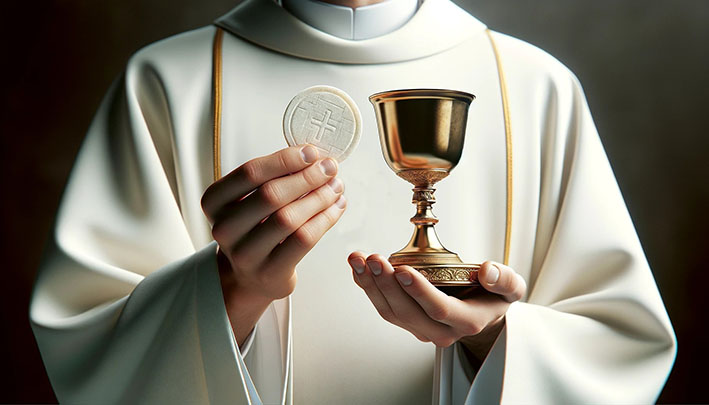
The Eucharist: What It Is and How to Receive It – On the Tongue or in the Hand?
In the spiritual life of a Catholic, the Eucharist holds a central place. Some receive it on the tongue and others in the hand, but does that matter? How did each of these methods arise and why? Which is the most appropriate? And which one did Jesus Christ use? What does the Church dictate?
-

Mary in the Bible: Ever Virgin
Mary: Ever Virgin, before, during, and after childbirth. This Marian dogma is the first and most deeply rooted of all, and it was never seriously questioned until the Protestant Rupture. We are going here to see its foundation in the Bible and in Tradition.
-

Mary in the Bible: Mother of the Church and our mother
Catholics believe that Mary is the mother of the Church and of each of us individually. This belief comes to us from the early Church and is also clearly reflected in the Bible in various places. In this article we will see how this is.
-

Mary in the Bible: Mother of God
Protestants reject the title “Mary mother of God” because of a misinterpretation of what the early Church meant by it. Let’s see what exactly it means, where it is in the Bible, and why denying Mary that title implies denying the Incarnation of God.
-

Mary in the Bible: Queen of Heaven (our advocate)
The Virgin Mary is the Queen of Heaven. That title, which some say is pagan, is actually the just title that the very Bible grants to Mary. Here we will see where that is in the Bible and what consequences it has for us.
-

Mary in the Bible: The Ark of the New Coventant (Assumption and other dogmas)
The Bible says little about Mary, or does it say a lot but we don’t know where to look? Let’s read the Bible through the eyes of early Christians and see what we can find about Mary. In this article we will deal with the dogma of the Assumption, but other Marian dogmas will show…
-

Mary in the Bible: The New Eve (Immaculate Conception)
The Blessed Virgin Mary is Immaculate since her conception, and also the mother of all Christians, but where is that in the Bible? In this article we will see where… and it is fascinating.
 Apologia 2.1 in English