


We have already seen in our previous article why Mary has the title “mother of God”, what exactly that means and where in the Bible you can find that. In the present article we are going to continue with the motherhood of Mary and we are going to explain why the Church says that Mary is also our mother, both as a group (mother of the Church) and for each and every one of us (our heavenly mother). We do not believe this out of sentimentality, but because the early Church developed this concept from the received Tradition and the Holy Scriptures. Here we will see where in the Bible is that.
Notice: This article is a (human) English translation from our original Spanish site. Expect links marked in yellow, if any, to open articles in Spanish at the moment.
Where is that in the Bible?
We are really lucky that Mary is not only the Mother of God, but also our mother. It was Jesus himself who shared her with us as a mother —with the Church and with each one of us — thus fully incorporating us into his family. Christians are part of the family of Jesus, and therefore we are brothers of Christ, children of God and also children of Mary. Jesus himself told us on many occasions that his heavenly Father is also our father, that is why he taught us to pray by repeating the words “Our Father who art in Heaven“. But it is also him who gave us his mother. Let’s see how.
The crucifixion

On the cross, desperately gasping for air as he choked, Jesus made an enormous effort to say a few words, all of the most importance. One of them was:
[
When Jesus therefore saw His mother and the disciple standing by whom He loved, He said unto His mother, “Woman, behold thy son!” Then said He to the disciple, “Behold thy mother!” And from that hour, that disciple took her unto his own home. (John 19:26-27)
We have already explained in this other article that whenever John uses the word “Woman” to refer to Mary, he is treating her as the New Eve, to whom Adam named “Woman”, and that is the way she is always mentioned before the Fall in Genesis 2:23 (he will later change her name to “Eve” only after the Fall Genesis 3:20). Therefore, in this scene he is presenting his mother as that Eve who was “mother of all living” (Genesis 3:20). But if Eve was our mother genetically, the New Eve is our mother spiritually, by the grace of God; If that Eve was the mother of all living, the New Eve will be the mother of all believers.
In this scene on the cross, Jesus is doing two things: he does not want to leave his mother helpless (since she has no other children who can take care of her), so he asks John to take care of her; but at the same time he is doing something much more important. He does not call them “mother” and “John”, but addresses both as archetypes: he calls his mother “Woman” (representing the mother of all believers), and John he calls “the disciple” (representing all the followers of Jesus), so what Jesus is also doing is giving us Mary as the mother of the whole Church, of each and every one of the disciples of Jesus.
The Woman of Revelation

There is also another biblical scene where we are told, this time more explicitly, that Mary is the mother of all Christians. It is in the Book of Revelation, the scene called “The portent”. We find it in chapter 12:
[
- 1 -
And there appeared a great wonder in heaven: a woman clothed with the sun, and the moon under her feet, and upon her head a crown of twelve stars. And she, being with child, cried, travailing in birth and in pain to be delivered. And there appeared another wonder in heaven: behold, a great red dragon, having seven heads and ten horns, and seven crowns upon his heads. (...) And she brought forth a manchild, who was to rule all nations with a rod of iron; and her child was caught up unto God and to His throne. (...)

- 2 -
And there was war in Heaven: Michael and his angels fought against the dragon; and the dragon fought and his angels, and prevailed not; neither was their place found any more in Heaven. And the great dragon was cast out — that serpent of old called the Devil and Satan, who deceiveth the whole world. He was cast out onto the earth, and his angels were cast out with him. (...)

- 3 -
And when the dragon saw that he was cast unto the earth, he persecuted the woman who brought forth the manchild. And to the woman were given two wings of a great eagle, that she might fly (...) And the serpent cast out of his mouth water as a flood after the woman, that he might cause her to be carried away by the flood. And the earth helped the woman; and the earth opened her mouth, and swallowed up the flood which the dragon cast out of his mouth. And the dragon was wroth with the woman, and he went to make war with the remnant of her seed, who keep the commandments of God, and have the testimony of Jesus Christ.
This vision of John has three parts, so let’s briefly analyze each of them. We will only deal with what is of interests in this issue, but if you want to delve into the full meaning and symbolism of this scene and the reasons why this woman is Mary, and not just a symbol of the Church as Protestants say, see the second part of our article on the New Eve.
1- We see a pregnant Woman and the Dragon (identified in the Book of Revelation as Satan) waiting for the child to be born to devour it. The child is clearly Jesus, the Messiah; we see that mostly because he is thus identified in the phrase “And she brought forth a manchild, who was to rule all nations with a rod of iron “. Psalm 2:7-9, a messianic psalm, tells us that the Messiah will come to rule all nations with an iron rod (= a scepter), and Revelation 19:11-16 identifies Jesus as the one who comes with the iron scepter. And so Protestants also identify that male child with Jesus, although in a strange maneuver they deny that the mother of the male child (Jesus) is Mary. Anyway, if we read that passage without any prejudice there is no reason to deny the obvious: the star-crowned woman who gives birth to Jesus is his mother, Mary. Satan failed to devour the child (that is, he did not defeat Jesus), who ascended into heaven and sits next to the throne of God (the Ascension).
2- In the second part we are given a flashback towards the origin of the conflict, and we see the fight between angels and demons and the defeat of Satan and his followers, who are expelled from heaven and thrown onto earth. This scene also echoes Luke 10:18, when Jesus said “I have seen Satan fall from heaven like lighting.” But this defeat of Satan will not be consummated until the end of time, when Saint Michael will throw him into the lake of fire. (Revelation 20:10).
3- Indeed, being thrown onto the earth caused problems to be transferred to this level. Jesus had already ascended to heaven so that now it is only her mother who remains on earth, and the Dragon will pour out all his fury on her, since his son escaped him. But Mary too will prove an unattainable goal for Satan, since she is free of sin, shown by that divine help in the form of eagle wings to escape the Dragon and that river that the earth swallowed in her aid. So Jesus and Mary are impossible goals for Satan, both unattainable (sinless), and what does he do? “ the dragon was wroth with the woman, and he went to make war with the remnant of her seed” (v.17), and who is that other seed? The verse continues: those “who keep the commandments of God, and have the testimony of Jesus Christ”, that is, Christians, the Church.
The scene begins explaining that the Woman was pregnant and gave birth to the Messiah, that is, she is the mother of Jesus, and ends saying that Jesus is not her only offspring (seed), there is also “the rest of her offspring” (or “the remnant of her seed”), which are the Christians in general, as we are told. This means that Mary is the mother of Jesus and our mother. Sure the one who is telling this has to be John, the same who explained that, being at the foot of the cross, Jesus gave us his mother as our mother, calling her “Woman”. Now in his vision it is that same “Woman” from the cross (and from Cana) who is described without further explanation as the mother of Jesus and our mother as well.
Pentecost

Luke introduces Mary as a prominent presence at the time Jesus is born, also at the time Jesus begins his teaching (wedding at Cana), instigated by no other than Mary; There the discipleship of Jesus begins to be built, what will later be his Church. But we also see Mary present in the group of disciples who gathered in the upper room at the time the Holy Spirit comes to all of them at Pentecost and presents her to us as a mother figure (“Mary, the mother of Jesus”). So when the Church was born, mother Mary was right there at her birth.
[
When they arrived, they went to the upper room where they were staying: Peter and John and James and Andrew, Philip and Thomas, Bartholomew and Matthew, James son of Alphaeus and Simon the Zealot, and Judas son of James. All of these were constantly engaged in prayer, together with the women and Mary the mother of Jesus, and with his brethren. (Acts 1:13-14)
If the role of Mary had not been especially relevant, then it would have been enough to include her in the group of women mentioned before, or in a group of relatives, as come later. But no, Mary is mentioned by name. This scene by itself would not be enough to conclude that Mary is the mother of the Church, but in the context of the other Biblical references seen previously, it is difficult not to notice here that when the Church was born, Mary had to be there as well. There is no childbirth without a mother.
Mary, the New Rachel
Apologist Brant Pitre offers us a new dimension in which the Bible presents Mary as the mother of believers; Let’s see his arguments. Jacob is the father of all the Chosen People, since the 12 tribes of Israel all came out of his 12 children, and although Rachel was only the mother of the last two of them (Joseph and Benjamin), the Jews have always considered her the mother of all Israel, for she was the beloved wife of Jacob. But to understand the parallel between Rachel and Mary we first must understand that Jesus is not only the new Adam, the new Moses and the new David, but also, and perhaps mostly, the new Joseph.
Indeed, the parallels between Jesus and Joseph, the son of Jacob, are numerous and striking, and were not lost on the early Church. Let’s see just a few examples:
Joseph was the firstborn of Rachel (Jesus the firstborn of Mary); Joseph was convicted along with two criminals, one of whom saved his life thanks to Joseph (Jesus was crucified along with two criminals, one of whom saved his soul thanks to Jesus); Joseph started ministering to the Pharaoh when he was 30 years old (Jesus began his ministry when he was 30 years old); Joseph, in his glory of power, reveals himself to his brothers, who do not recognize him (Jesus, in his glory of Resurrection, appears to his apostles, who do not recognize him); Judah, one of the 12 brothers, sold Joseph for 20 pieces of silver (Judas, one of the 12 apostles, sold Jesus for 30 pieces of silver*), etc. etc. etc.
*Note: in Hebrew Judah and Judas are the same name, Yehudah. Judah sold Joseph for 20 pieces of silver because that was the price of a slave under 20 years of age (Leviticus 27:5), and Judas sold Jesus for 30 pieces of silver because that is worth compensation for a dead slave (Exodus 21:32).
Once again we find ourselves with a typos (foreshadowing) of Jesus, and from that typos also flows the typos of Mary (read about typology here). If the mother of Joseph was Rachel, the mother of Jesus, the new Joseph, is Mary, the new Rachel. Let’s see why this is so and what the implications are.
Rachel, Mother of Sorrows of Israel
The Bible describes Rachel as adorned with great beauty and charming graces, but her life was fraught with suffering. She suffered because being in love with Jacob, her father gave him her sister Leah first. She suffered even more because Leah gave Jacob children and she found herself barren. She suffered greatly when she was made to believe that her only son, Joseph, had been torn to pieces by wild beasts, and never knew it was a lie. And she also suffered greatly, to the point of death, in the delivery of her second and last child, Benjamin.
Ancient Jewish tradition considered her the great mother of Israel (in the same way that Abraham is their father) and endowed her with an intercessory role before God for his people. Part of Judaism believes in the intercession of the saints in heaven (see here), and this role of intercession for Rachel was not only assigned to her in ancient Judaism, but is alive even today, and there are many Jews who pray to Rachel asking for her intercession, or pilgrim to her tomb and light candles begging her to pray before God for them (see here). All of these things sound very Catholic, so it’s no wonder that Jacob Neusner, a rabbi and scholar, wrote:
[
That is why I can find in Mary a Christian, a Catholic Rachel, whose prayers count when the prayers of great men, fathers of the world, fall to the ground... No wonder that, when Rachel weeps, God listens. How hard, then, can it be for me to find in Mary that sympathetic, special friend that Catholics have known for 2,000 years! Not so hard at all. So, yes, if Rachel, then why not Mary?
This rabbi is in fact thinking of an ancient extra-biblical Jewish tradition, already known in the time of Jesus. According to this story, when the Jews were taken into exile, Abraham and Jacob prayed God to have mercy on their people, but God would not listen, he wanted the Israelites punished… until Rachel, with her tears, moved him to the point of giving in, and he promised that the exile to Babylon would be temporary.
The Massacre of the Innocents

If you travel from Jerusalem to Bethlehem, there is a garden on a hill with a statue of Rachel weeping. They say that this is where Rachel wept when she saw her people taken to Babylon into exile. This tradition also left traces in the Bible. We see it in Jeremiah:
[
Thus says the Lord: A voice is heard in Ramah marked by lamentation and bitter weeping: Rachel is mourning for her children, and she refuses to be consoled because they are no more. Thus says the Lord to her: Cease your cries of lamentation and wipe the tears from your eyes. For your labors will be rewarded, says the Lord, and your children will return from the land of mercy. (Jeremiah 31:15-16)
These verses consecrated Rachel as Mater Dolorosa (Mother of Sorrows) and intercessor for her people. Notice also that Jeremiah is clearly presenting Rachel as intercessor and mother of all Israel, for she is weeping for “her children”, and those children here are not her 2 biological children, not even Jacob’s 12 children, but the whole of the people of Israel, who many centuries later are on their way to Exile. One more reason to consider that the spiritual motherhood of Mary (and the intercession of the saints) is a perfectly biblical concept.
The connection between Rachel and Mary is not just modern thought, it is found explicitly in the Bible. In that same area where Rachel cried, many centuries later a new tragedy fell on God’s people.
[
When Herod realized that the wise men had deceived him, he flew into a rage and issued an order to kill all the boys in Bethlehem and the surrounding area who were two years old or less, in accordance with the information that he had obtained from the wise men. Thus were fulfilled the words that had been spoken through the prophet Jeremiah:

“A voice was heard in Ramah, lamenting and sobbing bitterly:
Rachel weeping for her children, and refusing to be consoled,
because they were no more.”

After the death of Herod, an angel of the Lord appeared in a dream to Joseph in Egypt and said, “Arise, take the child and his mother, and go to the land of Israel, for those who sought to kill the child are dead.” He got up, took the child and his mother, and returned to the land of Israel.


(Matthew 2:16-21)
When the slaughter of the innocents, while Joseph flees with his family to Egypt to save Jesus, Rachel rises again to weep for her children. But that Rachel who fulfills the ancient prophecy is not Jacob’s wife, it is the New Rachel, Mary, who cannot remain impassive in the face of such atrocious misfortune. And just as Rachel’s weeping had its reward, causing her people to return from exile some years later, the New Rachel’s weeping also foreshadows that after a few years the Messiah will return from exile, so some years later: Joseph “got up, took the child and his mother, and returned to the land of Israel.” Just as it had happened before.
The Woman of Revelation revisited
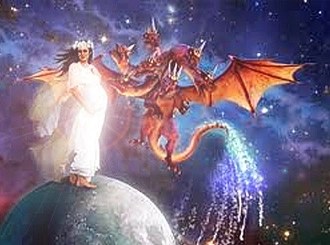
Another episode in which we see Mary as the New Rachel is, once again, in the Portent scene, in Revelation. In addition to all the Marian symbology that we have described above and in previous articles about that scene, we also have the fact that the elements of that vision are taken from —surprised?— the dream of Joseph (Rachel’s son) in which he saw that “The sun, the moon and eleven stars bowed down to me.” (Genesis 37:9), referring to his father, his mother and his 11 brothers. Compare that to “And there appeared a great wonder in heaven: a woman clothed with the sun, and the moon under her feet, and upon her head a crown of twelve stars.“ (Revelation 12:1).
But there is even more, the Book of Revelation continues saying “And she, being with child, cried, travailing in birth and in pain to be delivered.” (v.2). Catholics claim that Mary gave birth without labor pains, as we read in the prophecy of Isaiah 66:7. But this Woman Clothed with the Sun, who is clearly Mary because she will later give birth to the Messiah, is indeed in labor pains. The reason for this is that just like the sun, the moon and the stars that adorn her symbolize things, labor pains also symbolize something. Those labor pains only reinforce the connection between this Woman of Revelation and Rachel, who suffered so much in childbirth that she died in it. This connection would have been quite easy to see for the Jews in the first century.
The Crucifixion revisited

But there is another biblical scene where we can find echoes from Rachel in Mary. At the foot of the cross, Mary suffered so much that she felt as if a sword pierced her heart, just as Simeon had prophesied in the temple (Luke 2: 33-35). Here we have the new Mater Dolorosa suffering unbelievably, and if St Paul himself said that his sufferings cooperated with Jesus in our redemption (Colossians 1:24), why not acknowledge that same role of co-redeemer for Mary, who suffered the unspeakable at the foot of the cross? This suffering mother is in the New Testament the fulfilment of what that other suffering mother was in the Old. Even the name connects them: Rachel means “sheep”, and Mary is “the mother of the Lamb” (= the sheep).
And right there, at the foot of the cross, we see another glimpse from the past: Benjamin, the youngest of the 12 brothers, was Jacob’s “beloved son” (this is how his brothers in Egypt described him), and John, the youngest of the 12 apostles, was “the beloved disciple” of Jesus. Jesus, like the patriarch Joseph, had only one brother on his mother’s side, and that brother was John, because as we have already seen, Jesus gave John to Mary as his son (John 19:26-27), for this reason John, as a New Benjamin, will always refer to himself in his gospel as “the beloved disciple”, not out of vanity, but because Jesus had made him his brother, the New Benjamin (Jacob’s “beloved son”), the son of the New Rachel. And as we said before, by turning John and Mary into prototypes, that brotherhood between the New Joseph and the New Benjamin was also extended to all Christians. Just as Rachel was the mother of all the people of the old covenant, the New Rachel, Mary, became the mother of all the people of the new one, the Church. The pains of Mary at the foot of the cross were not only co-redemption pains, they were also labor pains.
Rachel: beautiful, loving, full of graces, intercessor… and mother of God’s People. So is Mary.
Mother of the Church

Some say that the title of Mater Ecclesiae (mother of the Church) is a very modern title that appeared in the 19th century and was approved by Paul VI in the middle of the 20th. But it is not a new idea. Once again, the official statement is confused with the belief; in fact Vatican II appeals to St Ambrose to justify its use. But this idea that Mary is not only our mother, but the mother of all Christians (the Church) has been in the Church through the centuries since its origin, although with different terminologies. Let’s see some examples.
Saint Irenaeus in the second century says that Mary “has become the cause of salvation for the entire human race” (Adv. haer., III, 22, 4: PG 7, 959), which fits with his concept of New Eve, mother of all the living. But also, he establishes in a more specific way her spiritual maternity over believers: “[Mary] generates men again in God” (Adv. haer., IV, 33, 11: PG 7, 1.080 ), that is, she is the spiritual mother of Christians. We also find other titles that, even though related to the same concept, are less evident, along with others that, though different, are very explicit, such as St Anselm in the 12th century: “You are the mother of justification and of the justified, the mother of reconciliation and of the reconciled, the mother of salvation and of the saved” (Or. 52, 8: PL 158, 957), that is, you are the mother of Jesus and of Christians. The same was said, in different words, by St Thomas Aquinas in the year 1274: “Oh blessed and sweet Virgin Mary, Mother of God, all full of mercy, daughter of the Supreme King, Lady of the Angels, Mother of all believers”.
We see that same dichotomy between physical mother and spiritual mother in the Bible about the paternity of Abraham. Paul presents him to us as the genetic father of all the Jews (Romans 4:1), but also as the father of all believers by spirit (Romans 4:11), since the Church includes both Abraham’s descendants and Gentiles who are his children according to faith, through the spirit, not through the flesh. The Old Testament begins when Abraham obeys God’s desire and leaves his land to go to Canaan, the New Testament begins when Mary obeys God’s desire and agrees to be the mother of the Messiah.
Justification
That Jesus gave us his mother at the foot of the cross is not that strange considering that Jesus had already called us brothers and told us that his Father was also our father, so now saying that his mother is also our mother is simply natural. Similarly, in Revelation we see that the mother of the Messiah is also the mother of “the rest of her offspring”, which is us. The scenes of the crucifixion and Pentecost also need to be interpreted correctly to see in them that Mary is the mother of the Church. And the vision of Jesus as the New Joseph (hence Mary as the New Rachel), although more than evident, is not made explicit in the Bible either, an interpretation must be made.
But that does not mean that we Catholics have sat down to reflect on these texts and have now come to the beautiful conclusion that Mary is our mother. A Protestant can tell us that this way of interpreting those texts may make sense, but that there is nothing to guarantee that this interpretation is correct, and they offer their own interpretation. Our interpretation would therefore have the same degree of credibility as any biblical interpretation that a Protestant can make on this passage or any other. But if we Catholics believe that this is not just an interesting and plausible theological conclusion, but the correct one, it is not because of what we see in this text, but because of what the Church founded by Jesus has seen in Mary for some 2000 years.

In the previous quotes, especially at the cross and in the Portent, we see that the border between “mother of every Christian” and “mother of all Christians” (= of the Church) is blurred and even arbitrary. In fact, there is no need to trace a border, neither did the early Church intend to do it.
Just as the early Church believed, we Catholics still believe.

[Click on the banner to access the index of the complete series]



 Apologia 2.1 in English
Leave a reply to Ann Cancel reply