


The Virgin Mary is the Queen of Heaven. That title, which some say is pagan, is actually the fair title that the very Bible grants to Mary. Here we will see where that is in the Bible and what consequences it has for us.
Notice: This article is a (human) English translation from our original Spanish site. Expect links marked in yellow, if any, to open articles in Spanish at the moment.
Catholics (Roman and Orthodox), Anglicans and even part of the Lutherans claim Mary to be the Queen of Heaven, and although it has not been declared as a dogma, it is an accepted truth and is part of Christian art and the liturgical calendar: the coronation of the Virgin is celebrated on August 22. This is also the reason why so many images of Our Lady are crowned and/or sitting on a throne.

The rest of Protestants reject this title, and some radicals go so far as to say that the title Queen of Heaven is a pagan inheritance or even a sample of the hidden Satanism in Catholicism, since the cult of Asherah or Astarte is explicitly condemned in the Bible, and that was the goddess who held the title of Queen of Heaven in ancient times.

[
The children gather up the wood, their fathers light the fire, and the women knead dough to make cakes for the queen of heaven. And to arouse my anger, they pour out drink offerings to other gods. (Jeremiah 7:18)
And yet, nothing could be further from the truth. The kingship of Mary is not only a logical consequence of the kingship of Christ, but it is mentioned in the Bible itself. This belief does not come from pagan influences nor is it a medieval invention, but is rooted in the teachings of the Bible and is another deeply Christian concept that cannot be dismissed.

The concept of Mary as queen was present in the primitive Church and the first artistic representation of Mary with royal attributes is already found in the art of the catacombs.

Byzantine Catholic art sometimes depicts Mary as an enthroned queen, especially in the themes of “Basilissa” (Queen) and “Kyriotissa” (Lady), also called “Enthroned Lady”. In Roman Catholicism we also find the enthroned Lady, but soon the crowned Mary theme will prevail. From the 12th century on, we also begin to find the scene of the coronation of Mary at the hands of Jesus, or of the Trinity or of angels, and since then, it will be a very popular iconography as a second stage of her Ascension.

This ancient tradition was not a late theological creation, but was taken directly from the Holy Scriptures and its foundation rests in both the Old Testament and the New. Let’s see how the Bible tells us that Mary is the Queen of Heaven.
Christ the King
As usually, Marian doctrines are derived from Christological doctrines and are the logical consequence of them. The queenship of Mary derives from the kingship of Christ, or in other words, it all starts with the fact that Jesus is king.

In the Old Testament God holds the title of king. God is King and will reign forever (Psalm 10:16), and is often depicted as sitting on his throne (Isaiah 6:1). In the New Testament, that title of king acquires a much greater role, and thus we see that the central nucleus of Jesus’ preaching is the Kingdom of God, something for which we ask every time we pray the Our Father.
But since the resurrection of Jesus, the title of king takes shape mostly in the incarnate God, in Jesus, although he does so by taking part in the royalty of the Father. Jesus ascends into heaven and sits on a throne at the right hand of the Father (Romans 8:34). In Revelation we see Jesus as king and judge, and with power to rule the nations with a rod (sceptre) of iron (Revelation 12:5). In Revelation 19:16 we are revealed the title that Jesus has on his thigh: “King of kings and Lord of lords.”
When he begins his public ministry, people acclaim him as “the Son of David”, that is, the legitimate successor of King David, called to restore his kingdom and fulfill the promise that God made to him, when he said to David: “Your house and your kingdom will last forever before me; your throne will be established forever” (2 Samuel 7:16). And that same figure of king from the house of David is assumed by Jesus, establishing parallels with the reign of David on multiple occasions, such as when he hands over the keys of the kingdom to Peter (duplicating the words with which David handed over the keys to his “first Minister”).
[
I will give you the keys of the kingdom of heaven. Whatever you bind on earth shall be bound in heaven, and whatever you loose on earth shall be loosed in heaven. (Matthew 16:19)
[
On that day I will summon my servant Eliakim, the son of Hilkiah ... I will place on his shoulder the key of the house of David. When he opens, no one will close; when he closes, no one will open. (Isaiah 22:20 & 22)

But it is God himself, through the mouth of the angel in the Annunciation, who declares Jesus the new King David:
[
Behold, you will conceive in your womb and bear a son, and you will name him Jesus. He will be great and will be called Son of the Most High. The Lord God will give him the throne of his ancestor David. He will rule over the house of Jacob forever, and of his kingdom there will be no end. (Luke 1:31-33)
Jesus is not only the New Adam and the New Moses; he is also the New David. Therefore the kingdom of David is the prefiguration of the kingdom of Christ (what we call typos, explained below). Just as David appointed a royal steward (prime minister) who in his kingdom bound and loosed (made decisions) in his absence, similarly Jesus appointed Peter prime minister (now we call that pope) so that in his kingdom (the Church) he would make decisions in his absence when He returned to the Father.
But if there is a king, there must also be a queen…
The queen in the monarchy of Israel
In any monarchy, when nothing is amiss, if we have a king we will also have a queen. Currently we think that the queen is the king’s wife, and since Jesus was not married, then in his kingdom there can be no queen. But in the monarchies of the Middle East in Antiquity, the queen was not the wife of the king, who used to have many wives (although in a few occasions a special wife might have an influential role) but her mother, who was only one and who received the title “Gebirah” (the great lady).
In the oldest epic work in the world, the Epic Tale of Gilgamesh —written by the Akkadians around 2,500 B.C. compiling much older Sumerian poems— we already see the figure of the gebirah or queen mother, who mainly exercises the role of intercessor or advocate for the people before the king, and we will find it like this in all the original cultures of Mesopotamia. Also in the monarchy From Israel.

Although she had no power on her own, the king often listened to her and gave in to her pleas, not only because of the influence that a mother has on her son on a human level (think of mothers back then, not so much of today’s), but because in addition to being his mother, she was the queen, and her role was institutionalized.
[
This was after King Jeconiah and the queen mother, the court officials, the leaders of Judah and Jerusalem, the artisans, and the skilled workmen had gone into exile from Jerusalem. (Jeremiah 29:2)
That we are talking about a true office, and not simply a mother-son sentimental relationship, we see more clearly in this other passage. King Asa had lost his mother, so the position of queen mother stayed in the hands of his grandmother (until he deposed her for idolatry):
[
He also deposed his grand-mother Maacah as queen mother because she had made an image of an Asherah. Asa cut down her idol and burned it in the Kidron Valley. (1 Kings 15:13)
Another clue can be found in the gospels. In Israelite genealogies just the paternal line is always mentioned, but there is an exception, in royal genealogies the mother (the queen), and not just the father, is mentioned (that is why Matthew, when giving the human genealogy of Jesus ends up by naming Joseph but also Mary), as we can see in this other quote:
[
In the eighteenth year of the reign of King Jeroboam, the son of Nebat, Abijam became the king of Judah. He reigned in Jerusalem for three years. His mother’s name was Maacah, and she was the grand-daughter* of Absalom. (1 King 15:1-2)
*Note: Let's clarify two common confusions about this quote.
1- It does not say that Jeroboam is the father of Abijam, but rather it is contrasting the two kingdoms into which Israel was divided: Jeroboam, son of Nebat was king of Israel when Abiam, Solomon's grandson, became king of Judah.
2- In Hebrew "daughter" and "granddaughter" use the same word, that's why there are translations that mistakenly say "daughter". Absalom, Solomon's brother, only had one daughter, Tamar. Besides, if Maacah were Absalom's daughter, then she would be first cousin of her husband, Rehoboam, Solomon's son. Anyway, Maacah was mother of Abiam and grandmother of King Asa, as we will next see.
Notice in the quote above that for King Abijam his father’s name (Rehoboam) is not mentioned, but his mother’s (Maacah). In her case, however, we find the usual: her paternal lineage (granddaughter of Absalom). Actually, it is not that in the genealogy of kings the mother is mentioned, but rather the queen (the gebirah). Let us remember that Abiam had lost his mother, so when giving his lineage they do not give us his mother, but his grandmother, since it was she who held the office:
[
In the twentieth year of the reign of Jeroboam as the king of Israel, Asa became the king of Judah. He reigned for forty-one years in Jerusalem. His grandmother’s name was Maacah, the grand-daughter of Absalom. (1 Kings 15:9-10)
Characteristics and functions of the queen
Let’s look at the case of Bathsheba. While she was the wife of King David she submitted to him as a subject, prostrating herself in her presence and honoring him:
[
So Bathsheba went into the king’s chamber [...] Bathsheba bowed down, paying obeisance to the king, and the king said, “What do you want?” She said to him, “My lord, [...] (1 Kings 1:15-17)
Notice now the difference in treatment when the one sitting on the throne is her own son. Now it is also the king who honors his mother, who is now the gebirah:
[
Bathsheba, therefore, went to King Solomon to speak to him on behalf of Adonijah. The king rose up to meet her and bowed down to her. He sat down on his throne, and had a throne placed for the king’s mother, so that she sat on his right hand. She said, “I desire to make one small request of you. Please do not deny me.” The king said to her, “Ask, my mother, for I will not deny you.” (1 Kings 2:19-20)
And the way to honor his mother includes sitting her on a royal throne at her right, thus explicitly indicating that she is the queen.
*Note: There are translations using "chair" instead of "throne", but it is a wrong translation because that same word (kese= seat of honor) that the Bible uses here for the throne of the gebirah is the one that has used a few words before to refer to the throne of Solomon.
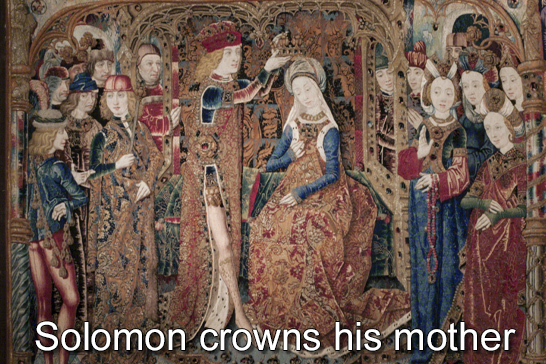
That both mother and son are king and queen and participate in the government of the kingdom is clearly seen in this passage from Isaiah, where he tells us that power is withdrawn from both:
[
Say to the king and the queen mother, “Descend from your thrones, since your glorious crowns have fallen from your heads.” (Jeremiah 13:18)
The queen mother held a position of power in the Israelite kingdom second only to the king’s. This in the Bible is expressed with the figure of “sitting on the right”. Just as we are told of Jesus that he is “sitting at the right hand of the Father,” so we are told that the queen (which is the gebirah) is situated at the right hand of the king.
[
Your throne, O God, will last forever and ever; the scepter of your kingdom will be a scepter of justice. [...] at your right hand is your queen adorned in gold of Ophir. (Psalm 45:7,10)
The power of the queen mother is not exercised directly, but through the king. The mother influences and intercedes before her son, who listens to her with all the affection of a son and with all the respect due to a prime minister. Let’s see how Adonijah, instead of going to the king and ask for a favor, goes to the queen mother so that she intercedes for him before the king:
[
Now Adonijah, the son of Haggith, came to Bathsheba, the mother of Solomon. She asked him, “Do you come in peace?” He answered, “In peace.” Then he added, “I have something to say to you.” She said, “Speak.” [...] I beg one thing from you; do not deny me.” She said, “Speak.” He said, “Please speak to Solomon the king, for he will not refuse you, and ask him to give me Abishag as a wife.” Bathsheba answered, “Very well, I will speak to the king for you.” Bathsheba, therefore, went to King Solomon to speak to him on behalf of Adonijah. The king rose up to meet her and bowed down to her. He sat down on his throne, and had a throne placed for the king’s mother, so that she sat on his right hand. She said, “I desire to make one small request of you. Please do not deny me.” The king said to her, “Ask, my mother, for I will not deny you.” (1 Kings 2:13-20)
In this particular scene, the king finally ignores his mother’s petition, but the fact is that the queen mother has no power over the king, she only has influence, albeit a powerful one, and although on this occasion we will later see that the king considers his mother’s request impossible to grant, we can see the mechanism of the queen’s intercession at work here.
Mary, the new gebirah
If Jesus, son of David, becomes the new king of Israel and of the whole world, as the prophecies announced for the Messiah, then there is no need to look very far for his queen mother. Obviously, his mother, Mary.
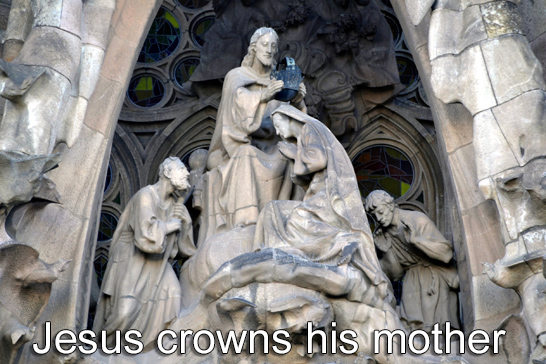
Mary is the new gebirah, the queen of that new eternal kingdom that Jesus has come to create, and as such —following the logic of the New Testament typology shown to us by St Paul— we can transfer to her the main attributes that queen mothers had in the Old Testament: an influential and powerful intercessor seated on her throne on the right of her son, Christ the King, and like him, crowned.
And where do we find this crowned Queen Mary?
[
A great sign appeared in heaven: a Woman clothed with the sun, with the moon beneath her feet, and a crown of twelve stars on her head. (Revelation 12:1)

The scene of the Woman of Revelation (the Portent) has been already discussed in detail in our previous article “Mary as the New Eve“, so we refer you there for more details. There we showed that this woman who appears in heaven is clearly the Virgin Mary, although she can probably represent the Church as well, since almost all the great images in Revelation represent two or more things. But here we are interested specifically in the fact that this Woman clothed with the sun is wearing a crown on her head.

Today’s Christians are accustomed, through centuries of sacred art, to seeing many representations of the Virgin with a crown of 12 stars positioned as a halo of holiness, but when first-century Jews read “a crown of twelve stars“, they did not think of halos or saints, they could only think of one thing: a monarch. In their imagination they would see the stars forming a royal diadem around the woman’s head, across her forehead. The image in any case is crystal clear: that woman is a queen.

As an anecdote, we can comment on the case of the representation of Our Lady of Guadalupe, considered in itself a miracle because the image miraculously appeared on the fabric of the tilma of the Indian Juan Diego without human intervention. One of the many wonders that scholars have discovered in this representation is that the stars in the mantle are not random, but rather represent the constellations that were in the sky on the day of the apparition —not as they would be seen from the earth, but as they would be seen from above the stars. It has been possible to identify the constellations that appear in the mantle, but according to the star map they form, it is also possible to find out where the unseen constellations would be. It should be noted that the representation of Our Lady of Guadalupe is none other than that of the Woman of Revelation, pregnant, standing on the moon and clothed with the sun. Well, if we put the other constellations in place, we see two very significant things that help to identify who this woman is: the constellation of Leo (lion) would be located precisely in her womb, that is, that woman carries the Lion of Judah (Jesus) in her womb, according to Revelation 5:5); and the constellation Corona Borealis (northern crown) would be located on her forehead, which explains why the typical crown of stars that this iconography always has does not appear in this depiction of Our Lady, since she already has a real crown of real stars not around her head, but on her forehead (as we have indicated previously), although being not on the mantle, these stars are implicit but not visible.

This idea of the queen mother is even more obvious because we are told that this woman from heaven is pregnant, and finally gives birth… not just a son, but a king-son who is to reign over all humanity:
[
She gave birth to a son, a male child who is destined to rule all the nations with an iron rod. And her child was taken up directly to God and to his throne. (Revelation 12:5)
That son is none other than the Messiah, since it was already prophesied that the Messiah would reign over all nations with an iron rod (scepter) and his kingdom would have no end:
[
“I myself have anointed my king on Zion, my holy mountain.” I will proclaim the decree of the Lord: He said to me, “You are my son; this day I have begotten you. Simply make the request of me, and I will give you the nations as your inheritance, and the ends of the earth as your possession. You will rule them with an iron scepter; you will shatter them like a potter’s vessel.” (Psalm 2:6-9)
In the Book of Revelation, when Jesus appears in heaven for the final battle, we are already told without metaphors that he is that prophesied king who will rule with an iron scepter:
[
He was known by the name "The Word of God". The armies of heaven were following him, riding on white horses and dressed in fine linen, white and clean. Coming out of his mouth was a sharp sword with which to strike down the nations. He will rule them with an iron scepter, and he will tread the winepress of the fury of the wrath of God the Almighty. On his robe and on his thigh he had a name inscribed: “King of kings and Lord of lords.” (Revelation 19:13-16)
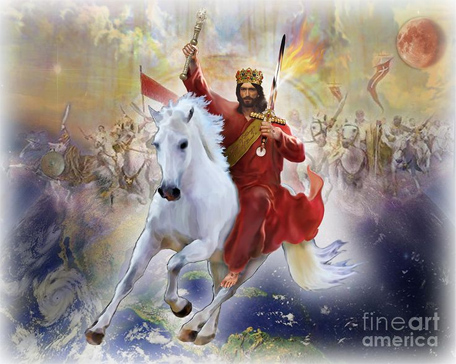
Therefore the Woman crowned with stars gives birth to the male child who “will rule all nations with an iron scepter“, and that is none other than the Messiah, Jesus, the son of David, whom we later see in heaven as “King of Kings“. So that woman is the queen mother of the messianic kingdom of which the Davidic kingdom was a typos. In the Book of Revelation, where we are told of the full triumph of that Kingdom, which “already is but not yet” (as theology says), we are shown with eschatological and triumphant images the king (King of kings) and the queen (the crowned Woman clothed with the sun) as a sign that the Kingdom for which we pray so much (thy kingdom come) will reach its fullness at the end of time.
There is another clear indication that this Woman clothed with the sun is Mary, the mother of the Messiah. The prophet Isaiah announced that the Messiah would be born of a virgin:
[
Therefore, 1 you will be given this sign by the Lord himself: 2 The virgin 3 will be with child, and 4 she will give birth to a son, and she will name him Immanuel. (Isaiah 7:14)
The Woman of Revelation fulfils that very prophecy, thus showing that she is the mother of the Messiah, that is, Mary:
[
1 A great sign appeared in heaven: 2 a Woman clothed with the sun, with the moon beneath her feet, and a crown of twelve stars on her head. 3 She was with child and about to give birth, crying aloud in the anguish of her labor. [...] 4 She gave birth to a son, a male child who is destined to rule all the nations with an iron rod. (Revelation 12:1-2,5)
This is John’s way of telling us that Jesus is the Messiah announced by Isaiah almost 8 centuries before, just as Matthew did in a more direct way:
[
All this happened to fulfill what the Lord had announced through the Prophet : "The Virgin will conceive and give birth to a son who will be named Emmanuel", which translated means: God with us". (Matthew 1:22-23)
But it is also his way of telling us that Mary is the queen-mother, the mother of the child “destined to rule all the nations“.
We have added numbers to locate 4 units of information that are exactly repeated in both passages (Isaiah and Revelation), showing that the Woman of Revelation is the sign that Isaiah announced, and therefore it is the same virgin who gave birth to the Messiah in Bethlehem, as Matthew confirms. Just as Jesus was born humble and poor but now reigns in heaven with glory as King of kings, Mary was a poor maiden but now reigns in heaven with her son as queen-mother, and this is how the Book of Revelation shows her, crowned and dressed with the sun
But Jesus did not come to be a political king ruling Israel, as many expected, he himself makes it clear when he speaks with Pilate:
[
Jesus replied, “My kingdom does not belong to this world. If my kingdom did belong to this world, my followers would have fought to prevent me from being handed over to the Jews. The fact is that my kingdom is not here.” Pilate then said to him, “So you are a king!” (John 18:36-37)
His kingdom is not of this world, as he himself clarifies. But after his Ascension in heaven, Jesus is seated at the right hand of the Father, that is, he reigns in heaven, he is King of Heaven. In the same way, his queen-mother can also bear the title of Queen of Heaven. And this is how John presents her to us in his vision in the book of Revelation: crowned with 12 stars —each star represents a tribe of Israel, that is, she is the queen of the new kingdom of David, which had unified the 12 tribes. And she appears in the realm of the sun and above the moon:
[
A great sign appeared in heaven: a woman clothed with the sun, with the moon beneath her feet, and a crown of twelve stars on her head. (Revelation 12:1)
In Antiquity it was considered that Creation was divided into two realms, the kingdom of what is imperfect and changeable (earth), and the kingdom of what is perfect and immutable (heaven). The moon was just the frontier between both kingdoms, because it is a celestial sphere, like what is in the realm of the perfect and immutable (such as the sun), but it is imperfect (the spots on its face) and changeable (the phases of the moon). So by placing Mary above the moon, she is not only telling us that she has no stain (she is Immaculate), but also that her reign is in heaven, so it is legitimate for us to use the title “Queen of Heaven“, thus acknowledging her powerful role of intercession far above that of angels and other saints, but at the same time making it clear that her royalty does not come from her own nature, but derives from the authentic source of royalty, Christ the King, which is subsidiarily extended to her for being her mother.
Biblical typology or how Salvation History works
We have seen that the Bible clearly identifies Mary with the queen, not in herself, but because she is the mother of Jesus, the King of the Universe, the New David. And this is not just about overrating a coincidence that some might find anecdotal. Someone could say that the fact that Jesus is the new king of the House of David (something biblically indisputable), does not necessarily imply that his mother has to be the queen-mother, in the same way that the fact that David had a first minister does not imply that Jesus also has to appoint a prime minister of his. Oh sorry, Jesus did appoint a prime minister, let’s call him “pope”. But that does not mean that since David played the harp, Jesus would also necessarily have to entertain himself with playing the harp.
To make this clear, let us first recall the biblical concept of typos as used by St. Paul (often translated as “figure”). He uses that word when he explains that Jesus is the New Adam:
[
Nevertheless, death reigned over all from Adam to Moses, even over those who had not sinned by disobeying a command, as did Adam who was a figure (typos) of the one who was to come. (Romans 5:14)
And he better explains the concept when he reminds us of the things that the Old Testament tells about the People of Israel, and adds:
[
All these things happened to them to serve as a figure (typikos), and they have been written down as a warning to us upon whom the end of the ages has come. (1 Corinthians 10:11)
Saint Paul’s reasoning is frequently used explicitly by the evangelists as well, reminding us that, in such and such character or scene, someone or something from the Old Testament is being fulfilled in the New, for example when John the Baptist is identified as the New Elijah:
[
And the disciples asked him, “Why then do the scribes say that Elijah must come first?” He said in reply, “Elijah will indeed come, and he will set everything right again. However, I tell you that Elijah has already come, and they did not recognize him, but they did to him whatever they pleased. In the same way, the Son of Man will suffer at their hands.” Then the disciples understood that he was speaking to them about John the Baptist. (Matthew 17:10-13)
But Jesus himself also uses this typology reasoning at times, such as when he compared himself to the Brazen Serpent, so we say that that serpent is a typos of Jesus, and his rising up in the wilderness is a typos of the crucifixion:
[
And just as Moses lifted up the serpent in the desert, so must the Son of Man be lifted up, in order that everyone who believes in him may have eternal life. (John 3:14-15)
But above all, the typological concept is necessary to understand why in the Sermon on the Mount Jesus abrogates the law of Moses, but at the same time emphatically declares:
[
“Do not think that I have come to abolish the Law or the Prophets [=the Old Testament]. I have come not to abolish but to fulfill them. Amen, I say to you, until heaven and earth pass away, not a single letter, not even a tiny portion of a letter, will disappear from the Law until all things have been accomplished. (Mathew 5:17-18)
This categorical statement would be contradictory if we do not keep in mind the concept of typology. The New Testament is not simply a mirror of the Old, but rather brings it to its “just fulfillment”, or as we see in other translations, to its “true meaning”, so that what we find in the Old Testament as a typos, seed, in the New we now find it grown in all its fullness and truth in the persons and events that we call antitypos, the fruit of those seeds of old. David is the typos of Jesus, Jesus is the antitypos of David. The fruit is not the same as the seed, though neither is it something different, but rather the logical and necessary development and culmination of that seed. Likewise in the Old Testament we see images that in the New will be fully developed, being the rule that the typos is merely a shadow of what will be the antitypos, and so the antitypos is much superior to the typos, just as the fruit is much superior to the seed.

The first Christians also reasoned after this biblical model, assuming that the coincidences between characters and facts of the Old Testament and the New are not mere coincidences, but that in God’s plan both Testaments are interconnected and in a way the Old announces what will be, and the New brings the Old to its perfection. That is why to understand the sacrifice of Jesus on the cross we have to understand what sacrifices were like in the Old Testament, and to understand the miracle of the loaves and fishes we have to understand the manna scene in the desert, and to understand who John the Baptist was we have to know who Elijah was… and to understand who Mary is we have to understand the Davidic monarchy. It is not about clinging to strange coincidences, it is about knowing how to read the signs of the Old Testament to decipher what we see in the New, because that is how God has organized it.
But not everything we see in the Old Testament is a typos of what will appear in the New. David’s harp is not a typos of anything. So why do we know that the role of the queen-mother in the Old Testament is truly a typos that will reach its fulfillment in the New with Mary?
When we are faced with an antitypos, the New Testament always sends clear signs that point to the typos preceding it (and helps to explain its meaning). In the case of the queen-mother of the Davidic monarchy as typos of a future queen-mother who will accompany the New King David, this sign could not be clearer and more direct: John is given a vision where the mother of that Messiah-king, Mary, appears in heaven crowned. In those times no woman wore crowns or diadems to attend the opera or to be named queen of the festivals; crowns were not used as an adornment of beauty, if you wore a crown you were the king or queen, period, there was no other meaning than that. (read more about typology here)
Conclusion
Following the logic of biblical typology, identifying Mary as queen-mother is not only telling us that she is the queen —and Queen of Heaven because she appears above the moon in the Book of Revelation— but also the original typos helps to understand the deeper meaning of its antitypos, so the Old Testament gebirah helps us understand what exactly it means to be Queen of Heaven. And as we saw above, the gebirah has three main characteristics:
- Her power is only below the king’s.
- She has no power of her own, her power is exercised through the great influence she has over the king, which allows her to intercede for others before him.
- Because she is the queen and the mother of the king, she is worthy of great veneration, second only to that which the king deserves.
And these are the three characteristics that the early Church already recognized in the Virgin Mary, queen and intercessor worthy of great veneration. We could add one more feature, because if Mary is the queen mother and the king, Jesus, is God, then Mary is necessarily the mother of God, but for that other dogma we already have another article so let’s leave it there for now.
But there is yet another conclusion. Jesus lived on earth as a poor and powerless man. As he himself told Pilate, “my kingdom is not of this world.” After the Ascension, Jesus sits at the right hand of God the Father, and in this way he becomes a powerful King, which is how he is described to us in the Book of Revelation. In the same way her mother, Mary, during her life on earth was a poor and powerless woman, and to the apostles and those who knew her, she seemed exceptional just for her holiness. But when she ascends to heaven, she is no longer only the mother of Jesus of Galilee, she is the mother of the King of kings, and therefore she is crowned and takes her place at the right hand of Christ, becoming from that moment on (not before) the Queen of Heaven, a powerful advocate for us.
That is why the new role of Mary was not immediately apparent to the first disciples, and it was necessary to meditate on the Bible more deeply to realize to what extent Mary was so much more than what she already seemed, a process that was gradual but very quick and, because it had Biblical roots, it was natural and did not find any opposition in a Church with a tremendous sensitivity to heresy. Realizing who Mary really was, was like watching the bud open up into a splendid rose, and no one, not even the various heretics that soon appeared, hesitated to accept this evidence. As the Christological doctrines became established, the Marian doctrines were also established, since both went hand in hand and crystallized in parallel. But curiously, the doctrines about Christ were not without controversy and heretics tried to deform his nature in many ways, but the doctrines about Mary were uncontroversial, at least not until Luther’s times, when the heirs of the Protestant Rupture slowly began to question them, thus losing the best mother and advocate God has given us. We Catholics must realise just how lucky we are.
Salve, Regina, mater misericordiae, vita, dulcedo et spes nostra, salve !


[Click on the banner to access the index of the complete series]



 Apologia 2.1 in English
Leave a reply to noursat Cancel reply