


The Blessed Virgin Mary is Immaculate since her conception, and also the mother of all Christians, but where is that in the Bible? In this article we will see where… and it is fascinating.
Introduction
When we talk about Marian doctrines, some wonder why the Bible speaks so little about Mary if she really is so important, and why the Church in its very first decades of life did not seem to be aware of her relevance either. What we are going to see here is that actually things are not like that. It is like when the moon rises during the day; the sunlight is so powerful that it is easy for the moon to go unnoticed if you don’t look where it is, but there it is. The light of Christ makes any other light around go pale, but should you know where to look, you will find that when the Bible and early Christians speak about Mary, they do not need many words to proclaim her importance.
In the first decades of Christianity, preaching, including biblical texts, is very Christocentric; the good news (gospel) proclaim that Jesus is God and he has saved us, and that message is almost the only thing that matters, the rest comes to help us understand how that is possible. The remaining doctrinal issues may be present, but usually in the background and hardly sketched. When the Church ceases to be mainly small communities of converts and begins to have many people who have grown up and lived partly surrounded by the Christian faith, then that central message is taken for granted and Christians begin to seek for a greater depth in the doctrines; there is a logical desire to know more about all the details of the Truth, not only its central idea.
And that is when a period of several centuries begins (from the middle of the 2nd to the 5th) in which Christians deepen their faith and little by little the focus is placed on questions such as what is the nature of Jesus, what are the sacraments, the Trinity, etc. They are not exactly trivial and unimportant things, but first things first, and it was not until the second half of the second century that these issues began to be clearly developed. For this reason, it is not surprising that the role of Mary also began to be analyzed in more detail in that same period, between the 2nd and 5th centuries, and always in parallel with the development of the theology about Jesus, so that Marian doctrines are logical consequences of the Christological doctrines that are being developed, as the Catechism of the Catholic Church says:
[
What the Catholic faith believes about Mary is based on what it believes about Christ, and what it teaches about Mary illumines in turn its faith in Christ. (CCC 487)
What the Gospels tell about Mary is short, except in Luke, but that is enough for them to make a series of statements about her that are truly surprising, and even more so if we put it in the context of the rest of the Bible and in light of what the first century Jews believed. In this series of articles we will reveal why Christians very soon begin to make statements about Mary that are really surprising. For this we are going to put ourselves in the mind of a first century Christian.
Typology
Before starting, we have to clarify a concept. Without the Old Testament we cannot fully understand who Jesus is and what his role is. Partly because what Jesus does or says, he does within the Old Testament molds which had shaped the religious mentality of Judaism. And partly because of typology.

The word typology derives from the Greek “typos” (nothing to do with wrong typing), which means outline, sketch, and which is usually translated as: type, figure or prefiguration. Typology, widely used by the early Church, is the study of how in the Old Testament we find sketches of Jesus or other characters from the New Testament. What Jesus and the others are or do in the New Testament can sometimes not be well understood unless we relate it to what their types (typos) were or did in the Old. The Kingdom of God is a very obscure concept unless we know how the Kingdom of David worked.
Another key idea is that the typos, as a sketch, is very inferior to its counterpart in the New Testament (its antitypos), in which that typos finds its fulfillment and perfection. For example, the brazen serpent hanging from a cross heals the wounded by poison (Numbers 21:9), but Jesus hanging from the cross saves the soul from sin and gives eternal life:
[
And just as Moses lifted up the serpent in the desert, so must the Son of Man be lifted up, in order that everyone who believes in him may have eternal life. For God so loved the world that he gave his only Son, so that everyone who believes in him may not perish but may attain eternal life. (John 3:14-16)
This way of interpreting the Bible is explained by Saint Paul and used by Jesus himself, so we know it is the correct one. Thus we say, for example, that Moses, Joseph, Jonah, David, etc. are typos (sketches) of Jesus, since each one in some way is a prefiguration of what Jesus will be, and they help us understand and contextualize it. Christ is the lamb of the paschal sacrifice, Jonah coming out of the whale’s belly on the third day prefigures the resurrection, etc. This concept was masterfully expressed by Saint Augustine of Hippo in the fourth century:
[
“Novum in vetere latet, Vetus in Novo patet”.
The New [Testament] is hidden in the Old, and the Old [Testament] is revealed in the New.
The same applies to Mary. In the Old Testament we have several “typos” that explain to us who Mary is, and what is said about her in the Bible must also be understood within the Old Testament religious molds of the first century Jews. There are details that go unnoticed for us but for a Jew of that time were tremendously revealing, and thus we find parallels between the Old and New Testaments that shed great light on who Jesus is, but also on who Mary is (read more of it here). Let’s start at the beginning, which will also take us to the beginning of the Old Testament.
The New Eve
The New Testament presents Jesus to us as the new Adam, whose obedience undoes the disobedience of the first Adam:

[
Therefore, sin entered the world as the result of one man, and death as a result of sin, and thus death has afflicted the entire human race inasmuch as everyone has sinned. (...) Nevertheless, death reigned over all from Adam to Moses, even over those who had not sinned by disobeying a command, as did Adam who prefigured/was typos of the one who was to come. (...) For just as through the disobedience of one man the many were made sinners, so by the obedience of one man the many will be made righteous. [Read full chapter] (Romans 5:12,14, 19)
He also mentions this “typology” explicitly in another letter of his:
[
Just as in Adam all die, so all will be brought to life in Christ ... As it is written, the first man, Adam, became a living being; the last Adam has become a lifegiving spirit. (1 Corinthians 15:22, 45)
This role of Jesus as the New Adam (the new man) was retained in the early Church, and we see it in the early Fathers, such as Irenaeus, Clement of Alexandria, Origen, Athanasius, Gregory of Nazianzus, etc.
When we look at Jesus through the eyes of Saint Paul as the New Adam, we understand that salvation did not consist simply in rescuing sinners from hell, but that Jesus came to undo the effects of the Fall led by man (Adam) in order to enable the restoration of the original state of grace present in Creation.
But if Saint Paul is right in his approach, and certainly he must be since this reasoning is found in the Bible, we have to see into this issue closely to remember that the Fall was not exclusively Adam’s fault. In fact, the role of Eve was essential, since she was the one who, listening to the Serpent (Satan), caused the fall of both and opened the doors for sin to enter the world and corrupt it. We cannot think of Adam as bringing sin to us as if Eve had done nothing. Therefore, if Jesus is the New Adam who undoes the sin of the first, an obvious question arises, who is the New Eve?

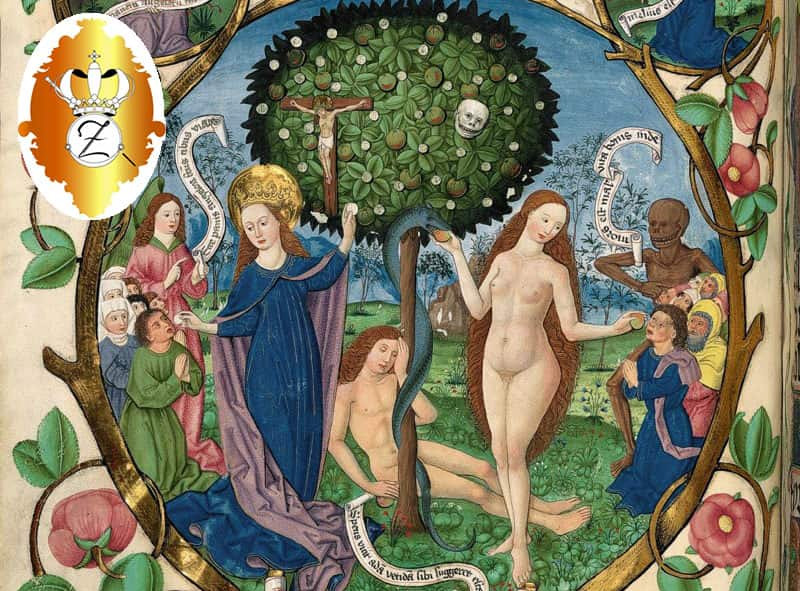
It is no wonder that when the early Church wants to teach that Mary has a singular role, only below that of Jesus’ himself, it does so through the doctrine of Mary as the New Eve. Whereas sin entered the world with Adam and Eve, the New Adam (Jesus) and the New Eve (Mary) bring us salvation: Jesus because he saved us, and Mary because she collaborated with the divine plan. But not only that, if Jesus and Mary are the New Adam and the New Eve, it is because they are the antithesis of the fallen Adam and Eve. Both mean the return to the world of the pure man and the pure woman, just as Adam and Eve were before the Fall, and therefore represent the culmination of what men and women can be when the stain of sin is not in them.
Saint Paul explains that sin entered the world through the disobedience of the first Adam, but now by the obedience of the New Adam many will be saved. Since it is also correct to claim that by the disobedience of the first Eve sin entered the world, we can also say that by the obedience of the New Eve salvation came to the world. when God cursed the serpent in Paradise he made an announcement of hope for humanity:
[
The Lord God said to the serpent, “Because you have done this, you will be the most cursed of all the animals and of all the wild beasts.On your belly you shall crawl and you shall eat dust for all the days of your life. I will establish hostility between you and the woman, between your line and her line. Her offspring will crush your head and you will bruise his heel. (Genesis 3:14-15)
Eve’s offspring will crush the serpent’s head (destroy sin). That prophecy referring to Eve comes true in Mary, because her offspring (Jesus) destroyed sin.
In the early Church
Saint Justin Martyr was born in Palestine round the year 100. He is the first Christian theologian, and we already find in his writings this embryo or root where Marian doctrines will be developed. That is proof that, for the Church, Mary was never just another woman.
[
[Christ] was born of the Virgin as man, so that by the same path through which the serpent’s disobedience began, it might also be destroyed. For Eve, while still a virgin and pure, having conceived the word spoken to her by the serpent, brought forth disobedience and death; but Mary, the Virgin, conceived faith and joy when the angel Gabriel brought her the good news that the Spirit of the Lord would come upon her and the power of the Most High would overshadow her, and thus the Holy One born of her would be the Son of God. To this she responded: 'Let it be done to me according to your word.' And from the Virgin was born Jesus, of whom we have shown so many Scriptures refer, through whom God destroys the serpent and those angels and men who are like it. (Justin Martyr, "Dialogue with Trypho", chapter 100, c. A.D. 160)
Here Mary is compared to Eve, when Eve was “virgin and undefiled” (immaculate, without sin), but apart from that, they are presented as antitheses, just as was the case with Jesus and Adam. Eve obeys the Serpent and brings us -through Adam- sin, Mary obeys God and brings us -through her son- salvation, and her son is that offspring that “destroys the serpent” just as was promised to Eve.
The doctrine of the New Eve is not a mere allegorical figure that Saint Justin uses casually, that same idea is reflected in the Bible and we will also find that it is repeated over and over again in the Christian theology of the first centuries. What we see in Justin is simply the first text where that theology is explicitly exposed, but not as an innovation, rather as an attempt to explain what was already implicit in the gospel. At one end we have Adam and Eve next to the forbidden tree giving way to the Serpent/Satan with their disobedience, and at the other end we have Jesus and Mary next to the tree of the cross destroying, with their obedience, that same Serpent.
We also find all this and more soon after, in the theology of Saint Irenaeus. He was a disciple of Saint Polycarp, who in turn was a disciple of Saint John the apostle, he who took Mary home and therefore the one who best knew her. For St Irenaeus, the saving role of Jesus consisted in undoing the knot that Adam had created (same as Saint Paul said), for this reason, he affirms, when Saint Luke gives the genealogy of Jesus, he begins with the Lord and goes back to Adam, as undoing the way (Luke 3:23ff). In his theology, this notion of undoing the mess is fundamental, and the role that Mary represents as New Eve is just as fundamental in undoing the knot as the one that Eve had in tying the knot for us. In his book “Against the Heresies” (c. Year 180) he even says things like this:

[
Eve, still a virgin, became disobedient and, for herself and for all humankind, became a cause of death. Mary, obedient virgin, became, for herself and for all humankind, a cause of salvation [...]. From Mary to Eve the same path is retraced, for there is no other way to untie what has been bound except by reversing the direction of the knot [...]. Thus, the disobedience of Eve was redeemed by the obedience of Mary, for what the virgin Eve bound in unbelief, Mary loosed through faith. (Irenaeus, "Against Heresies", fragments from Book III, 3.10.4)
The role that Irenaeus grants to Mary is of such magnitude that he could not have imagined something like this for himself if such an idea had put him in contradiction with the doctrines taught by the apostle Saint John to his teacher Polycarp. And indeed this concept must come from John. But if John was aware that Mary played such a unique role, why did he not print it in his gospel even more intensely than Saint Luke? The answer is that he did, but in John’s way, using theological language that points beyond the surface of things, as we will see later.
For those who still affirm that the early Church was ignorant of Mary and that it was not until the Middle Ages that Marian doctrines were invented, it must be very disconcerting to discover that as early as the second century a second generation disciple of the very apostle Saint John was saying that Mary is “the cause of salvation for the human race“. In Irenaeus we find this theology of Mary as a New Eve surprisingly developed for such an early text. For him, Eve was an anthropological sketch of women, a kind of failed project, while Mary was the perfection of that project. If Jesus was the model of the perfect man, Mary was the model of the perfect woman. Obviously Irenaeus is comparing Mary and Eve just in terms of creatures; at no time does he suggest that Mary can share some of Jesus’ divinity, but the fact is that in the second century we already see that one of the earliest and most important fathers of the Church have a concept of Mary that is essentially as high as it could be in the Middle Ages or today, although their Marian theology is not, understandably, as elaborate.
In the New Testament

Let us now look at two biblical passages that often cause surprise because of the cold manners that Jesus seems to display when addressing his mother:
[
When the wine was exhausted, the mother of Jesus said to him, “They have no wine.” Jesus responded, “Woman, what concern is this to us? My hour has not yet come.” (John 2:3-4)
Some dare to interpret this as Jesus treating his mother with disrespect, which may help them to preach that Mary deserves no special treatment. If Jesus treats her mother with a certain disdain, as if she were any other woman, it is clear that we cannot venerate her. They do not realize that by using that argument they are accusing Jesus of sinning against the fourth commandment (you shall honor your father and your mother). Even if Mary were a woman like any other, for Jesus she was his mother and he owes her every respect. No Jew of the time would have addressed her mother with the word “woman” without affronting her.

But if we see Jesus call his mother “woman” the first time John introduces us to Mary, right at the beginning of Jesus’ teaching, we will see the same thing again right at the end of his teaching, when Jesus is on the cross and moments before dying he addresses his mother again:
[
Standing near the cross of Jesus were his mother and his mother’s sister, Mary the wife of Clopas, and Mary Magdalene. When Jesus saw his mother and the disciple whom he loved standing beside her, he said to his mother, “Woman, behold, your son.” Then he said to the disciple, “Behold, your mother.” And from that hour the disciple took her into his home. (John 19:25-27)
Here it is even stranger, because he says to John “Here is your mother”, and does he call his own mother “woman”? This he says with his last words, devoting his last breath to leaving his mother, widowed and now childless, in John’s care. It is a moment of enormous solemnity, it is not the moment to speak nonsense. If we had any doubts at the wedding at Cana, here at the foot of the cross it is clear that this name, “Woman”, is not a banality, quite the contrary. But if we want to find the answer to this enigma we won’t have to move far, because we will find it in the Bible itself.
In the Old Testament

If we ask any Christian what the first woman was called, they will all say Eve. What few realize is that this was not her first name. When God created the animals, he paraded them before Adam so that he could name them all. Then God created the woman and Adam also named her, but that name was not “Eve”, she went by a different name:
[
The man said, “This one is bone of my bones and flesh of my flesh. She shall be called woman (Ishah) because she was taken from man (Ish).” (Genesis 2:23)
Therefore the first woman was called Woman, in Hebrew Isha, in Greek Gyné, and this is how Genesis refers to her every time it mentions her. So where does the name Eve come from? Also from Genesis, but this new name was given to her by Adam after the Fall. In the Bible we are used to seeing many cases in which a person is called to a new, better life, and receives a new name (Abram: Abraham, Sarai: Sara, Jacob: Israel, Simon: Peter, Levi: Matthew). In this case the same thing happens, Woman is given a new name, although not to start a better life but a worse one. When the undefiled Woman falls into sin, Adam, who had given her the name Woman, now changes it to Eve:
[
You shall have to sweat to eat your bread until the day when you return to the earth, for from it you were drawn. You are dust, and unto dust you shall return. The man called his wife Eve (Hava = life) , for she was the mother of all those who lived. (Genesis 3:19-20)

The name of Eve only appears twice in the Bible, at this moment of the Fall, and in the following chapter, where we again see it associated with sin:
[
Adam was intimate with Eve, his wife, and she conceived and bore a son named Cain. (Genesis 4:1)
Therefore we have Woman, immaculate, and Eve, sinner, as two radically opposed phases of Adam’s companion. If Saint John wants to show us Mary as the New Eve, it stands to reason that he does not call her Eve (sinner) but Woman (undefiled), since Mary is the fullness of Eve. This explains why when John introduces Mary at the beginning of Jesus’ teaching, in Cana, and at the end of his teaching, at the cross, Jesus addresses her in both cases calling her Woman (and not Eve). If the first Eve invited the first Adam to commit the first sin, now in Cana Mary, the new Eve, invites the New Adam to perform his first miracle. Eve initiated the Fall, Mary sets salvation in motion; that is how John presents this to us and that is how he names her.
In Cana the message contained in the words of Jesus is about himself: if Mary is a Woman, the New Eve, he is the New Adam according to the theology of Saint Paul, the one who will save us from the consequences of Adam’s first sin. On the cross, however, the message is about her mother: if Mary is “Woman”, then she is immaculate, since sin came into Creation only after Eve bit into the apple, which is when Woman was renamed Eve. Even more, if Jesus had said “Mom, here is your son. John, here is your mother”, then everything would have stayed between Mary and John. But what Jesus says is:
[
“Woman, behold, your son.” Then he said to the disciple, “Behold, your mother.” And from that hour the disciple took her into his home. (John 19:26-27)

By referring to his mother with the original name of Eve, who as Genesis says is “the mother of all living” and then referring to John with the generic name of “the disciple“, Jesus is transforming that new relationship in a figure (typos) of something much more transcendent: Mary becomes the mother of all the disciples of Jesus, that is, of all Christians. In other words, Mary is not only our mother, but also mother of the Church (the group of Jesus’ disciples). At the same time, if Mary becomes our mother, Jesus is our brother, and even more so his heavenly Father is our Father. Jesus, in addition to ensuring the old age of his mother, is incorporating all of us into his own family.
To better grasp this issue and see more clearly that Jesus is calling his mother by the name of the first woman, we could use the Hebrew word by which Eve was first named: Ishah (Woman). The previous quotes would then look like this:
[
The man said, “This one is bone of my bones and flesh of my flesh. She shall be called Ishah because she was taken from man (Ish).” (Genesis 2:23)
[
When the wine was exhausted, the mother of Jesus said to him, “They have no wine.” Jesus responded, “Isha, what concern is this to us? My hour has not yet come.” (John 2:3-4)
[
“Isha, behold, your son.” Then he said to the disciple, “Behold, your mother.” And from that hour the disciple took her into his home. (John 19:26-27)
For a Jew of the time, this use of nicknames to refer to someone treating him as a representation of something is not at all strange, like saying that Jesus is Emmanuel (=God with us). When Jesus wanted to tell Peter that he was acting as the tempter, he did not say “you are acting like the devil”, but called him by the corresponding name and said “get behind me, Satan” (Matthew 16:23). By the same device, when he means her mother is functioning in her role as New Eve, he calls her Ishah (Woman), just as he did with Peter.
In Saint Paul we see the doctrine of Jesus as the New Adam, in Saint John we see the doctrine of Mary as the New Eve. Actually both speak of the same thing from two different points of view, because if Jesus is the original Adam, Mary is the original Eve and vice versa, because if sin came into the world through the collaboration of Adam and Eve, salvation also came through the collaboration of the new Adam and the new Eve. Indeed, we see them together at the moment of the Fall:
[
The woman saw that the tree was good for food and pleasing to look at and desirable for imparting wisdom. She took some fruit and ate it. Then she gave some to her husband, who was with her, and he also ate it. (Genesis 3:6)

And we see them together at the moment of Redemption:
[
Standing near the cross of Jesus were his mother and his mother’s sister, Mary the wife of Clopas, and Mary Magdalene. (John 19:25)
For a Protestant, the idea that Mary collaborates with Jesus in redemption may sound in some way scandalous, because only God saves. For a Catholic, such as Saint John was, the concept of man collaborating with God in salvation is a natural concept. We are not passive subjects of a God who does and undoes with us as he pleases. The entire History of Salvation, and also our individual salvation stories, are an act of God in collaboration with man. That is why God chose a People, that is why he brought his people out of Egypt through the arm of Moses, that is why He opened the gates of heaven for us but leaves it up to us to walk towards them, that is why Jesus began his teaching thanks to Mary’s push in Cana, that is why on the cross not only Jesus suffered, but at his feet Mary’s heart broke, just as Simeon had prophesied:
[
Then Simeon blessed them and said to Mary his mother: “This child is destined for the fall and rise of many in Israel, and to be a sign that will be opposed, so that the secret thoughts of many will be revealed, and you yourself a sword will pierce.” (Luke 2:34-35)

Obviously, God could have saved us without anyone’s help, he could have brought his people out of Egypt without the help of Moses, he could have redeemed us without any Chosen People process and without even incarnating, but for some reason he decided to do it all with our collaboration, and it continues to be so. But if anyone thinks that the suffering of Mary adds nothing to the sufferings of Jesus, then read what Saint Paul wrote:
[
I find great joy at present in suffering for you, and in my own body I am completing the sufferings that still must be undergone by Christ for the sake of his body, the Church. (Colossians 1:24)
If Saint Paul dares to say that with his suffering he is contributing to the good of the Church, cooperating with Jesus, no one can say that Mary with her suffering at the foot of the cross did not do the same thing. Saint John, with his theology of the New Eve, tells us that it is so. But there is much more.
In the Book of Revelation
Saint John is also the author of the book of Revelation (a.k.a. the Apocalypse), the last book of the Bible. This book is full of visions where everything is in allegories and symbols, some of them explained right there and most of them not (because they are taken from the Old Testament); it also makes allusions to the book of Genesis. In addition to all the references to God, the saints and the angels, in this story about the consummation of time we see the exaltation of several characters that acquire epic proportions:

- Christ the King: The humble and murdered Jesus appears in the Book of Revelation as the victorious King and judge, the Pantokrator, the Lion of Judah who, leading the heavenly armies, will defeat the forces of evil and do justice to everything and everyone.
- The Portent: The exalted figure of Mary turned into a character of cosmic proportions.
- The Dragon (or the serpent): Satan at his best —or rather at his worst— reaching the heights of his wicked glory before being finally destroyed. (The Greek “drakon” can be translated just as well by dragon or serpent).
These three characters, who are exalted here, recreate the story of Genesis once again, but now we do not have Adam and Eve being seduced by the serpent and bringing about sin, but the New Adam and the New Eve defeating the serpent and destroying sin. If in the New Testament Saint John subtly expounded his theology of the New Eve, in the Book of Revelation he develops it much more clearly. You can read the complete scene in Revelation 12, here we will reproduce the most significant fragments:

[
A great sign appeared in heaven: Woman* clothed with the sun, with the moon beneath her feet, and a crown of twelve stars on her head. She was with child and about to give birth, crying aloud in the anguish of her labor. Then another sign appeared in heaven: a huge red dragon [...] The dragon stood in front of the woman who was about to give birth, so that it might devour her child as soon as it was born. She gave birth to a son, a male child who is destined to rule all the nations with an iron rod. And her child was taken up directly to God and to his throne.
*Note: In English it is always translated as "a woman clothed with the sun...", but the Greek literally says "Woman clothed with the sun...", without an article of any kind, so it is easier to see the link between this woman and the Name Woman that Eve had in Paradise.
Here we see Mary again referred to as “Woman.” On the one hand, the identification with Mary is clear because this woman is pregnant and gives birth to “a male child who should rule all nations with an iron scepter“, in clear reference to the Messiah. This child “should rule…” because that is what Psalm 2 had prophesied, a messianic psalm where it is announced that the Messiah will rule all nations “with an iron scepter”, not gold as would be expected, alluding to the fact that he will bring justice with rigor. If that male child is Jesus, then the woman who gives birth to him is his mother, Mary. Next we see the same idea we recite in the Nicene creed as “and ascended into heaven, and sitteth on the right hand of the Father“, expressed here as “the son was raised up to God and to his throne“. But on the other hand, the references to Genesis are confirmed because that lurking dragon or serpent is Satan himself in the same animal form he appeared in Genesis. And in case anyone is still unconvinced, John himself clarifies it:
[
The great dragon—the ancient serpent who is called the devil, or Satan, the deceiver of the whole world—was hurled down to earth, and his angels were cast down with him. [...] They (the martyrs) have conquered him by the blood of the Lamb and by the word of their testimony; even in the face of death they did not cling to life.
The entire Book of Revelation is very Christocentric, but in this chapter the central figure (not of the global history but of this scene) is the Cosmic Woman, the same one who gave birth to the Messiah. And that woman is not an ordinary woman, she is not only the mother of the Messiah, but her power is symbolized in that figure “clothed with the sun, with the moon beneath her feet, and a crown of twelve stars on her head.” She is not a simple woman, she is a cosmic queen, or as Catholic theology expresses it, Queen of Heaven, since this denomination comes from this scene. And then we are described how the dragon, unable to defeat the Messiah, focuses his hatred against the second most important figure, the Woman.

[
When the dragon realized that he had been hurled down to earth, he pursued the woman who had given birth to the male child. But the woman was given the two wings of the great eagle so that she could fly away from the serpent into the wilderness, to the place where she was to be looked after for a year, two years, and a half year. Then from his mouth the serpent spewed out water like a river after the woman to sweep her away with the flood. However, the earth came to the rescue of the woman: it opened its mouth and swallowed the river spewed from the dragon’s mouth. Then the dragon became enraged at the woman and went off to wage war on the rest of her offspring, those who keep God’s commandments and bear witness to Jesus.
We see that it has also been impossible for him to defeat the Woman, that is, to stain her with sin, because if Mary is the Woman of Genesis, she is undefiled, immaculate (it is for a reason that this iconography of the Portent is the one used in Catholicism to represent the Immaculate), but this passage here also shows a difference: Jesus is undefiled by himself, because he is God, Mary is undefiled (out of the reach of Satan) because she receives divine help (eagle wings, the river swallowed by the earth), that is, if she is immaculate it is because Jesus is her savior.

The three and a half years that the woman spends in the desert in safety comes from an ancient tradition that says that after Pentecost, when persecution began, the disciples decided that John should take Mary away from Jerusalem for protection (3.5 years is not a literal time). John took her to Ephesus. Notice that Mary is carried to her refuge by “the two wings of the great eagle“, and the apostle John, who carried her, is traditionally identified with the eagle. The reference to the desert (Ephesus is not in the desert) echoes when the Child was in danger after birth and Saint Joseph took them, mother and child, to Egypt for protection. In this scene from the Book of Revelation various scenes from the life of Jesus (and Mary) merge: childbirth in Bethlehem, massacre of the Holy Innocents, flight to Egypt, death on the cross, Ascension, flight to Ephesus, massacre of persecuted Christians… all this mixed with the symbology of Genesis.
An entire book could be written on this chapter of the Book of Revelation, but that is not our aim here, only to show Saint John’s idea of Mary. Even so, it is convenient to briefly comment on the interpretation that has been given to this Woman of Revelation. Most Protestant theologians, and shamefully some modern Catholics, affirm that this Woman is not Mary, but just a symbol of the Church.

It is possible that it does symbolize the Church, but that cannot deny the obvious, that this Woman is the mother of the Messiah, that is, she is Mary. In the Bible, and even more so in Revelation, we often find different layers of interpretation. The three protagonists of this scene are individual biblical characters and at the same time they are also symbols of three collectives, one value not canceling or diminishing the other.
The dragon (or serpent) is described with seven crowns, a symbol of human power, of rulers, so in addition to being that same Satan who triumphed in the Fall and will now be defeated at the end of time, it also represents the corrupt powers of this world (the governments, the leaders, the powerful), as it is more clearly seen in the following chapters of the book. The child, who is Jesus, is here also a symbol of the Christians persecuted and murdered by those perverse leaders, and his Ascension to heaven symbolizes that of the martyrs, who, killed in persecution, go to heaven and escape the clutches of the dragon, for that reason we are later told that the dragon is persecuting “the rest”, that is, the other Christians who are still on earth. And the Woman is Mary, the one who gives birth to the Messiah, but she may at the same time symbolize the Church. If the other two figures are individuals but also symbolize something larger, it is not surprising that the Woman is also an individual symbolizing something larger.
| Character | Identity | Symbol |
|---|---|---|
| The Dragon/Serpent | Satan | Perverse leaders |
| The Child | Jesus | The Martyrs |
| The Woman | Mary | The Church |
In this scene from chapter 12, besides those three characters, we also find Saint Michael, the demons, the angels, the martyrs and the other disciples of Jesus. All of them are concrete and individual beings, just like Satan and Jesus. So it doesn’t make much sense to think that all the characters in this chapter are real characters (regardless of the fact that they can also symbolize something) except the Woman who gives birth to the Messiah.
According to the way the symbols of the Book of Revelation work, it is more than likely that we have this double layer of interpretation, but in any case, the identification of Mary with the Church is not, in our opinion, very clear for various reasons. First, because later on we will have another scene, the Wedding of the Lamb (Revelation 19:7-8), where Jesus, in the form of a Lamb, marries his bride, a woman dressed in white who represents the Church. Those who say that this woman in white is the same Woman who appeared crowned with stars in the Portent, do not necessarily have to be wrong, since the entire book is very symbolic, but from a narrative point of view it is at least shocking that the same character (the Woman) who represents the mother of the Messiah is shortly after shown playing the role of the wife of the Messiah. There was certainly no need to repeat the same woman in two such incompatible roles. It is all too reminiscent of pagan Oedipus marrying his mother.

Another reason that discourages the idea of this woman being the Church, is that Revelation places her dressed with the sun and on top of the moon. Why on top of the moon? In ancient times it was considered that this world was full of defects, but the stars above were perfect, without stain or mutation. The moon marked the border between the imperfect realm of the earth and the perfect celestial realm because, although it is a celestial body, it has spots and is mutable (it changes phases). From the moon downwards (including the moon) things were the kingdom of imperfection, from the moon upwards it was the kingdom of perfection. If the Woman of Revelation is on top of the moon, it means that she is perfect, at least in the sense that she has no stain (immaculate). The sun that clothes her is the grace of God that fills her (Luke 1:28). That fits with Mary as the immaculate New Eve, but it doesn’t fit with a Church that has always seen herself as sinful.
Only the triumphant Church is immaculate, and here is the third problem, because that Church is represented by the Child (Jesus) in heaven, not by the Woman, who is his mother. The Dragon attacks the Child but the Child is put to safety in heaven (also representing the martyrs of the persecution, whose soul is kept out of the devil’s reach). The Dragon then attacks Mary, and since he cannot hurt her either, he then “went off to wage war on the rest of her offspring, those who keep God’s commandments and bear witness to Jesus” . Here again we have clear references to Genesis. There when God cursed the serpent (the Dragon) he said to him:
[
I will establish hostility between you and the woman, between your line and her line. Her offspring will crush your head and you will bruise his heel. (Genesis 3:15)

What we see in Revelation, and in particular in the Portent scene, is the fulfillment of this prophecy. John explains that the Dragon is the serpent of Genesis, and once again calls Mary “Woman”, like the immaculate Eve before the Fall. In this recapitulation, the third protagonist, Adam, does not appear, but the New Adam does appear in the form of that lineage or descendant of Mary, the Child. In Genesis God told the serpent that Eve’s lineage would bruise its head and it would bruise his heel. It seems that both parties are going to fight and hurt each other, but the final victory is for the lineage of Eve, since wounding the heel hurts, but crushing the head is deadly. Eve’s lineage, and here we come again with multiple levels of interpretation, are on the one hand the human race in general (all descendants of Eve) and on the other hand Jesus specifically. If Mary is the New Eve, the prophecy of the first Eve is fulfilled in her, so we can see that indeed the lineage of Mary, that is, Jesus, was the one who crushed the head of the serpent, that is, who defeated Satan, and the one who destroyed evil.
That Eve’s lineage is the entire human race is obvious, and Genesis makes it explicit when it calls her “mother of all living” (Genesis 3:20). But it was also considered —even by first century Jews— that when the prophecy speaks of the lineage of Eve killing the serpent, that lineage of Eve refers specifically to the Messiah.
[
"I will put enmity between you and the woman, and between your offspring and her offspring"... For her offspring, however, there will be remedy, but for you, O serpent, there will be no remedy at all, for they will find peace in the end, in the day of King Messiah. (Targum Neofiti, Jewish commentary on Genesis 3:15)

As for the serpent wounding the heel, if we consider Eve’s lineage as human beings, it refers to the damage that sin does to everyone. If we consider the lineage of the New Eve, Jesus, the damage of the serpent was to cause his crucifixion. But a third level is missing, one which in the Book of Revelation is fundamental, since what these scenes show to us is the persecution that the Church will suffer at the end of time, so the damage that Satan will cause on the heel of the offspring of the New Eve (who is also the mother of the Church) refers to the persecution of Christians, and several scenes later we will see Jesus crush the head of the serpent (thrown into the sea of fire).
We can see that the Woman’s offspring is the Church because, as we said, part of that offspring (the martyrs) are killed and go up to heaven and “the rest” stay on earth and suffer persecution from the Dragon. Therefore, if the Woman is Mary and her offspring (lineage) is on the one hand the Child (Jesus = the martyrs = the triumphant Church) and on the other hand “the rest” (the Christians on earth = the militant Church), then she cannot be the Church, but the mother of the Church. Her offspring is the Church (both the Child and “the rest”). Furthermore, the Woman gives birth to the Child, who is Jesus; if she represented the Church, this image of giving birth to the Messiah would not make any sense, since it is the other way around, it is the Messiah who creates the Church.
Mary in this scene is shown as Immaculate (because she is shown as New Eve and on top of the moon), Queen of Heaven (because she is crowned and cosmic), and mother of the Church and of all believers (because her offspring, her children, are on the one hand Jesus and on the other hand all Christians). Therefore, the higher level of interpretation of Woman would not be a collective, but rather a maternity that would encompass a collective. We could represent it like this:
| Character | Function | Individual | Symbol of… |
|---|---|---|---|
| The Dragon | Evil | Satan | Perverse leaders |
| The Child | Eve’s lineage | Jesus | The Martyrs |
| The Woman | Immaculate Eve Jesus’ mother | Mary | Mother of the Church Mother of Christians |
Interpreting the Woman here as a symbol of the Church would not diminish or hinder the obvious interpretation, that she is also representing Mary, but still does not make so much sense.
Conclusion

All this helps us to see that even if we only had the writings of Saint John, they are enough for a first century Jew to realize that Mary is not an ordinary woman, but has a very important role second only to Jesus himself. In addition to collaborating in the salvation that Christ brought, Jesus presents her to us as the mother of believers and of the Church. Her nature as New Eve also presents her as immaculate, and certainly in the Bible the type (outline) of the Old Testament is always inferior to the character that represent its fulfillment in the New, and just as Joseph or Jonah or Moses or David are inferior to Jesus, and Elijah is inferior to John the Baptist (according to Jesus himself in Matthew 11:9,11), likewise Eve is inferior to Mary, so if Eve was the only woman born without sin, Mary was not only her equal in this, but surpassed her, because as the Book of Revelation points out to us, the serpent that made Eve fall could not make Mary prey of its attacks.
This is acknowledged by the Catechism of the Catholic Church, which when speaking of Mary as Immaculate reminds us that this belief is rooted in the primitive concept of the New Eve, a concept that was defended by all of the early Christians, by fathers of the East and West, Asia and Africa, it is found in Greek, Latin and Syriac texts alike, and not a voice against it is ever heard, which shows to what extent this belief had consensus in Christianity.
And finally, for those who out of ignorance say that the dogma of the Immaculate Conception, proclaimed in 1854 by Pope Pius IX, is yet another innovation about Mary, we will close with a quote from Saint Ephrem of Syria, from around the year 350:
[
Thou alone, O Jesus, and Thy Mother, are in every way wholly beautiful; for there is no stain in Thee, nor any stain in Thy Mother. (Carmina Nisibena 27.8)


[Click on the banner to access the index of the complete series]



 Apologia 2.1 in English
Leave a reply to Mary in the Bible: Mother of the Church and our mother – Apologia 2.1 in English Cancel reply