


Mary: Ever Virgin, before, during, and after childbirth. This Marian dogma is the first and most deeply rooted of all, and it was never seriously questioned until the Protestant Rupture. This belief is rooted not only in the Church’s unanimous Tradition but also in the Bible. Here we are going to see why that is so and to dismantle the relatively recent arguments that have appeared against it.
Notice: This article is a (human) English translation from our original Spanish site. Expect links marked in yellow, if any, to open articles in Spanish at the moment.

Introduction
We have texts from as early as the second century that show the virgin birth was universally accepted in the Church. Apart from some minor heretical movements, this belief was not seriously challenged until the eighteenth century by the heirs of the Protestant Rupture and their personal speculations. In a society that has largely stopped valuing virginity —often even despises it— it is not easy to understand that, being a virgin (just like Jesus), Mary can reach much higher spiritual heights, or how celibacy, as Saint Paul says, can make us more free and close to the citizenship of heaven. That is why the attacks on the virginity of Mary find in certain sectors of society little opposition, as if it were not an important issue. For Protestants, moreover, this is one more opportunity to devalue Mary, so rejection of this doctrine is increasing among them but, are they right?
On the other hand, the Church always saw in the virginity of Mary her greatest virtue, since sex conditions part of our behavior, binding us strongly to our animal nature while our soul is free of it; and in any case, the truth always deserves to be defended against falsehood and lies, so let us see why for 2000 years Mary has been and is called ‘the Virgin’.
The brothers of Jesus

Let us begin with the most obvious and straightforward counterargument. Many Protestants today believe that Jesus had siblings. This is mentioned in the Bible on several occasions, such as:
[
Is not this the carpenter, the son of Mary, the brother of James, and Joseph, and Jude, and Simon? are not also his sisters here with us? And they were scandalized in regard of him. (Mark 6:3)
We have already published a detailed article on why it is not possible that Jesus had any brothers or sisters, giving explanations, quotes and answers to all the objections, so we are not going to dwell too much on the subject and if you want to delve into this matter we recommend you visit our article Los hermanos de Jesus (see an automatic translation here). In any case, we will now make a brief summary of the main arguments for and against Jesus having more siblings. Details and citations, if you need them, can be found in the aforementioned article.
In Middle Eastern languages, the word “brother/sister” often refers to close relatives (siblings, cousins, uncles, nieces, in-laws, etc.), and sometimes even to relatives in general. We see this frequently in the Bible, such as when Abraham calls Lot “brother”, even though the previous chapter tells us he was his nephew.
[
And these are the generations of Thare: Thare begot Abram, Nachor, and Aran. And Aran begot Lot. (Genesis 11:27)
Abram took Sarai his wife, and Lot his brother's son (Genesis 12:5)
[
Abram therefore said to Lot: Let there be no quarrel, I beseech thee, between me and thee, and between my herdsmen and thy herdsmen: for we are brethren. (Genesis 13:8)
While it’s true that the New Testament was written in Greek, not Hebrew, we call it “Biblical Greek” because it is heavily influenced by the Semitic language it translates, similar to how traditional English translations of the Bible often retain a Semitic tone. Thus, both Biblical Greek and traditional English translations use the verb “to know” in the sense of having sexual relations, something normal in Hebrew but alien to Greek or English, as in: “Adam knew Eve his wife: who conceived and brought forth Cain” (Genesis 4:1). Several centuries before Christ, the Old Testament had already been translated into Greek (The Septuagint), and there we already see that biblical Greek maintains the Hebrew use of calling relatives “brother/sister”.
We see the same thing in the New Testament, as when John says that next to Jesus’ cross was “his mother and his mother’s sister, Mary.” This other Mary is the wife of Cleophas (or Clopas), who according to the historian Hegesippus (2nd century) was Joseph’s brother. So this Mary was the sister-in-law of the Virgin, although John calls them simply “sisters”. It would be absurd to suppose that two living sisters were given the same name by their common parents. So the so-called “brothers of Jesus” could simply be relatives.
In the quote above, the siblings are specifically said to be: James, Joseph, Jude, Simon and two or more sisters. On several occasions the Bible mentions that James and Joseph are sons of Mary of Cleophas, and therefore they would be cousins of Jesus on his father‘s side. This James is called other times “James the Less”, one of the apostles. Hegesippus the Nazarene also tells us that “James the Just”, the first bishop of Jerusalem, was the son of Cleophas and cousin of Jesus, so that he is the same as we call James the Less and brother of Jesus. He also says that when they martyred him, they named “his brother Simon” his successor, so we already have three brothers identified as sons of Cleophas and the other Mary. We still have Jude, who wrote the epistle of Saint Jude in which he identifies himself as the “brother of James”, at the time bishop of Jerusalem (which is why Jude identifies himself with his famous brother James and not with his father, which would be the usual). And if the four brothers were actually cousins of Jesus through his uncle Cleophas, it is easy to think that those sisters mentioned were also cousins by the same route.

Some think that these “brothers” could be children of a previous marriage of Joseph, who came as a widower, but not children of Mary, so that her virginity is preserved and at the same time it is recognized that “brothers of Jesus” literally means that: brothers. This is not possible either for two reasons. To begin with, we have that the men of Israel have to offer a sacrifice to the Temple when their firstborn is born. Two turtledoves are established for the poor, which is what Joseph takes to the Temple. If Joseph already had children before Jesus was born, then Jesus would not legally be his firstborn and they could not have made that sacrifice in the Temple. Besides, if James, Simon, etc. were sons of Joseph, that would mean that the mother of the boys would be dead before he married the Virgin Mary. However, the Bible mentions “the mother of James and Joseph” as being in various scenes of the life of Jesus, such as the crucifixion, so the theory of the widower with children does not work either, although theologically it would be acceptable.
In the said article Los hermanos de Jesus you will find more details and more arguments, so this is enough for a summary, except we have not yet mentioned the one which is possibly the ultimate argument. When Jesus is about to die, he tells his disciple John “behold, your mother“, so that John would take her home and take care of her until her death, as he did. If Jesus did such a thing, it was because he was an only son and his mother, a widow, would be left totally alone after his death. Had he had more siblings, he would not have entrusted his mother to John, but rather she would have gone with one of her sons or daughters, whether they were her own or provided by her husband, Joseph. If we assume that Mary did have more children but they were very bad children and did not want to take care of her, then all of them would have been socially classified as bad people. This is incompatible with the fact that two of those sons were successively appointed bishops of Jerusalem, due to their great virtues.
Mary’s enigmatic response to Gabriel
We are so familiar with Mary’s response to the Archangel Gabriel during the Annunciation that nothing about it catches our attention —aside from the miracle itself. Let us examine the scene more closely:
[
And in the sixth month, the angel Gabriel was sent from God into a city of Galilee, called Nazareth, to a virgin espoused to a man whose name was Joseph, of the house of David; and the virgin's name was Mary. And the angel being come in, said unto her: —Hail, full of grace, the Lord is with thee.
But she was greatly troubled by his words and wondered in her heart what this salutation could mean. And the angel said to her: —Fear not, Mary, for thou hast found grace with God. Behold thou shalt conceive in thy womb, and shalt bring forth a son; and thou shalt call his name Jesus. He shall be great, and shall be called the Son of the most High; and the Lord God shall give unto him the throne of David his father; and he shall reign in the house of Jacob for ever. And of his kingdom there shall be no end.
And Mary said to the angel: —How shall this be done? because I know not man.
And the angel, answering, said to her: —The Holy Ghost shall come upon thee, and the power of the most High shall overshadow thee. And therefore also the Holy which shall be born of thee shall be called the Son of God.
(Luke 1:26-35)

Mary replies: —How shall this be done? because I know not man.
As mentioned earlier, the verb ‘to know’ here means ‘to have sexual relations.’ We usually find it understandable that Mary is surprised by the angel’s announcement since she has never had relations with a man. However, note that the angel did not say, ‘You are pregnant and will give birth to a child,’ but simply announced it for the future, without specifying whether it would happen in the next few seconds or the next few years. The gospel has just told us that this maiden “was betrothed to a man” (or “spoused” in other translations, but with the same meaning). For all intents and purposes, for a Jew, entering into an engagement was equivalent to marriage, although there was a 12-month period before consummating* the marriage and starting to live together. Therefore, Mary could be considered a married woman at that time, which is why Joseph, upon learning of her pregnancy, did not simply break off the engagement. Instead, the law permitted him to have her stoned for adultery, though he chose another option: to repudiate her, meaning to divorce her.
* Jewish marriage functioned quite differently from ours, so to begin with, speaking of "engagement" and "marriage" means distorting the original concept, since in reality it would be more accurate to say that Jewish marriage had two phases: kiddushin and nissuin; currently they are celebrated in a row but in ancient times they were separated by a year. From the first moment they were both considered married, and although the ideal was for them not to have relations until the nissuin, it was only for practical reasons, but it was legitimate to have them and in fact it was quite normal, without causing scandal or criticism for anyone. Another very different matter from our marriage is that for us to "consummate the marriage" means to have sexual relations for the first time in marriage (although not doing so does not mean that the marriage is automatically invalid). But for the Hebrews, marriage was consummated in three possible ways: 1- paying the dowry for the bride, celebrating the engagement (kiddushih), which was the most official and formal way, or 2- taking her to live in your house, or 3 - lying with her; This is why St. Paul warns us in 1 Corinthians 6:16 that lying with a prostitute is the same as marrying her ("Don't you know that he who unites himself with a prostitute becomes one body with her?"), and why also Isaac took Rebekah to his tent and married her, understood as having sexual relations ("Then Isaac took Rebekah to the tent of Sarah his mother, and took her to wife." Genesis 24:67), and no one reproached him for his action (note that they do it in his mother's tent, not in a hidden corner). In the Bible we find cases in which only one of these three ways consummates the marriage and both are married before God and before the law, but they are not mutually incompatible ways, and it is normal that all three are used: the kiddushih (“engagement”) is celebrated, then the nissuin (“wedding”) is celebrated, and that is when, after the party, the husband receives his wife in his house and there they first have sexual relations (or maybe they already had them after the kiddushih) . It is important to bear all this in mind because in the case of Joseph and Mary they had already celebrated the kiddushih, and therefore they were legally married, and when Joseph decides to divorce instead of moving on to the nissuin phase, it is the angel who appears to him and explicitly asks him to "receive Mary in his house", that is, to formalize the nissuin, but the fact that they had not had sexual relations did not mean for a Jew that this marriage was invalid or in some way defective.
Jewish scholar Joachim Jeremiah sums up what it was like.
From that moment [when the parents accept the groom] and up to twelve months later, the betrothal took place. The moment of the start of the betrothal was marked with a wedding gift (Gen 34 12, Ex22 17, 1 Sam 18 25). From the moment of the betrothal, the bride was treated as if she were really married. The union could not be dissolved except by legal divorce; breach of fidelity was treated as adultery and the woman's property became virtually her husband's, unless he expressly waived it. But even in this case he was the natural heir. After the betrothal contract, the bride and groom continued to be separated, each one in their parents' house. During this period, the bride was preparing for her future role of wife and the groom was in charge of arranging future accommodation for his wife, which could even be a room in the parents' house. Finally the day of the wedding arrived.
(Joachim Jeremias, "The Parables of Jesus")
For this reason, even though they were not yet “married” (they hadn’t gone through the nissuin), the angel told Joseph not to be afraid to take “his wife” home (goodbye to the myth that Mary was a single mother):
[
Joseph, son of David, fear not to take unto thee Mary thy wife, for that which is conceived in her, is of the Holy Ghost. (Matthew 1:21)
Those who claim that Mary conceived Jesus while still unmarried necessarily affirm that Jesus was a bastard child, and the Law expressly prohibited bastards from entering the Temple (Deuteronomy 23:2), whereas Jesus is seen in the Temple a multitude of times without anyone stopping him, nor did any of his contemporary enemies ever accuse Jesus of being a bastard, for the simple reason that he was not.

In fact, the Annunciation must have happened just a short time before the wedding, perhaps even the day before, because the morning after having the vision of the angel, Matthew tells us:
[
And Joseph rising up from sleep, did as the angel of the Lord had commanded him, and received Mary into his home as his wife. (Matthew 1:24)
From the betrothal to the wedding, which was a year later, the bride and groom could not live together, so that he “received Mary into his home” means that it was already the wedding day. Therefore, the maiden who receives the angel’s announcement is an engaged woman, betrothed and about to start living with her already husband.
If a young woman (from the old days) who is about to celebrate her wedding is told “you are going to have a son”, she would surely smile with pleasure but it would not cross her mind to respond baffled by saying “how is that going to be? I’m still a virgin!” Obviously, soon enough when you get married, you will find yourself in a position to comply with the announcement no problem. If a bride from the old days were told before the wedding that she would have a child, it would not seem strange to her at all. The strange thing would be being told that she was not going to have one.
It is true that when the angel gives Mary this news, there is barely a minute left for Mary to become pregnant. As soon as she says ‘yes’, she will become pregnant. But Mary doesn’t know that, she only knows that the angel has told her that at some point in the future she is going to get pregnant. The logical thing would be to think that very soon, as soon as she goes to live with her husband, she would become pregnant with that child that was announced to her. Let’s see exactly what the angel had announced to her when she gave that strange reply:
[
—Fear not, Mary, for thou hast found grace with God. Behold thou shalt conceive in thy womb, and shalt bring forth a son; and thou shalt call his name Jesus. He shall be great, and shall be called the Son of the most High; and the Lord God shall give unto him the throne of David his father; and he shall reign in the house of Jacob for ever. And of his kingdom there shall be no end.
And Mary said to the angel: —How shall this be done? because I know not man.
The angel is telling her that she is going to conceive and give birth to a son who will be called the Son of the Most High and will inherit the throne of David. Mary still has no reason to suppose that the child will not be generated by man but by God himself. The angel has not yet explained to her when or how that is going to be, and the expression “he shall be called the Son of the Most High” can be interpreted as just a rhetorical formula of exaltation. Even so, the angel is saying that she is going to be the mother of an absolutely exceptional son. But Mary’s reaction is not to be overwhelmed with joy at such magnificent news about her future son. No, what leaves Mary completely confused and perplexed is a much more practical and mundane matter, and so her reaction is: —How shall this be done? Because I know not man.

We would expect Mary, with her very close wedding on her mind, to think that the angel was announcing the greatness of the son that she would undoubtedly soon have with her future husband, so her response here sounds incoherent, absurd, and we cannot even explain it away as an excess of innocence and naïvete, since Mary’s own response indicates that she knows perfectly well where children come from (because I know not man). And that is the point, that she knows where children come from, so when the angel tells her that she is going to have a child at some point in the future, she immediately thinks that for this to happen, she must have sexual relations sooner or later (even if it was many years from now), and apparently that idea for her is totally out of place. To understand it better let’s make up an example. Keep in mind that gout is a disease that is caused by eating too much meat (an oversimplification, but just an example):
Megan is a committed vegetarian and she is horrified by meat. One day she goes to a fortune-teller to have her future told, and after looking into her crystal ball the teller solemnly announces: —I see that thou shalt be bedridden in a hospital, suffering from gout. Megan firmly believes in divination, so she is very puzzled by what the fortune-teller has told her and responds: —But how is that going to happen to me? I don’t eat meat.
Within that context, everyone would perfectly understand Megan’s reaction. We all realize that Megan’s surprise is not due to the fact that she has not eaten meat before now and therefore should not have gout, because they are announcing something that will happen in an indeterminate future and could be years from now. What Megan reveals is that she is a vegetarian and she has never eaten meat and has no intention of ever eating it, which is why the idea of ever ending up with gout attacks seems inconceivable to her. When one says “I don’t eat meat” or “I don’t smoke” or “I don’t like football”, one usually means “I don’t and I won’t”.

The same applies to Mary. Her answer reveals that she is not only a virgin at the moment, but that she has a firm intention to remain a virgin forever. For this reason, when faced with an announcement as admirable as the one made by the angel, what leaves her perplexed is not the greatness announced, but the fact that she is being told that in the future she will have a child, when she has the total and absolute determination to remain a virgin forever. This means that Mary had made a vow of chastity before God, and therefore she felt totally disconcerted to see that God himself is announcing to her, through an angel, that she will one day break her vow, which the Law of Moses considers irrevocable. That trains clash is what explains why Mary is so bewildered by the issue of breaking her vows that she did not even care about the great news about her son inheriting God’s throne.
It is as if an angel appears and says that God has arranged for us to steal and kidnap people for a living and he will make us rich and powerful. No doubt such contradictory divine will would cause a short-circuit in our head and would leave us perplexed: instead of rejoicing at the announcement of wealth, we would get stuck in an idea: how is it even possible that God is ordering me to break his own commandments? Getting rich and powerful would already be irrelevant at that point. Something similar is what Mary felt when that very God to whom she had consecrated her body forever is telling her that she is going to break her vows, and because of this she is blessed and full of grace. Rome does not pay traitors, but neither does God. What’s going on here? The puzzle will be solved when the angel explains to her that all this will happen without the need for her to break her vows, since it will be God himself who will make her womb blossom and she will be able to stay a virgin and fulfill her vow. In fact, it is quite reasonable to think that this vow of chastity, by which Mary gave herself to God forever, is one of the reasons why God considered her worthy of being her mother and her wife.

And then what about Joseph? If Mary had the firm intention of remaining a virgin forever, how is it that she is engaged and about to get married? isn’t that contradictory? Was he fooled into a barren marriage?
Vows in marriage
It is not uncommon to find so-called experts who claim that for Jewish women of the time, motherhood was the greatest blessing, while sterility was the worst curse. They argue that virginity was valued only until marriage, and the idea of a Jewish woman choosing to remain a virgin forever, like Christian nuns, was inconceivable in their culture. They also say that all the women of Judea lived with the hope of being the mother of the expected Messiah, so none would voluntarily decide to deprive themselves of that possibility. If that were true, all the Jewish women of that time would go to give birth to Bethlehem, since the prophecies announced that the Messiah would be born there, but there is no news that the town was famous as a national birth center.
It is simply not true that vows of chastity were foreign to Jewish culture. Even in Jesus’ time, there were communities like the Essenes and the ‘Therapeutas’ who voluntarily took vows of chastity, even within marriage. For married couples, these vows were usually temporary, lasting months or years, but they could also be perpetual. Jews were also required to abstain from sex on certain festivals and in situations, such as when priests had their turn to officiate in the Temple. So chastity itself was a highly valued trait in Jewish society.

In the Bible, specifically in Deuteronomy, we also find regulations concerning these types of vows for single, married, and widowed women. For brevity, we will only include the section that applies to married women.
[
If she marries after she has made a vow or a rash statement from her mouth by which she has bound herself and her husband hears about it, and he says nothing to her on the day that he hears about it, then her vows and the oaths with which she bound herself will be valid. But if her husband forbids it on the day that he hears about it, then he makes void the vows she has made and the rash statements from her mouth by which she has bound herself. The Lord will release her. (...) Her husband can let stand or make void any vow or oath by which she bound herself to deny herself. But if her husband says nothing to her from day to day, then he confirms all her vows and all her oaths. He has confirmed them because he said nothing to her on the day that he heard about it. But if he makes them void after he has heard about them, then he will bear her guilt. (Numbers 30:7-9,14-16)
In other words, if a woman has made a promise to God and then gets married, her husband has the power to confirm or annul that vow the moment he finds out. If that same day he decides to make that vow void, the woman is free of that promise, but if the day passes and he does not make it void, it will be confirmed and she will no longer be able to break it, under penalty of paying the consequences.
Yet, it is a bit shocking that the husband has the power to annul these vows, considering they are promises that the wife has made to God. The key to understand what is really happening here is in verse 14 though, when we read “any vow or any obligation“, and then we are explained what vows they are talking about: “by which she bound herself to deny herself“. Other translations say: to humble herself, but the verb form used in the original Hebrew is “le-annot napesh“, which could be literally translated as “to afflict her soul“. This form is used in the Bible for any type of sacrifice, but especially for two things, to practice fasting and to abstain from sex. Leviticus 16:29 gives instructions for celebrating the Day of Atonement and again uses this form “afflict your soul”, which is more usually translated as “fast”, but according to Jewish scholar Jacob Milgrom, the oldest interpretation that we have from that verse (in the Mishnah, Yoma 8:1) does not interpret it as fasting, but as abstaining from sexual intercourse.
If the quoted text from Numbers referred to fasting, it would not make much sense. It is not possible to fast permanently, and if the woman’s promise were to fast on certain days, it does not seem very appropriate for the husband to have to get involved in approving or annulling a vow that is between his wife and God. But if instead of referring to fasting it refers to a vow of virginity, then it is easy to understand that if the husband, already married, finds out about that vow, he should have the right to confirm or annul it, since it is a vow that will affect him directly to the point that the only way for his wife to keep her vow of chastity was for her husband to also join in that same vow. It should be a shared decision or else announced before the betrothal, so the future husband could accept or not marry under those conditions. And the sentence “But if he makes them void after he has heard about them [later than that same day], then he will bear her guilt” is also easier to understand now, because if the husband decides at the wrong time to annul his wife’s vow of chastity by sleeping with her, it will not be she who breaks her vow, but he who would be responsible for the serious fault.

Mary had taken this vow of chastity before her marriage and therefore knew that by committing herself to Joseph he would have the ability to confirm or cancel her vow. Now, by listening to Mary’s response to the angel, we see that Joseph actually already knew about the vow and he had accepted it, so that her vow was already confirmed in perpetuity. That is why May is very surprised to hear the news that she will be pregnant, because she believed that door was completely closed already, once Joseph had accepted her vows.
Had it not been so, she would be aware that her vow of chastity was completely up in the air, since it depended on Joseph’s reaction when he found out, and therefore the angel’s announcement would not have been so shocking to her; she would have naturally thought that if the angel said she was going to get pregnant, that simply meant that Joseph would not accept her vow of virginity. If Joseph had not confirmed her vow already, nothing in the angel’s announcement could baffle her and she would simply accept God’s will over her own (after all, her virginity vow was meant to please God).
The New Ark of the Covenant
Even without a vow of chastity, there is a very strong reason why Joseph would not dare to violate’s Mary’s sanctity, that is, to desecrate Mary’s inside. Two reasons actually. And “desecrate” would certainly be the right word here.
On one hand, Mary had just become the wife of the Holy Spirit. To put it simply, who would dare to cheat on God? Joseph, even though he was legally her husband, would have understood that his role was to be her caretaker, not her lover. The Church has always considered the Song of Songs to be a symbol of God’s love for Mary (who at the same time is here a symbol of the Church). That is why the Church applies to Mary the compliments that God, the lover, dedicates to the Shulamite, the beloved: Tower of David, walled garden, etc.

Notice the expression “walled/closed garden” that Song of Songs applies to Mary, alluding to her virginity: My sister, my spouse, is a walled garden, an enclosed fountain, a spring sealed up. (Song of Songs 4:12)
The second reason is that Mary would have God himself in her womb, and Joseph knew that, the angel told him. That means that Mary would be the new Ark of the Covenant, the one that contains God inside, the most sacred object in the Temple, so powerful and sacred that no one can touch it —even when transporting it, gold bars had to be put through its rings to move it avoiding all contact. The Ark is not only tremendously sacred and untouchable when God is inside, but it is equally sacred and untouchable when God is not inside*, for whether he is there or not, he has already made it his home and bathed it in his sacredness.
* For example, whenever the Israelites crossing the desert set out, God was not in the Ark, he was leading them ahead in the form of a column of smoke or fire. And yet the Ark was equally untouchable when transported.

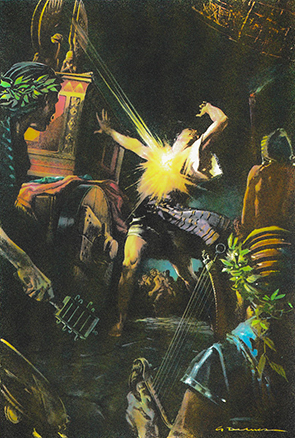
On one occasion, when King David, against divine instructions, decided to load the Ark onto a wagon for transport, a hole in the road caused the carriage to tip, and the Ark began to totter. Uzza, forgetting the prohibition against touching the Ark, reached out to steady it and died on the spot (2 Samuel 6:6-8). Apparently God killed Uzza despite his good intentions, but that’s not really it. If God forbade touching the Ark, it was not to boast to be untouchable, but to protect us humans from a sanctity so great that our bodies cannot bear it; everything that God prescribes to us is always for our good, not for his whim.
A Jew like Joseph was obviously well aware of all these things, and when he learned that his wife Mary would be the God-bearer, he would inevitably see her as the new Ark, and her womb as the holiest place in Creation. If the enormous respect for the sacred were not enough to dissuade him from any sexual intention, the great fear of not ending up like Uzza would undoubtedly do the trick.
Things are even easier to understand if we give credit to an old tradition —documented already at the beginning of the 2nd century in the Protoevangelium of James. That book says that Mary was a virgin consecrated to the Temple since her childhood. Joseph was already very old and the priests asked him to marry Mary so he would take care of her and protect her and her virginity vow. That is why 12 years later Joseph, quite old, makes his last appearance in the Bible and nothing more is said about him. But even in that case it still stands that Mary had made a vow and Joseph knew it, and that same source tells it so.
In other articles in this series we have tangentially touched on the issue of Mary’s perpetual virginity by delving into other topics, such as other implications of being the New Ark. We refer our readers to those other articles so as not to repeat more data here.

The virgin birth
Some people can easily accept that Mary remained a virgin until childbirth, as the child was not conceived by a human father. They can also accept that she remained a virgin afterward, believing it requires only the will to do so. But they struggle to accept the virgin birth itself. How could the child be born without breaking the hymen? As early as the third century we have some voices asking the same question. And yet it does not make much sense that a person who accepts the virgin conception would have trouble accepting the virgin birth. If it was God who made Mary fertile while keeping her intact, what problem is there for him in getting out of her while keeping her equally intact?

We don’t need to think of fertilization or childbirth in terms comparable to human ways. A Catholic who believes that God valued His mother’s body and soul so highly as to have her born without sin and taken up into heaven without allowing her body to see corruption should not believe that the same God would tear her body by entering or leaving her womb. God wanted her pure and whole.
This aligns with the Catholic belief that Mary had a painless birth. Even today, women can have painless deliveries with epidurals, so would God allow His mother to suffer what neither pagans nor atheists endure now? If the conception was supernatural, so was the birth. A main argument for this is that the suffering of childbirth is one of the consequences of Eve’s sin.
[
To the woman also he said: I will multiply thy sorrows, and thy conceptions: in sorrow shalt thou bring forth children (Genesis 3:16)
The problems of pregnancy and childbirth are a consequence of the Fall. Mary was created free of the original sin that we inherited from Adam and Eve, and therefore also free of its consequences. Neither discomfort in pregnancy nor pain in childbirth. And now let’s move on to the central nucleus of the prophecy of the sign by Isaiah:
[
The virgin will be with child, and she will give birth to a son, and she will name him Immanuel. (Isaiah 7:14).
Note carefully, and this is how the Christians and part of the Jews interpreted it in ancient times, that the phrase uses the term “the virgin”*, which acts as the subject for the three following actions: “she will conceive, give birth, name”. It is a virgin who must get pregnant, but it is also a virgin who has to give birth and a virgin who has to give the child a name; that means she will be a virgin before, during and after childbirth.
* Another issue is that many modern translations say "young woman" instead of "virgin", but the ambiguity of the original Hebrew word was not such for the ancient Jews, who always interpreted it as "virgin". ” and so it was reflected in the Greek translation of the Septuagint or the New Testament itself, which uses the word “parthenos” (Greek for “virgin”) to translate it. In addition, Isaiah says that God is going to give us a sign so that we know that the Messiah is coming, and certainly a virgin becoming pregnant and giving birth is a good sign to know that this is God acting, but if it were just a "young woman" conceiving and giving birth, what kind of sign would that be if it is something that happens constantly? The matter is settled because it is the Gospels themselves that, when transcribing the prophecy into Greek, say "parthenos" (virgin). So no room for comments.
Faced with this, some Protestants use a biblical quote to show that, according to the Bible, Mary did give birth in pain. It is about the Portent, the vision of Mary pregnant in heaven —which happens to be shown as the sign announced by Isaiah:
[
And a great sign appeared in heaven: A woman clothed with the sun, and the moon under her feet, and on her head a crown of twelve stars. And being with child, she cried travailing in birth, and was in pain to be delivered. (Revelation 12:1-2)

If a Protestant ever uses this argument, the first thing to say is that according to them this vision does not refer to Mary, but rather —Protestants say— this woman clothed with the sun is merely a symbol of the Church; so if they admit that this is Mary, they had better admit all the other Catholic conclusions that derive from it. In our article on The New Eve we have already addressed that subject in depth, proving that this woman (whether or not she represents the Church) is clearly Mary, and not just a symbol, and that is how the Church has always presented it. But if she is Mary, and she is, how come Revelation tells us that she cried and was in pain? We have already explained that in our article Mother of the Church. The New Testament presents Mary to us as the New Rachel, with clear equivalences that we explain there. One of them is in this very scene, since Mary is presented here to us as the mother of the Church, explicitly saying that this woman clothed with the sun is the mother of the Messiah, but also of all Christians.
[
And the dragon was angry against the woman: and went to make war with the rest of her seed: those who keep the commandments of God, and have the testimony of Jesus Christ. (Revelation12:17)
John is presenting Mary, among other roles, as the mother of the People of God. In the Old Testament, the figure that plays the role of mother of the People of God is Rachel, who suffered and wept for her children according to the biblical and extra-biblical interpretations that the Jews have. The culmination of Rachel’s sufferings is in the delivery of her second son, Benjamin, which finally caused her death. If John is presenting Mary, pregnant with the Messiah, as mother of all Christians, that is, mother of the People of God, then it is easy to see why he wants to present her as the New Rachel, so that everyone (of that time) understands it. And to show that identification with Rachel, nothing easier and more appropriate than resorting to the image of labor pains, closely associated with Rachel.

Therefore, in that scene it is not Mary who suffers from childbirth but Rachel. Mary appears powerful and in heaven, and John adorns her with a series of elements that symbolize attributes that she possesses: clothed with the sun (full of grace), above the moon (Immaculate), crowned (Queen), confronted with the primeval Serpent (the New Eve, virgin and sinless), with labor pains (the New Rachel, mother of God’s People). Neither Mary had to fight with a snake nor did she have to suffer from childbirth, these are symbols that describe her nature. But in addition, we have Isaiah as a witness:
[
Before she was in labour, she brought forth; before her time came to be delivered, she brought forth a man child. Who hath ever heard such a thing? (Isaiah 66:7-8)
This prophecy of Isaiah is considered messianic and therefore applicable to the birth of Jesus. Giving birth without pain does not imply giving birth without losing virginity, but it shows that Mary did not have a normal birth and supports the idea that Jesus came out of her womb without causing any harm to her blessed mother. Any child who loves her mother wishes they had never caused her pain, and Jesus, no exception, also had the ability to do so. If “a sword pierced Mary’s heart” (Luke 2:35) when she was older, it was not because Jesus hurt her, but because she suffered when she saw the suffering of her son.
That same evangelist tells us that Mary “gave birth to her firstborn son, wrapped him in swaddling clothes, and laid him in a manger” (Luke 2:7). If she had had a normal delivery, it is very unlikely that she would have taken care of those tasks herself right after giving birth with her husband by her side.
Till she gave birth to her son
There is a verse often used by Protestants to deny that Mary remained a virgin after Jesus was born. It appears in the angel’s announcement to Joseph.
[
After he had decided to follow this course of action, an angel of the Lord appeared to him in a dream and said, “Joseph, son of David, do not be afraid to receive Mary into your home as your wife. For this child has been conceived in her womb through the Holy Spirit. (...) When Joseph rose from sleep, he did what the angel of the Lord had commanded him. He took Mary into his home as his wife, but he did not know her until she gave birth to her firstborn son*, and he named him Jesus. (Mathew 1:20, 24-25)
* In translations it is common to put a period after "firstborn", but let's not forget that punctuation is a modern addition, it is not in the original texts, and here there is no need to include it. Also, it is common to say "whom he named Jesus", but the original Greek says "and he called his name Jesus" (and he named him Jesus), so we have changed that part of the quote to match the Greek and better understand the text.
The argument here is that if ‘he did not know her until she gave birth,’ it implies that after the birth, he did ‘know’ her in the biblical sense —much like saying, ‘don’t wake me up until 9’ implies waking up after that time. However, it is hard to believe that after 2000 years, no one in the Church would have realized what this quote implies. The original text is in Greek, and if it means what it seems to imply, Greek-speaking Eastern Christians would have noticed it long ago. However, no one has ever considered this verse a problem. Among them Origen, who in the year 235 praised the virginity of Mary with these words:
[
Mary preserved her virginity to the end, so that the body that was destined to serve the Word would not know a sexual relationship with a man, from the moment that the Holy Spirit and the strength of the Most High had descended on her as a shadow. I think it is well founded to say that Jesus has become for men the scoop of purity that consists of chastity and Mary in turn for women. It would not be good to attribute the scoop of virginity to another.

In fact, there are several Greek fathers from the first centuries that explain this detail. The form “until” in the original Greek reads “heos hou“, and there are other passages in the Bible where that same expression is used without marking a limit of change of situation. Let’s see some examples:
[
For he must reign, until he hath put all his enemies under his feet. (1 Corinthians 15:25)
Luke 1:32-33 tells us that his reign will have no end, so it is evident that after putting the enemies under his feet, there is no change of status and he will continue to reign.
[
And the waters were going and decreasing until the tenth month: for in the tenth month, the first day of the month, the tops of the mountains appeared. (Genesis 8:5)
The flood waters finally returned to their pre-flood levels, so it doesn’t make sense to think that when the first mountain peaks appeared the water stopped going down.
What’s happening here, as in the phrase referring to Joseph, is that the focus is on a specific period, and the word ‘until’ indicates that this state covers that entire time. What happens or does not happen afterward is no longer relevant to the narrative. In this case, ‘until’ doesn’t mark the end of the state, but simply the end of the period of interest. For example, with Christ, we focus on the battle of good against evil, not on what happens next. With the Flood, we focus on the time the ark sails without direction or land in sight, not on what happens once land begins to appear. The waters continue to recede, and Christ continues to reign, but these events are beyond the current narrative focus.
In the case of Joseph, Matthew is there interested in demonstrating that Isaiah’s prophecy had been fulfilled in Mary, and that implied that Mary would have to be without sexual relations at least until Jesus was born, that’s why the “until” covers all that period, but it does not say anything about whether after that time the condition continues or not, since that is no longer relevant to the narrative and by delimiting the time, Matthew manages to mark more clearly the parallelism between what happened and what was prophesied.

There are many more examples of biblical sentences that use “until” (heos hou) with this sense of continuity, but what has been said is enough to see that the quote from Matthew is not an irrefutable argument Far from it, because the sentence can be interpreted both ways. Taking into account the other evidence we have and the great consensus in Tradition from the beginning when it comes to considering Mary ever virgin, a quote that can be interpreted in two ways does not pose any challenge.
A very detailed analysis of this grammatical matter can be found in the book “Mary Among the Evangelists”, by Rev. Dr. Christiaan Kappes et al (pg 36ff). There she delves into the bowels of Greek grammar and says things as technical as this:
In fact, the story of the childhood in the Gospel of Luke is a perfect example of the imperfect [indicative] + “until” indicating a continuation of the activity of the verb that precedes “until”. Let's see this: “The boy (John the Baptist) was growing and he was getting stronger in his spirit; and he dwelt in deserted places until (heôs) the day that he manifested himself to Israel” (Luke 1:80). John always lived in deserted places. We have no reason to think that he changed his residence after becoming famous. So while the Chrysostom and Jerome examples are correct, they do not explicitly include the imperfect indicative verb + “until”. They don't really know these intricacies of Greek grammar; when an aorist active verb and other indicative verbs are used in the New Testament followed by “until the time” (when she gave birth), the action can continue.
Note that although our grammar does not work the same as the Greek, we can also use "until" to indicate an action that continues beyond the moment that interests us. For example: "I didn't like the party, it was a pain from the time I got there until I left." Of course I am here only interested in my experience of the party, since the moment I arrived till the moment I left, but in no way am I implying that I was the cause of the party being a pain or suggesting that before I arrived everyone was having a good time, and after I left everyone went back to having a good time. In fact what I am implicitly saying is that the party was ALWAYS a pain, before, during and after our stay, but in our story we are interested in talking only about the time that we were there, the rest of the time is of no interest.
Anyway, this shows that everything is clearer than it seems if we analyze the quote according to the subtleties of Greek grammar, although it is not so easy to see when the things we are dealing with are simply translations into our own languages. That is why when one tries to discover new meanings in a Bible written in Spanish, English or Czech, one can easily make big mistakes for the simple reason of not working with the original language. A translation is always, to a greater or lesser extent, a betrayal.

However, that same quote from Matthew informs that after listening to the angel, Joseph obeyed him and received Mary, his wife, in his house. That means, as we have said, that they went from kiddushih (“engaged”) to nissuin (“married”), and on the first day of “married” sexual relations began, if they had not started during the engagement. But it is clear that Joseph did not touch Mary despite starting to live together, since Matthew has told us that he “did not know her until she gave birth” (assuming as we have proven that after that he did not know her either). The instructions that Joseph receives from the angel are as follows:
[
«Joseph, son of David, fear not to take unto thee Mary thy wife, for that which is conceived in her, is of the Holy Ghost. And she shall bring forth a son: and thou shalt call his name Jesus. For he shall save his people from their sins». (Matthew 1:20-21)
To which we are told that “Joseph rising up from sleep, did as the angel of the Lord had commanded him” and took Mary into his home as his wife. However the angel did not command him not to have relations with Mary, there is not even a hint. Joseph could have taken Mary (already pregnant) home and at any time have normal sexual relations. There is no prohibition on them from Heaven asking them not to have relationships, it is rather their decision. The logical explanation would be what was said, that Mary had a perpetual vow of chastity and Joseph had not canceled it the day he was informed of it, so both were in a vow of chastity and the angel did not need to deal with the issue. In addition to the other considerations that we have discussed (see Uzza).
In this way, that same phrase “but he did not know her until she gave birth to her firstborn son” not only does not oppose the virginity of Mary but is one more argument in its favor. If the only thing the evangelist wanted was to say that Joseph was not the real father of the child, it would suffice to make it clear that Mary was a virgin until the moment of conception, or until after delivery if he wanted to demonstrate the fulfillment of the prophecy. But if we talk about the holiness of Mary, that she consecrated her body totally to God without reservation, then not having sexual relations is indeed an important matter.
In the early Church
Ultimately, it is best to consult those who have the most knowledge —the first Christians who were closest to the original sources of information. What did they believe about Mary’s virginity?
The “Protoevangelium of James” was written around the year 120, placing it very close to the time when Mary lived. It may contain a significant amount of authentic information that was still in circulation at the time, and it also helps us gauge the beliefs of early Christians. The large number of preserved copies in various ancient languages attests to its wide acceptance. This book, which focuses on the childhood of the Virgin Mary and the birth of Jesus, primarily aims to demonstrate Mary’s perpetual virginity, highlighting the importance that the second generation of Christians placed on Mary.
In this book, we learn about Mary’s parents, Saint Joachim and Saint Anne, who dedicated Mary to the Temple from a very young age. The practice of dedicating women to Temple service dates back to ancient times (Cf 1 Samuel 2:22). For example, Hannah dedicated Samuel to the Temple as soon as she weaned him (1 Samuel 1:20-24). This dedication likely led to Mary taking a vow of perpetual chastity, similar to Samuel’s. The book also explains that the priests selected a just and elderly widower to marry her and serve as her protector, thereby respecting her vow.

Much of what this book states may be historically authentic, even though it is not considered an inspired text and certainly contains a lot of legend. In chapters 19 and 20, we are told how a midwife witnessed Mary’s virgin birth. While this account is presented in a legendary form, it demonstrates that the belief in the virgin birth was widespread even at such early dates. Additionally, it supports the idea that Mary did not have other children besides Jesus, as the existence of Mary’s grandchildren at that time would have been well-known, undermining the book’s credibility.
Shortly after, in the second half of the second century, Saint Irenaeus’s statements about Mary’s virginity set the pattern for what the apostolic fathers generally believed. They all referred to Mary as the Virgin, though usually in a general sense, without explicitly indicating whether this applied to her entire life —though it often seems that it did:
[
Correspondingly, we also find the Virgin Mary obedient when she says: "Behold the handmaid of the Lord; be it done to me according to thy word". To Eve, on the other hand, indocile, since she disobeyed while she was still a virgin. ... Having disobeyed, she became the cause of death for herself and for all humanity; so also Mary, having a man as her husband but being a virgin like her, having obeyed she became a cause of salvation for herself and for all humanity.
(“Against the heretics”, fragments of the 3rd century, year 180)
It will be years later, already at the end of the second century, when Tertullian explicitly denies that Mary was a virgin during or after childbirth, but in saying so he does not resort to the weight of the received Tradition, but to his own conclusion when meditating on the following biblical verse :
[
… they carried him to Jerusalem, to present him to the Lord, as it is written in the law of the Lord: Every firstborn male shall be consacrated to the Lord... (Lucas 2:22-23)
In the original Greek it does not say “every first-born male” but literally “every male who opens the womb” (the womb being “open” forever, that is). Therefore, Tertullian thought, this means that Jesus “opened her mother’s womb” and that is why at the time of delivery she had to stop being a virgin (regardless of what she did or did not do afterwards).
The expression ‘opening a womb’ has nothing to do with virginity, but anyway, we think this reasoning is weak for another reason. In Exodus 13:11-16 God establishes that every firstborn male of people or animals belongs to him, so they must be offered to God in sacrifice. But in the case of human firstborns, they will be ransomed by offering an animal sacrifice in their place. That is, the child belongs to God but you can (have to) offer a substitute sacrifice and thus rescue him to leave him alive. If we want to take those passages to their logical conclusion, as Tertullian seems to be doing on this matter, we would have to work out the full logic and see that if Jesus “opened his mother’s womb” like any other firstborn, it must equally be true that Jesus, with the sacrifice of the two turtledoves, was rescued like any other firstborn. But Jesus was never rescued, he always belonged to the Father, and in fact in his case the two turtledoves did not work as a substitutionary sacrifice because finally Jesus had to offer himself as a sacrifice and only then return to the Father, to whom he belonged.
But the very fact that we have this claim by Tertullian trying to contradict conventional lore is proof that the conventional belief in such early times unanimously accepted the virgin birth.
It is a clear example that when we start our own collection of doctrines by analyzing biblical verses our way, we have to be very careful lest we end up inventing human doctrines, that is why this type of speculations may be fine as long as one remains firmly within the limits of what Tradition has transmitted to us. In other words, Tertullian fell here into the Protestant error of Sola Scriptura, something that we have not seen him do on other subjects. The thing is that if Joseph presented the turtledoves in the Temple to “rescue” his firstborn, it was not because that child had opened his mother’s womb or not, but simply because God wanted Jesus to comply in everything with the religious precepts and customs of any other Jewish child, not because it made any sense in his case. Likewise, Joseph went to the Temple every year to present a sacrifice for his sins and those of his entire family, as everyone else did; even Jesus joined that pilgrimage from 12 on, and not because of that can we infer that his wife Mary and his “son” Jesus were both sinners. Same with Jesus’ baptism.

For all these reasons, Tertullian’s inference, the first argument against the perpetual virginity of Mary, is completely refuted. However, the result is that from this point onward, Mary’s virginity became a subject of debate. As some opposing views emerged, many more opinions explicitly in favor also appeared, and the idea gradually gained official status until it became dogma and the debate ended. This is what always happens with doctrines, while everyone accepts them they are taken for granted and do not receive much attention at an official level, but if they begin to be attacked, defenses arise until they are finally dogmatized and that’s it.
That is why, in the following century, the 3rd, we find more writings explicitly developing the idea that Mary was a virgin not only until childbirth but throughout her life. Hippolytus of Rome called her ‘the ever-virgin,’ and, following her example, he promoted monastic celibacy as the ideal Christian state. Origen, at the beginning of the century, was also a strong advocate of Mary’s virginity as a supreme virtue. He wrote things like that quote already seen above in which he says: “Mary preserved her virginity to the end, so that the body that was destined to serve the Word would not know a sexual relationship with a man…” .
The reasoning is straightforward: the chalice of the Eucharist is an object consecrated to God and can no longer be used for anything else. Its contact with the Eucharistic wine excludes it from all profane use; for example, a priest could never take it home and use it as a cup for drinking wine at dinner. Similarly, Mary’s womb, which contained God for 9 months, could not be used for anything else after Christ was born, as it was forever consecrated to God and only to God.
In the fourth century, Saint Jerome stands out writing “The Perpetual Virginity of Mary” where he defends that this doctrine was already taught by the apostolic fathers, and quotes Ignatius, Polycarp, Irenaeus, Justin etc. In that same book he wrote:
[
I was requested by certain of the brethren not long ago to reply to a pamphlet written by one Helvidius. I have deferred doing so, not because it is a difficult matter to maintain the truth and refute an ignorant boor who has scarse known the first glimmer of learning, but because I was afraid my reply might make him appear worth defeating.
Saint Athanasius also called her “the ever virgin Mary” in his “Discourse against the Arians”, as did Saint Epiphanius and others. Saint Ephrem also strongly opposed those who questioned perpetual virginity:
[
How could it have been possible that she who was indwelled by the Spirit, who was covered with the shadow of the power of God, became a woman of a mortal and gave birth in pain, according to the first curse? (...) A woman who gives birth in pain could not be called blessed. The Lord who entered with the doors closed*, came out of the virginal womb in the same way, because this virgin really gave birth but without pain.
(Ephrem the Syrian, Diatessaron 2,6: SC 121,69-70, 14th c.)
* a reference to the time when the risen Jesus appears to his disciples, who were locked in the upper room, behind closed doors.

More contentious was the issue of virginity during childbirth. In 390 Saint Ambrose, Bishop of Milan, held a synod in which it was established that the perpetual virginity of Mary (before, during and after childbirth) was the orthodox position, a point that would progressively acquire dogmatic force in the Councils of Ephesus (431) and Constantinople II (553), where she is officially declared “the ever-virgin”.
Saint Augustine (centuries 4-5) said that the birth of Jesus was like light passing through glass, he did not cause pain or rupture. He talked about the virginity of Mary in many other occasions. Let us quote just a few:
[
By being born of a Virgin who chose to remain a virgin even before knowing who was going to be born of her, Christ wanted to approve virginity instead of imposing it. And he wanted virginity to be freely chosen even in that woman in whom he took for himself the form of a slave.
(Holy Virginity, 4.4 – 401 A.D.)
[
Heretics called Antidicomarites are those who contradict the perpetual virginity of Mary and affirm that after Christ was born she was united with her husband as one.
(Augustine of Hippo, Heresies 56 – 428 A.D.)
[
She had vowed to keep her virginity, and her husband was the guardian of her modesty rather than destroyer of it; better, he was not a guardian, since this was left to God, but a witness of her virginal modesty, so that her pregnancy would not be attributed to adultery. When the angel gave him the announcement, he said: How can this be, if I don't know a man? If she had intended to "know" him, she would not have been surprised. Such strangeness is proof of her decision.
(Augustine of Hippo, Sermon 225: The Incarnate Word, c. 400)
[
Who will be able to understand this news, unheard of, unique in the world, incredible novelty, but made credible, and incredibly believed throughout the world, namely, that a virgin conceives and a virgin gives birth and remains a virgin? What human reason does not understand, faith perceives, and where human reason fails, faith makes progress.
(Augustine of Hippo, Sermon 190: In Natali Domini VII ch. 1, c. year 391)
[
She was a virgin when she conceived, a virgin when she gave birth, a virgin during pregnancy, a virgin after childbirth, always a virgin. Why does this amaze you, oh man? Once God deigned to be a man, he agreed that he should be born that way.
(Augustine of Hippo, Sermon 186: The birth of the Lord, year 400)
[
Indeed, after his resurrection, to those who believed that he was a spirit, and not a body, he said: Touch and see, for a spirit does not have flesh and bones, as you see that I have. And yet, the solidity of that body of a mature man entered the presence of the disciples without the doors being open. If, then, he who, being great, was able to enter through closed doors, why couldn't he likewise go out, when he was little, through upright members? But the unbelievers do not want to believe either one thing or the other. One more reason for faith to believe both, that unbelief does not. This precisely characterizes incredulity: the opinion that Christ has nothing to do with divinity. But faith, believing that God was born in the flesh, has no doubt that both things are possible for God, namely, that the body of an elderly person should appear before those who were inside the house without being seen. doors were opened for him and the husband-child came out of his nuptial bed, that is, from the virgin's womb, keeping the mother's virginity intact.
(Augustine of Hippo, Sermon 191: The birth of the Lord, year 411)
St. Augustine also directs our attention to this quote from Ezekiel:
[
This gate shall be shut, it shall not be opened, and no man shall pass through it: because the Lord the God of Israel hath entered in by it, and it shall be shut. (Ezekiel 44:2)
It is about the vision that the prophet had of the Temple of God. Mary was the temple of God and for this reason this same concept can be applied to her, since the idea is that when a place has been inhabited by God, its sacredness is so great that no man can desecrate the place. This same idea has been used many times before and after St. Augustine, that Mary’s womb was made so sacred that any human intrusion would amount to desecration. The Ark (chest) that has contained God himself cannot later be used to store kitchen dishes.

Also Saint Augustine shows that since the first centuries Christians were aware of the implications of Mary’s response to the angel, and for this reason he comments:
[
"You are a virgin, you are holy, you have made a vow", "This is what her words indicate with which Mary replied to the angel, who announced that she would conceive in her womb: «How -she says- will this happen, if I do not know a man?», words that she certainly would not have pronounced if she had not previously consecrated her virginity to God.”
(Saint Augustine, Sermons on the Birth of Saint John the Baptist, 291:6 and The Holy Virginity, 4:4)
And in this very small sample of how much the first parents wrote about the virginity of Mary, we can also see one thing clearly: everything has already been said. No matter how many scholars, theologians and research we have today, it is very difficult for someone to come up with an argument in favor of the truths of our faith that has not already been expressed at some point by the fathers of the Church. Sometimes we now believe we have found a really witty idea, until we see it already written in some text from those first five centuries that lay the foundations of all the doctrines of our Catholic faith.
Conclusion
No Christian who accepts the truth of the Bible can doubt that Mary was a virgin until the birth of Jesus. The discussion is whether she remained a virgin also during and after the birth and forever, because that is not explicitly stated in the Bible. But that discussion is a mostly recent debate, which was not relevant until the Protestant Rupture and even so the contrary position was quite minority and even anecdotal until more modern times.
Although the Bible does not explicitly tell us anything about whether or not Mary remained a virgin forever, we have seen here part of the many biblical testimonies that serve to support this position. We have also dismantled the main arguments that opponents offer.
But in the end, as usually happens, the field where doubts are resolved and the truth is clearly imposed without confusion or distortion, is a field in which Protestants do not want to enter, so they are left with their human speculations forever delving deeper and deeper into the biblical texts, locked in a labyrinth of ideas that will always be provisional, questionable and redefinable. Catholics, thank God, can enter into that clear field, which is Tradition, also hand in hand with the Magisterium, whose authority clears up all doubts and ends all discussions. The Church has always defended the perpetual virginity of Mary, and from the first apostolic fathers to the present, it is a received teaching that admits no contradiction.

And with this article we put an end to the series of articles on Mary in the Bible. Each article focuses primarily on a particular topic, but inevitably almost all touch on parts of other topics as well. Together they all try to prove, without exhausting the issue, that everything the Church teaches about Mary has solid foundations both in the Bible and in Tradition.

[Click on the banner to access the index of the complete series]



 Apologia 2.1 in English
Leave a reply to الكلدانية Cancel reply