
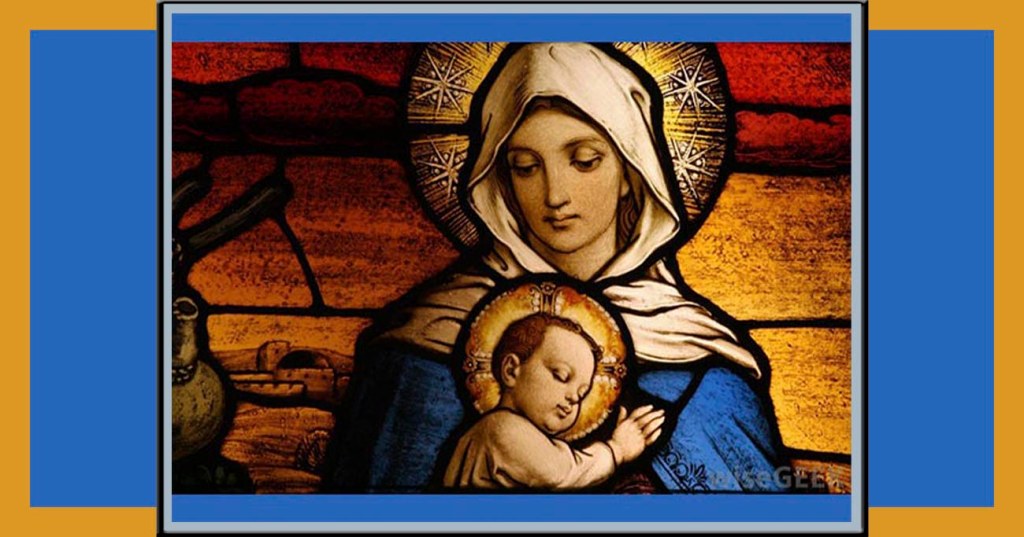

Let’s talk about Mary, who she really was, and what the early Christians thought of her in the 1st to 3rd centuries.
Some Protestants argue that Catholic veneration of the Virgin Mary and the saints is a later development, influenced by pagan practices and originating in the Middle Ages or the Council of Nicaea. They often ask, ‘Where is that in the Bible?’ While Christianity has been handed down through both Sacred Scripture and oral Tradition, safeguarded by the Church, we recognize that Protestants typically focus on what is explicitly written in the Bible. For this reason, we will also turn to the Scriptures to explore the foundations and traces of this doctrine within them.
Notice: This article is a (human) English translation from our original Spanish site. Expect links marked in yellow, if any, to open articles in Spanish at the moment.
The veneration of the saints and of Mary are two aspects of the same phenomenon, not two separate things. Mary is venerated because she is the holiest of all human beings; her veneration (hyperdulia) is, therefore, an elevated form of the veneration given to the saints (dulia), which is distinct from adoration (latria), reserved for God alone. Thus, both types of veneration are rooted in the belief in the Communion of Saints. However, that is not the focus of this article. Instead, we will examine whether Constantine was the cause of this veneration or if it already existed before him. Let us explore what the Bible and the early Church reveal on this topic, prior to the Council of Nicaea (AD 325).
To understand Mary’s role in Christian devotion, it is essential to grasp the concept of the Communion of Saints and the roots of this belief in both the Bible and the early Church. Only then can we comprehend why Catholic and Orthodox Christians believe in the intercession of the saints and Mary. However, we have already analyzed this in the first part of this article, so if you have not read it yet, it would be a good idea to start there: (automatic translation of The Veneration of the Virgin and the Saints (Part 1).)
About Mary

The Virgin, as the holiest of all creatures, receives a special form of veneration and is also the object of pilgrimages. The veneration of Mary follows the same framework and logic as the veneration of other saints, but she has always been regarded as far above the rest because she was the vessel of the Incarnation of Jesus. The Bible itself provides arguments to support the idea that Mary deserves a higher degree of veneration, although it remains essentially of the same kind.
– In the angel Gabriel’s greeting, he calls her “full of grace” (Luke 1:28).
– Her cousin Elizabeth praises her, saying, “Blessed are you among women, and blessed is the fruit of your womb! […] And why is this granted to me, that the mother of my Lord should come to me?” (Luke 1:42 ff).
– Mary herself, filled with joy, prophesies: “Behold, from now on all generations will call me blessed, for the Almighty has done great things for me” (Luke 1:48-49).
– Mary was also with the apostles at the moment the Church was born through the illumination of the Holy Spirit at Pentecost (Acts 1:12-14 and Acts 2:1), thus being, along with the apostles, part of the foundation upon which the Church is built. She was present with Jesus at key moments: His birth, the beginning of His ministry, His death and resurrection, and even in the Book of Revelation when Jesus returns triumphantly.
It is not, therefore, necessary to invent a pagan influence to explain the great veneration for Mary. If the early Christians venerated the saints, how could they not venerate even more the holy mother who bore God in her womb and raised Him? The explanation offered by her detractors is either that Constantine introduced her cult at Nicaea (which is historically false, as Mary was not a topic of discussion at that council) or that the mass conversions of the time led many Christianized pagans to retain their old worship of mother goddesses and transfer that devotion to Mary.

To compare Mary with the mother goddesses of antiquity is to completely misunderstand her. Mary could not replace Isis, Astarte, or Diana in that role because her role was, in fact, the opposite. The mother goddesses were an evolution of the original Mother Goddess, a personification of the earth as a source of fertility and the origin of all life. Mary, however, was not a symbol of fertility but of virginity. She owed her grace to being the Mother of God, not for having engendered God or created the world, and she is light-years away from the sexual rites associated with pagan mother goddesses.
If the only thing transferred to Mary was affection for a maternal figure, it would be easier to explain the phenomenon by referring to the love people felt for their own mothers rather than devotion to a pagan goddess. However, this argument would be just as problematic for a Protestant as for a Catholic. An atheist would quickly assert that, yes, in Mary we sublimate our love for our mother and, similarly, in God we sublimate our love for our father. They would argue that both figures are merely products of human psychology when it fails to completely overcome the infantile phase and still needs to cling to paternal and maternal figures. If one believes this does not happen with their idea of God the Father, then why accuse others of exactly that with their idea of Mary as Mother?
We believe in God because He exists, not because we wish to invent an eternal Father. Likewise, we believe that Mary, through her motherhood, was not only the mother of Jesus but also of all of us, who are His brothers and sisters. This is attested by Jesus on the cross, with His final breath, through John (John 19:26-30). If we feel a special affection for Mary, it is not due to psychological needs but because Mary deserves it. Is it really so strange to venerate the mother of Jesus, the mother of God?
The likely reason most Protestants (though not all) completely disregard Mary is their rejection of what they consider to be Catholic idolatry. This rejection prevents them from approaching her even a little. It is a paradox that they seem to hold more respect and admiration for Jesus’ apostles than for His own mother, despite the fact that the praises directed to her in Scripture have no parallel.
Therefore, as they need to discredit the Catholic idea that venerating Mary is correct, many once again use the convenient excuse of paganization supposedly introduced at the Council of Nicaea to lump Marian doctrines into this claim, asserting that Constantine invented them. However, we can prove that this is not true because we have numerous testimonies showing that, before Constantine, Christians already rendered Mary a veneration not only equal to but greater than that given to other saints. Let us look at some examples.
“Dialogue with Trypho the Jew” (around the year 150), by the martyr and apologist St. Justin Martyr, is the first preserved text where Mary is presented as the new Eve (just as Jesus is the new Adam). If sin came to us through one virgin, salvation came to us through another virgin thanks to Jesus. If the first Eve did the will of Satan, the new Eve did the will of God.
This doctrine of the new Eve is fundamental for understanding the development of subsequent Marian doctrine.
[
“We understand that He [Christ] became man through the Virgin, so that the disobedience caused by the serpent would end by the same path through which it began. For Eve, a virgin and undefiled, having conceived the word of the serpent, brought forth disobedience and death; whereas the Virgin Mary, having conceived faith and joy […] responded: ‘Let it be done to me according to your word.’”
(St. Justin Martyr, Dialogue with Trypho)

Saint Irenaeus (also in the 2nd century), who was a disciple of Saint Polycarp, himself a disciple of the Apostle Saint John, also presents to us the doctrine of the New Eve and considers Mary our most eminent advocate, that is, the principal intercessor between Jesus and mankind (while Jesus, as Saint Paul rightly declares, is the only mediator between mankind and God the Father).
[
Eve showed herself disobedient: she disobeyed while she was still a virgin. Just as Eve, the wife of Adam but still a virgin […] disobeyed, and thus brought death upon herself and upon the whole human race, so Mary, betrothed but a virgin, by obeying, obtained salvation for herself and for the whole human race* [*not by herself, but by bringing forth Jesus]. […] In the same way, the knot formed by Eve’s disobedience could only be untied by Mary’s obedience. What the virgin Eve bound through her unbelief, the virgin Mary loosed through her faith. (Saint Irenaeus, Adversus Haereses)
The fact that two of the early Church Fathers speak of Mary as the new Eve demonstrates that this idea was already widespread by the mid-2nd century. Therefore, it must be an older doctrine and very likely originates with Saint John the Evangelist, as it is in his writings that we most easily find justification for this association. Let us not forget that few texts have survived from the underground Church of the 1st and 2nd centuries. Thus, when we see an idea appear for the first time in a text, it does not mean that it is in that text where it first took shape. Rather, the idea was probably already widespread and may have even appeared in earlier texts that, unfortunately, have not been preserved.
The Protoevangelium of James

Thus, we see that as soon as Christian apologetics began to develop, the figure of Mary was already presented as an element of the utmost importance. But even from the 2nd century, we already have some examples of popular devotion in images and writings. A proof that the figure of Mary was already significant is that, due to the little information provided about her in the Gospels, an apocryphal gospel soon appeared to fill that void by giving us additional details about the Virgin. Scholars date it to around the year 150, and the first reference to it is found in the early 3rd century, cited by Origen, who also argued that every man who resembles Christ becomes a son of Mary and referred to her as Theotokos (Mother of God).
This Protoevangelium, according to scholars, is based on oral traditions that still endured but also on the imagination of its author. What matters for us now is not distinguishing what might be historical and what might be invented, but the very fact that the Christian community felt the need to know much more about Mary. Additionally, this Protoevangelium, even if it invents elements freely, presents a story of Mary that was credible to Christians of that time. In other words, the image of Mary given by this gospel reflects what Christians in the first half of the 2nd century thought about the Virgin. For this reason, it is so valuable to us for understanding how Mary was regarded in the popular devotion of the early Christians.
If the image of Mary presented by this book had been innovative, according to the mindset of Christians at the time, it would have been immediately declared a dangerous heresy. Yet we see the opposite: the claims of this apocryphal gospel not only faced no opposition but were enthusiastically received. This proves that such a vision of Mary fit comfortably within the established orthodoxy. The fact that this gospel about Mary aroused enormous interest in its time is demonstrated by the unusual number of ancient copies that have been preserved. In Greek alone, we have 140 manuscripts, but there are also copies of translations into Syriac, Ethiopic, Coptic, Georgian, Old Slavonic, Armenian, Arabic, Irish, and Latin.
It is undeniable that Christians from all churches had a great interest in learning more about a figure they considered fundamental to their faith. In this Protoevangelium, Mary is already portrayed in a way very much in line with current Catholic theology: Mary is completely pure and a virgin before, during, and after childbirth, and she is presented as a model of holiness.
Council of Ephesus

Those who claim that Mary was declared the Mother of God at the Council of Nicaea (AD 325) under Constantine’s influence do so out of ignorance, as it seems to have become fashionable in some circles to attribute all Catholic doctrines rejected by Protestants to Nicaea and Constantine. In reality, it was at the Council of Ephesus (AD 431). However, to say that it was at this council that it was “decided” that Mary is the Mother of God is also a mistake.
Councils were not parliamentary meetings where bishops decided to create new doctrines. They were simply gatherings aimed at clarifying a doctrinal point that had begun to be questioned by some new heresy. The purpose of declaring a dogma was not to create a new doctrine, but to defend a doctrine that had always existed against a novel attack.
At the conclusion of the council, Saint Cyril made the following declaration:
[
We greet you, O Mary, Mother of God, true treasure of the whole universe, torch that will never be extinguished, temple that will never be destroyed, refuge for all the forsaken, through whom He who is blessed forever has come into the world. Through you, the Trinity has received greater glory on earth; through you, the Cross has brought us salvation; through you, the heavens rejoice with trembling and the demons are put to flight; the enemy of souls is cast into the abyss, and we, weak creatures, are raised to a place of honor.
In reality, the problem that this council sought to resolve was not about the nature of Mary, but once again about the nature of Jesus. A theory began to emerge in the East, claiming that Jesus had two natures, divine and human, but that these were entirely separate and independent, “like a man putting on a garment.” This theory went largely unnoticed until Nestorius was appointed Patriarch of Constantinople. At the beginning of the 5th century, he was called to intervene in a conflict caused by a monk who denied that Mary was the Mother of God.
Nestorius’ explanation was doubly heretical. Not only did he agree with the monk, but his explanation also rejected the idea that in Jesus there are two natures but one single person. Nestorius argued that Mary was only the mother of Jesus’ human nature and not of His divine nature, meaning she was Christotokos (Mother of Christ), but not Theotokos (Mother of God).
Faced with accusations of heterodoxy, Nestorius, Patriarch of Constantinople, appealed to the judgment of Pope Celestine I. In response, Cyril, Patriarch of Alexandria, also appealed to the pope, who sided with Cyril and granted him the authority to declare Nestorianism heretical. However, the situation became more complicated. Cyril anathematized Nestorius with arguments that were not entirely clear, and in the end, the conflict escalated further.
Nestorius turned to the emperor, who decided that the best solution would be to convene an ecumenical council where the bishops could carefully study the matter. The pope approved this decision, sent delegates, and the council began on June 22, 431, in the city of Ephesus. This is the main text of the council’s decision:

[
Therefore, we do not say that the nature of the Word, transformed, became flesh; nor that it was transmuted into the whole man, composed of soul and body. Rather, we affirm that the Word, having united to Himself, according to hypostasis or person, the flesh animated by a rational soul, became man in an ineffable and incomprehensible manner and was called the Son of Man—not by mere will or favor, nor by the mere assumption of a person alone. The natures that come together in true unity remain distinct, but from both results one Christ and Son—not as though the difference of the natures is destroyed by the union, but because divinity and humanity constitute for us one Lord, Christ, and Son through an ineffable and mysterious concurrence into unity.

For He was not first an ordinary man, born of the holy Virgin, upon whom then the Word descended; rather, united from the womb of His mother, He is said to have undergone a carnal birth, as One who made the birth of His own flesh His own. In this way [the Holy Fathers] did not hesitate to call the holy Virgin Mother of God [Theotokos].
Thus, the origin of the problem was not Mary but the correct understanding of the nature of Jesus. The council reaffirmed that Jesus was one person, not divided into two independent natures, and as a logical consequence, it was also proclaimed that His mother necessarily had to be the mother of both natures, since division was impossible. Thus, she was officially reaffirmed as Theotokos (= the one who gives birth to God). In other words, Ephesus confirmed that what the majority of Christians believed about Jesus and Mary was the true orthodoxy, and they declared Nestorius and his followers heretics for attempting to change it.
Further proof that this belief about Mary was held by the entire Christian people is found in the descriptions of the reaction of the crowd when they were told that Mary had been confirmed as Theotokos. Saint Cyril, a participant in the council, recounts the popular reaction of the masses, who had gathered from many places and camped around Ephesus, eagerly awaiting the outcome:
[
“One cannot imagine the joy of these fervent people when they learned that the Council had declared that Mary is indeed the Mother of God and that those who do not accept this truth are outside the Church. The entire population remained from dawn until nightfall near the Church of the Mother of God, where we, the 200 bishops of the world, were gathered. When they heard the Council's declaration, they began to shout and sing, and, with torches lit, they accompanied us to our homes, burning incense along the way. Let us praise with our hymns Mary, the Mother of God, and her Son Jesus Christ, to whom be all honor and glory forever and ever.”
But we are already moving into later times. The testimonies of Marian veneration from the 4th and 5th centuries onward are overwhelming, but we are more interested in the origins, despite the limited documentation. So, let us return to the 2nd century, since from the 1st century we have hardly any writings or testimonies beyond the Gospels and a few other sources.
In the catacombs

In the art of the catacombs, specifically in the Catacomb of Saint Priscilla, we find the earliest preserved depiction of Mary—from the second half of the 2nd century—apparently already disregarding the Old Testament prohibition against making images (something we will discuss at length in this other article (automatic translation)).
However, this is not merely a simple image of Mary or a biblical narrative scene; it is the representation of a message. She is shown nursing Jesus, and as a result, the center of attention is more on her than on the child. The child is not a mere “complement” to Mary; instead, He turns His face and glances at the viewer, making Himself present and thereby endowing Mary with the significance derived from being His Mother—the one who nursed Him.
Above her head, there is a star, and to her right, a man, identified as the prophet Balaam, points to the star with his index finger. The man wears a philosopher’s toga, which was the conventional way in catacomb art to depict biblical prophets (by association of ideas). This scene alludes to the following biblical prophecy:
[
“I see him, but not now; I behold him, but not near: a star shall come out of Jacob, and a scepter shall rise out of Israel.” (Numbers 24:17)
This is one of the messianic prophecies and, therefore, it refers to Jesus, not to Mary. However, the way the scene is depicted, with Mary as the central figure nursing Jesus, indicates that she is the one who brought this foretold star to Israel. She was the one who made the arrival of the Messiah possible through her “yes”, and thus her role in the history of salvation is central, second only to that of Jesus and certainly above that of the apostles or any other saint.
If the intention had simply been to represent that Jesus fulfilled the prophecy, instead of depicting Him as a small child on His mother’s lap, almost turned away, they would have shown Jesus standing or enthroned, facing the viewer, with the star shining above His head. In that case, Mary would have been a distracting element, omitted from the scene. But that is not what we see.
Here, all the glory of the prophecy is directed toward her role in it as the Mother of that promised Messiah. This representation, rich in symbolic language, presents Mary as Theotokos (Mother of God). While this is the oldest preserved depiction, many others like it follow.

In the house of Mary in Nazareth

Another example from around the same period is found beneath the present-day Basilica of the Annunciation in Nazareth, built over the house where Mary lived (the basement of the original dwelling is still preserved). Archaeology has disproved claims that Nazareth did not exist at the time of Jesus and, therefore, that Mary could not have lived there. Jewish texts from the period also mention Nazareth as the destination of a family of priests expelled from Jerusalem after the city’s destruction in AD 70.
It is worth recalling that it is the Bible itself that tells us this is where the angel appeared to Mary:
[
“In the sixth month, the angel Gabriel was sent from God to a town in Galilee called Nazareth, to a virgin betrothed to a man named Joseph, of the house of David. The virgin’s name was Mary.” (Luke 1:26-27)
Excavations beneath the present-day basilica and its surroundings revealed the remains of several churches built one atop another. Among these remains, archaeologists identified a structure interpreted as a Judeo-Christian place of worship, possibly serving as a center of pilgrimage by the 2nd century, with some graffiti on its walls that might date back to the late 1st or early 2nd century. Over time, this site saw the construction of a series of churches: a subsequent church, then a Byzantine basilica (5th century), followed by a Crusader church (12th century), a Franciscan church (18th century), and finally the current basilica built in 1969.

In the graffiti from the church-synagogue, we find inscriptions in various languages, such as: “In the holy place of Mary…” (possibly written in the late 2nd or early 3rd century), “Hagia Maria” (“Holy Mary”), and one in Greek that simply reads “Xe Mapia” (pronounced /heh mah-REE-ah/), an abbreviation of Χαῖρε Μαρία (“Hail Mary!”). Additionally, a subterranean grotto used as a chapel was uncovered, complete with an altar, more graffiti, and five successive layers of plaster on the walls. A coin from Constantine’s era was found in the third layer, confirming that the earliest layer likely dates to the 2nd or early 3rd century, demonstrating the long-standing use of the site.
This evidence strongly suggests that, even before Constantine’s time —possibly as early as the 2nd century— Christians were already venerating the house of Mary as a holy site. Furthermore, the fact that the early local community built a place of worship there, including a baptistery, underscores the site’s origins within a Judeo-Christian community. This view is largely based on the work of Bellarmino Bagatti, a Franciscan archaeologist renowned for his extensive excavations and studies of early Christian Nazareth. According to Bagatti, this community retained its Jewish character well into the Byzantine period, as evidenced by inscriptions in Greek and Aramaic, the absence of pagan symbols, and the continuity of worship, with no clear pagan influences that could explain such early Marian devotion.
Mary, Mother of God

We have already seen in the scene of the Visitation how Saint Elizabeth refers to her cousin as “the mother of my Lord.” In the New Testament, “Lord” means “God”, and even Protestants accept this, which is why the divinity of Jesus is frequently affirmed whenever He is called “Lord.”
To make this even clearer, we can observe that the version of the Old Testament used and quoted by the evangelists (the Septuagint or Bible of the Seventy) systematically replaces the name of God with the word “Kyrios” (= Lord). Therefore, the biblical phrase “ἡ μήτηρ τοῦ Κυρίου μου” (hē mētēr tou kyriou mou), or “the mother of my Lord,” literally means “the Mother of God” in New Testament Greek.
On several occasions, Mary is called “the mother of Jesus” or Jesus is referred to as “the son of Mary.” In response, some Protestants argue that Mary was, indeed, the mother of Jesus, but not of God—that is, she was the mother of Jesus’ human nature, but not of His divine nature. Similarly, they interpret the expression “mother of my Lord,” used by Saint Elizabeth, as referring to Jesus in His human identity, not to God.
However, this leads us into a contradiction. If we separate Jesus’ human and divine natures, as Nestorius did, then He would be “Lord” only in His divine nature, and in His human nature He would be merely another man—that is, not Lord. But even in that case, Saint Elizabeth’s expression would explicitly refer to the divine nature of Jesus, thereby declaring that Mary is the mother of His divine nature—that is, the Mother of God. This brings us back to the same conclusion and, in doing so, those Protestants would inadvertently fall into an even greater heresy than the one they supposedly aim to avoid.
But regarding the meaning of the expression “mother of Jesus,” we cannot say that it refers only to the human part of Jesus. The fact is that distinguishing in Jesus two separate and differentiable natures, one human and one divine, is, as we have seen, an ancient heresy that was addressed at the Council of Chalcedon (AD 451).
With the exception of some evangelical churches, neither Catholics nor Protestants accept the idea of two separated natures in Jesus. The Chalcedonian Creed, which is also accepted by many Protestants, affirms that Jesus is “truly God and truly man” without division of natures:
[
“…begotten of the Father before all ages according to the divinity, and in the last days, for us and for our salvation, born of the Virgin Mary, Mother of God*, according to the humanity; to be acknowledged as one and the same Christ, the Son, the Only-begotten, in two natures, without confusion, without change, without division, without separation, in no way abolished by the union of the natures, but rather with each nature being preserved and concurring in one person and one hypostasis; not parted or divided into two persons, but one and the same Son, the Only-begotten, God the Word, the Lord Jesus Christ, as the prophets of old have taught concerning Him, and as Jesus Christ Himself has taught us, and as the Creed of the Fathers has handed down to us.”
(Fragment from the declaration of the Council of Chalcedon, AD 451.)
(*It is funny how in many Protestant books this phrase “Mother of God” is omitted.)
If it states that He was begotten by Mary “according to the humanity” and by the Father “according to the divinity,” it does so to avoid the thought that Mary generated the Son, for the Son is preexistent, equal to the Father. However, this does not mean that Mary’s motherhood did not also extend to the divine nature of Jesus. This is why it says, “born of the Virgin Mary, Mother of God, according to the humanity.”
Shortly thereafter, it clarifies that although Jesus manifests two natures, human and divine, He is not “divided into two persons, but one only,” and the Greek word for “persons” here is the same one used to describe the three “persons” of the Trinity. Thus, what is being stated is that Jesus, God, now also made man, is God and man inseparably for all eternity. This is why Jesus is in heaven body and soul, not only in spirit.
It cannot be said that Mary is the mother of Jesus as a man but not of the Second Person of the Holy Trinity, because Jesus is one single person: God and man at the same time. It is similar to how we would not say that the mother of Pope Francis is the mother of Francis the man but not the mother of the pope, since he is the same person with different roles. Likewise, it would make no sense to say that your mother is the mother of only your body and not your soul, as if, when you die and your body decomposes, the relationship between your mother and you would cease to exist. Thus, Mary is truly the Mother of God because she gave birth to Jesus, who is one single divine Person with two natures: divine and human.
Therefore, if the Bible states that Mary is the “Mother of the Lord” and that she is “the Mother of Jesus”—which amounts to exactly the same thing—even disregarding the treasure of Tradition, there are no grounds to believe that the early Christians did not consider Mary to be the Mother of God, as we have already seen. And if they considered her the Mother of God, it is impossible to think that they did not venerate her with all the respect that such a title rightly deserves.

Not even Luther dared to question this truth:
(She is) the most exalted woman and the noblest jewel of Christianity after Christ... She is nobility, wisdom, and holiness personified. We can never honor her enough. Even though that honor and praise must be given to her in such a way that it does not detract from Christ or the Scriptures.
(Luther, Sermon, Christmas 1531)
And why did Luther call for special veneration of Mary? Let us allow him to explain it himself:
…she is rightly called not only the mother of man, but also the Mother of God... it is certain that Mary is the Mother of the real and true God.
(Sermon on John 14:16; cited in St. Louis edition, Jaroslav Pelikan, Concordia, vol. 24, p. 107)
It would be much later when the followers of Luther and Calvin abandoned the doctrine of their founders and began to declare that Mary was only the mother of Jesus’ human nature, thereby falling into the ancient Nestorian and Gnostic heresies that claim Jesus the man and Jesus the God are two distinct realities merely existing together—a kind of case of possession.
If these were indeed separate, we would then also have to deny the very foundation of Redemption and claim that it was not the Son who died on the cross to redeem us, but only Jesus the man, since Jesus the God cannot die. By denying that Mary is the Mother of God, they are also denying the entire basis of Christianity. This would leave us with a situation where God did not give His Son to die for our salvation, but instead, the Son dwelt within a human being born of Mary (or perhaps within an empty body, a shell, delivered by Mary), and it was this human being (or shell) that died on the cross. Such a claim would render the sacrifice useless, for the death of a mere mortal could not have redeemed us.
This assertion would destroy all theology, both Protestant and Catholic, because Redemption is founded on the truth that the Son, God Himself, died for us. If Jesus was at the same time and uniquely true God and true man when He died on the cross, then in the same way He was true God and true man when He was in the womb of Mary. We cannot have Jesus change His nature according to what suits us in the moment.
Protestants, therefore, face a serious problem with their doctrine concerning Mary. However, the Catholics of the early Church, like Catholics today, never struggled with this issue. Now and always, we have venerated Mary because she is the Mother of God and, as Luther also affirmed, our Mother.
Mary, the Intercessor
We already explored in our previous article how the intercessory power of the saints can be justified, as reflected both in the Bible and in the early Church. Regarding the specific intercession of the Virgin Mary, we must consider that if Jesus listens to the prayers of the saints, how much more would He listen to the prayers of His own Mother.
The Bible itself gives us a beautiful example of Mary’s intercession before Jesus to help others. It is, in fact, through her intercession that Jesus begins His ministry and performs His first miracle, thus initiating His mission. You can read about this in the account of the Wedding at Cana.
Collyridianism
But although many Protestant theologians understand how Catholic veneration of Mary works, ordinary Protestants—and even some who are not so ordinary—are convinced that what Catholics do is worship the Virgin as if she were a pagan goddess. This is the continuous accusation on the matter, and they remind us, as if we didn’t know, that only God can be worshiped.
This is paradoxical because the Catholic Church itself had to combat this heresy in the 4th century. It seems that in some areas of Syria and Arabia, there was a Gnostic sect composed mainly of women that truly worshiped Mary as a goddess, mixing Christian and pagan elements. Saint Epiphanius of Salamis fought against this heresy in his book Panarion (AD 375).
Although this heresy appears to have disappeared by the time of Muhammad, some believe that its memory led Muhammad to mistakenly believe that Mary was part of the Christian Trinity. It seems that even today, some Protestants maintain the same misperception as Muhammad.
The radar against heresies

There is another argument that proves powerful for those well-versed in the first centuries of the Church. Those were times when doctrine was being solidified, and during this process, it was natural for people to emerge with their own interpretations of particular aspects of the faith. What we today might like to call “different points of view” were, in that purist era, considered heresies. There were no “big” or “small” heresies; all were of utmost importance and were vigorously attacked by the early Church Fathers, who prioritized the purity of the faith. Any small deviation from orthodoxy caused an enormous uproar—something that, with our modern mindset, might often seem disproportionate. But what kind of truth could they have passed on to future generations if it had already been distorted from the very beginning?
If a new doctrine emerged as the result of reflection on Scripture (always illuminated by the received Tradition), it was scrutinized with the utmost care and accepted only if it was logical and free from any suspicion of error. This is why we see the great conflicts that arose in those early centuries, especially from the 2nd to the 5th century, often over minute details regarding the nature of Jesus.
Yet it is precisely in those centuries that we see the rise of Marian theology. What is particularly surprising about this theology is that, despite formulating such profound and far-reaching claims about Mary and her role in Christianity, we see absolutely no sign of controversy anywhere—except for the already-mentioned Nestorian dispute in the 5th century, which, at its core, was also a Christological debate.
Given the climate of that era, it is truly remarkable that the significant development of these doctrines occurred without causing any opposition, as though they seemed logical and natural to everyone. When we first encounter Christian writers referring to Mary as “Mother of God” or “Our Mother,” for example, we do not see any theologian rising up indignantly to shout “blasphemy!”—something that often happened even for seemingly trivial matters.
It is true that these doctrines took time to be officially declared. However, it is equally true that, as they emerged, they were so widely accepted that, already by the 2nd century, they functioned de facto as official doctrines, developing without any opposition.

This clearly indicates that the current understanding of Mary must, in some way, have already been embedded in the early apostolic communities. Thus, when further reflection later took place and she was declared the Mother of God, among other things, the groundwork had already been laid throughout Christianity for this to be accepted as perfectly reasonable. Theologians gradually uncovered in Scripture all the connections that demonstrated Mary’s central role in our faith, but it seems as though the people already knew this intuitively, without the need for so much analysis.
The same has occurred with the more recent dogmas of the Immaculate Conception and the Assumption. Although these were only officially declared in recent times, such beliefs were already fully established in the early Church and have been, and remain, common beliefs in both the Catholic and Orthodox Churches from those times until today, even if they received official sanction only recently, and only within the Catholic Church.
It is no surprise that the people already venerated the Virgin if we consider that the last books of the New Testament (those of John) are the ones that most clearly reveal the symbolism allowing us to understand Mary’s role. After all, it was John who lived with her during her final years, and it is natural that it is especially when someone dies that we reflect more deeply on what that person truly meant. This happened with Jesus (compare the vision the apostles had of Jesus while He was alive with the image they had of Him after the Resurrection), and it also happened with Mary. This is why in the other Gospels, as well as in Acts or the Epistles of the apostles, we find few references to Mary. But when John writes, after Mary’s death, we see how he begins to understand that Mary was much more than her humility seemed to suggest.
Why are Marian doctrines not clearly presented in the Bible?

In reality, we have just answered that question. Many Catholics would like the Bible to state with total clarity everything that Mary represents and is. This is understandable, but often things don’t work that way. Similarly, the nature of God and of Jesus could have been expressed with total clarity, which would have spared us all the controversies that arose later. If the Nicene Creed had been written by Saint John in his Gospel, there would have been no need to convene the Council of Nicaea, and all the Arian controversies would not have existed.
The truth is that the New Testament is small and primarily concerned with conveying the fundamentals of our faith. It rarely dwells on nuances or details, which is where controversies later arise. In the same way, the three synoptic Gospels are more focused on presenting the actions and words of Jesus than on revealing their full meaning. But years later, when the disciples had time to reflect on these things (and the help of the Holy Spirit to do so), we see how Saint Paul presents a well-developed theology explaining how Jesus died to save us and the cosmic significance of His resurrection.
Later still, we have the Gospel of John, where the theological development is even greater. For instance, the significance of the Eucharist is deeply elaborated in the discourse on “the living bread that came down from heaven”, in contrast to the succinct description of the Last Supper in the earlier Gospels. This theological development is even broader and deeper in the last book of the Bible, the Apocalypse of John (which also gives us the most information about Mary). So, it is normal that later reflection allowed the Church to understand more clearly the implications of these events.
But this process of reflection and discernment did not end with Saint John. Revelation did, but the discernment and deepening of that revelation did not. After Pentecost, it was the Church, guided by the Holy Spirit, supported by the Scriptures, and upheld by the oral Tradition of the apostles, that was tasked with safeguarding Jesus’ doctrine and continuing to deepen its understanding. Even Protestants cannot deny the validity of this reasoning, as they themselves believe that the Holy Spirit still gives them discernment today to correctly understand the implications of what they read in the Bible. Therefore, they cannot find it absurd that, especially in the first centuries, Christians strove to better comprehend the implications of everything sacred history had revealed to them.
This process, which also applies to Jesus, is especially intense in the case of Mary. Everything we need to understand Mary’s role is there, in the Scriptures, but it requires deep analysis and subsequent comprehension to bring it to light. As we have seen in the previous sections, the oral Tradition of the apostles (at least that of Saint John) must have already left a greater understanding of Mary than what we see in the written Scriptures. Long before theologians grasped the justification, Marian veneration was already widespread among the people, demonstrating that the faith they received from their elders included Mary in a much more explicit way than the Bible records. This suggests that Mary’s role was clearer in the oral tradition than in the written one, though in both cases the roots are the same, and there can be no contradiction between the two traditions.
That said, nearly everything the Church teaches about Mary is found in Scripture, though not in an explicit but rather an implicit and veiled form. The key to uncovering it is called “typology,” a biblical interpretive technique widely used by the early Church because it was taught by Saint Paul and often used in the Gospels, starting with Jesus Himself. This technique allowed the early Christians to better understand who Jesus was, but also who Mary was. When we apply typology, we see that it is not true that the Bible speaks little about Mary. It speaks plenty and, above all, it says great things about her. (read more about typology here)
You can read more about this in another article we have dedicated specifically to discussing it: Mary in the Bible: The New Eve.
Sub tuum praesidium

Another proof that Mary was already considered the Mother of God and our intercessor before Christ long before the Council of Ephesus (AD 431) has been provided recently by archaeology. A traditional prayer to the Virgin, widely used in both the Catholic and Orthodox Churches, was discovered in the 20th century on an Egyptian papyrus near the city of Oxyrhynchus. It is dated to the year 250, though this does not rule out the possibility that the prayer is even older. The papyrus also demonstrates that this prayer has been faithfully transmitted by the Church for all these centuries.
The prayer appears on the papyrus in classical Greek and is exactly the same as the one we pray today:
Under thy protection, we seek refuge,
O Holy Mother of God;
do not despise our petitions
that we send to you
in our needs,
but deliver us from all danger,
O ever-virgin, glorious and blessed!
It is impressive to pray this prayer, knowing that Christians were already praying it by at least the year 250, which is the date of the papyrus in which it was found. We have not received it from archaeologists, but from the tradition of the Church, through Latin in the case of the Latin Church or Greek and Old Church Slavonic in the East. It is, however, pleasant that archaeology once again shows us that tradition is not something invented, but truly transmits with fidelity the heritage that the early Christians received from Christ and the Apostles. It also shows us how true doctrine was already in the people before being gathered by theologians or declared as dogma.
And here we have one more proof that the persecuted Church in the catacombs already venerated the Virgin Mary as the Mother of God (Theotokos) and as our intercessor (and as ever-virgin). And of course, all this happened long before the Council of Nicaea, at least a century before according to this papyrus, and given the scant survival of texts from that time, almost certainly much earlier. So, let us once again exclude Emperor Constantine from Catholic doctrines, which are not Constantinian but rather pure Christianity.

Conclusion
We have seen how the recognition of the Virgin as the Mother of God, mother of mankind, and intercessor has biblical roots, and how in the 1st and 2nd centuries, Christian communities already showed signs of understanding that Mary’s role was fundamental. However, it wasn’t until the 3rd century that Mary began to occupy as prominent a place in popular devotion as she does now, and it would take one or two more centuries for that role to be fully recognized in official doctrine.
However, this process is understandable and normal. The New Testament is not a manual of instructions nor a compilation of doctrines; it is a collection of books that unfold the story of salvation and the construction of the Church in a way that serves as revelation. From there, the Church would gradually need to delve deeper into the Scriptures to understand all the implications contained within them. Some doctrines are clearly explained (and even then, some deny them), such as the divine filiation of Jesus, transubstantiation, the Incarnation, the redemptive death, the resurrection, the devil, the virginity of Mary, or the rejection of divorce, etc. Other doctrines are not fully explicit but are easy to infer if we add 2+2, such as the Trinity or the communion of saints. But other doctrines require deeper reflection to realize their full consequences; among these are the doctrines about Mary, whose seeds are already present in the Bible, but require thoughtful reflection to understand their implications.
That is why, in the early years, the focus was solely on Jesus and nothing else. The priority was to proclaim the good news that God had become man and had died for us to save us; everything else (including the doctrine of the Trinity or the true nature of Jesus, the Holy Spirit, or Mary) was secondary. It wasn’t that it wasn’t important, for it was, but first things first.

When we begin to have consolidated communities, that’s when we start to see how these communities reflect on the message they have received. This is how, in a relatively short time, people begin to realize Mary’s role and value it as she deserves. For the same reason, it will be when the Church emerges from the catacombs, at the end of the persecutions, that it will finally have the peace to delve deeper into the received message at a more theological level. Therefore, it is not surprising that it was in the 4th century when bishops and apologists dedicated themselves to clarifying and solidifying doctrine. They will once again start with the most basic matters, such as the nature of Jesus and the Holy Spirit at a deeper level. It is when these matters are clarified that they move on to the next: Mary.
Thus, in the 5th century, we see how the time has come for the Virgin to be officially defined in doctrine. But just as Christians believed Jesus was truly God and truly man long before the Councils of Nicaea, Constantinople, or Ephesus ratified it, we also see that Marian doctrines were already present in the people long before Ephesus declared it or before the Church Fathers began to give the matter the attention it deserved.
Although the role of Jesus has been central from the very beginning, it took several centuries to develop all its implications and doctrines (which has not stopped most Protestants from accepting them). Similarly, the role of Mary has been gradually unfolding, albeit with a bit more slowness. This unfolding and deepening of certain doctrines should not surprise our Protestant brothers, for they have been doing the same thing for four centuries without ceasing. The difference is that, in their case, it is not about understanding better the implications of their doctrines, as it was for the early Christians. Instead, their ongoing doctrinal investigation and development are leading many of their denominations (though not all) to change doctrines or create schisms. The disruptive nature of human thought and reasoning, left to its own devices, always tends to behave this way. Although they claim to always be within the framework of the Holy Spirit’s inspiration whenever they interpret or reinterpret the Bible, their enormous diversity of interpretations clearly shows that the Holy Spirit does not seem to be assisting them in this.
In the case of the early Christians, this did not happen because they always had the treasure of the tradition received from the apostles to distinguish between what was a deepening and greater understanding and what would simply be a deviation from orthodoxy that leads to error and confusion.

The passages in the Gospels that explicitly mention Mary are scarce, but along with the implicit references, they are of key importance in the history of Salvation. With these fragments, the teachings of the apostles, and the reflection upon them, the early Christians quickly discovered that Mary was a fundamental element in their relationship with God. Even the more modern Marian dogmas are already present in the popular devotion of the first centuries: the Immaculate Conception and the Ascension, with numerous historical testimonies.
However, we cannot deny that, as in all religions and eras, there are people who fall into excesses or misunderstand Mary’s role. This, however, is not a flaw in the truth, as the truth does not fail, but rather an excess that the Church must attempt to correct wherever it occurs. If someone focuses so much on Mary that they place Jesus or God in the background, they are clearly stepping outside Catholic orthodoxy. But to deny that Mary has a fundamental role within Christianity would be to misunderstand both the Bible and the faith of the early Christian communities, who passed on to history the beliefs we now profess and which Catholics and Orthodox have safeguarded and preserved throughout these 2,000 years of the Church of Jesus.
Only in this way can we understand the emotion that has inspired such beautiful praises as this one:
Blest be thy purity,
Forever it shall be,
For God delights to see
Such grace and majesty.
To thee, O Queen of light,
O Virgin, pure and bright,
I offer, with this plea,
My soul, my heart, to thee.
Look kindly, Mother dear,
And guide me ever near.

[Click on the banner to access the index of the complete series]



 Apologia 2.1 in English
Leave a reply to camily Cancel reply